
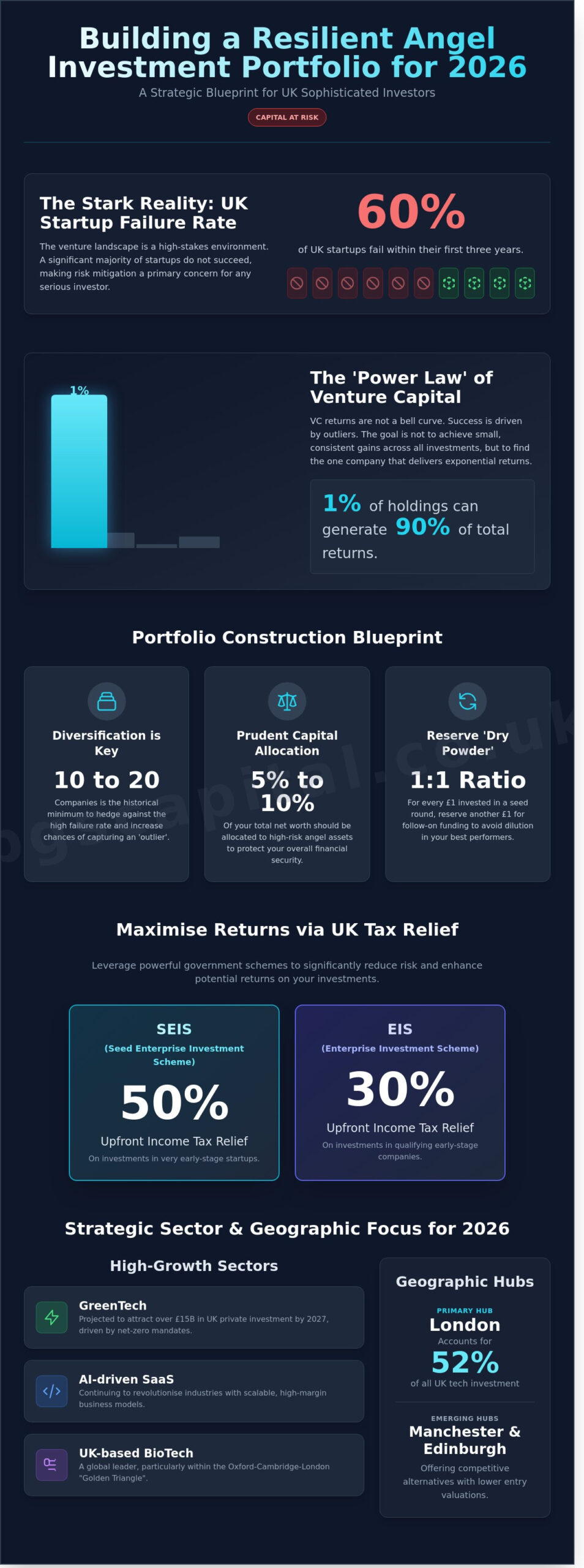
Recent data from the 2024 venture landscape shows that 60% of UK startups fail within their first three years of operation. For high net worth individuals, building an angel investment portfolio is not a pursuit of luck; it’s a calculated exercise in risk mitigation and tax optimisation. CAPITAL AT RISK. You recognise that the primary hurdles aren’t just capital allocation. The real challenge lies in accessing pre-vetted, high-quality deal flow and managing the administrative complexity of HMRC tax relief regulations.
This guide outlines the exact architecture required to develop a structured 10 to 20 company portfolio by 2026. We’ll show you how to maximise your returns through SEIS and EIS schemes while securing exclusive access to pre-IPO opportunities before they reach the London Stock Exchange. We’ll examine the specific allocation strategies and eligibility requirements necessary for sophisticated investors to scale their private equity exposure effectively.
Key Takeaways
- Understand the ‘Power Law’ of venture capital to ensure your portfolio is structured to capture the 1% of holdings that typically generate 90% of total returns.
- Identify high-growth 2026 sectors including UK-based BioTech and AI-driven SaaS while balancing risk between SEIS-eligible startups and pre-IPO secondary placings.
- Maximise capital efficiency by leveraging the 30% and 50% upfront income tax reliefs available through the EIS and SEIS schemes for sophisticated UK taxpayers.
- Implement a professional due diligence framework for building an angel investment portfolio that prioritises founder resilience and filters out low-quality lifestyle businesses.
- Access exclusive pre-IPO and IPO deal flow by utilising a specialist introducer network to establish direct connections with investor relations teams.
The Fundamentals of Building an Angel Investment Portfolio in 2026
Building an angel investment portfolio in 2026 requires a shift from speculative betting to disciplined asset management. An angel portfolio is a curated collection of early-stage and pre-IPO private equity holdings. These assets represent ownership in companies that haven’t yet listed on public exchanges. In the current UK market, where public equity volatility remains high, these private holdings offer a distinct path to alpha. However, they’re inherently illiquid. You must accept a 5 to 10 year horizon for your capital. There’s no secondary market to provide immediate exits; your returns depend entirely on a trade sale or an Initial Public Offering.
The core driver of venture returns is the Power Law. This principle dictates that venture capital returns aren’t distributed on a bell curve. Instead, a tiny fraction of investments, often just 1%, generates 90% of a portfolio’s total returns. Most companies in your portfolio will return zero or less than the initial capital. Understanding The Fundamentals of Angel Investing is vital because it prepares you for this binary outcome. You aren’t looking for steady 10% gains across the board. You’re hunting for the single ‘outlier’ that can return 50x or 100x your investment.
The 2026 UK market outlook shows a marked increase in private equity interest. Data from the first quarter of 2026 indicates that High Net Worth Individuals (HNWIs) have increased their allocations to private markets by 14% compared to 2024. This trend is driven by the maturation of the UK tech ecosystem, particularly in deep-tech and sustainable energy sectors. Investors are moving away from traditional fixed-income products that failed to beat inflation in the mid-2020s, seeking the higher risk-reward profile of early-stage ventures.
Why Diversification is Non-Negotiable
Diversification is your only hedge against the 80% failure rate typical of UK startups. To mitigate this risk, a portfolio of 10 to 20 companies is the historical minimum. Anything less is a gamble, not a strategy. You must move beyond ‘spraying and praying’, which involves making small, random investments without a coherent plan. A structured investment thesis is required. This means defining the sectors, stages, and founder profiles you’ll back. Follow-on funding is another pillar of this strategy. Successful companies will raise multiple rounds; you must have the capital ready to participate in these later stages to prevent your equity percentage from being diluted into insignificance.
Determining Your Capital Allocation
Prudent financial planning suggests allocating only 5% to 10% of your total net worth to high-risk angel assets. This ensures that even a total loss doesn’t compromise your lifestyle or long-term security. Within this allocation, you must maintain ‘dry powder’. This is capital held in reserve specifically for future funding rounds of your best-performing companies. If you invest £30,000 in a seed round, you should ideally have another £30,000 set aside for the Series A. According to 2026 UK regulatory standards, a sophisticated investor is an individual who has signed a statement confirming they have an annual income of at least £175,000 or net assets exceeding £250,000, excluding their primary residence and pension benefits.
Strategic Portfolio Architecture: Sectors, Stages, and Geography
Constructing a resilient investment strategy requires more than just capital allocation; it demands a blueprint. When building an angel investment portfolio, you must balance high-growth speculation with calculated risk mitigation. For 2026, market data identifies GreenTech, AI-driven SaaS, and UK-based BioTech as the primary sectors for capital deployment. GreenTech is projected to attract over £15 billion in UK private investment by 2027, driven by stringent net-zero mandates. Similarly, the UK BioTech sector remains a global leader, particularly within the Oxford-Cambridge-London “Golden Triangle.”
Geography plays a central role in deal flow quality. London remains the undisputed centre of European venture capital, accounting for approximately 52% of all UK tech investment in 2024. However, regional hubs in Manchester and Edinburgh are emerging as competitive alternatives with lower entry valuations. Successful investors don’t just follow “favourite” industries. They use objective financial metrics, such as the Burn Multiple and LTV/CAC ratios, to validate their gut instincts. According to the UK Business Angels Association, professional angels often spend 20 or more hours on due diligence for a single deal to ensure these metrics align with long-term growth projections.
Stage Diversification: Seed to Pre-IPO
A balanced portfolio mixes risk profiles across the company lifecycle. Seed stage deals, often supported by SEIS tax relief, offer 100x return potential but carry a high probability of total loss. Pre-IPO and secondary placings offer a different proposition. These assets typically target 2-5x returns with a much shorter horizon to liquidity. BGS Capital facilitates access to this later-stage pipeline, connecting investors with companies preparing for public listing. Secondary placings are particularly useful for adding liquidity-near assets to a portfolio that might otherwise be locked in for 7 to 10 years.
Sector-Specific Theses
Expertise is your greatest hedge against risk. Developing a deep understanding of 2-3 core sectors improves your due diligence efficacy and allows you to add genuine value to founders. However, avoid over-concentration in a single industry. A sector-specific downturn, like the 2022 SaaS correction, can devastate an undiversified portfolio. Sophisticated UK investors now use ESG (Environmental, Social, and Governance) filters as a standard requirement. By 2025, an estimated 75% of institutional capital will be ESG-mandated, making early compliance a prerequisite for future exit opportunities.
Successful building an angel investment portfolio relies on accessing the right deals at the right time. If you are looking to diversify into later-stage opportunities, you should check your eligibility to join our network of professional investors.
- GreenTech: Focus on carbon capture and battery storage technologies.
- AI-SaaS: Target vertical AI solutions that solve specific industrial inefficiencies.
- BioTech: Prioritise drug discovery platforms with established patent trails.
- Secondary Placings: Use these to manage portfolio liquidity and reduce time-to-exit.
CAPITAL AT RISK. Past performance is not a reliable indicator of future results. Investment in early-stage companies involves a high degree of risk and may result in the loss of your entire investment. Ensure you are fully aware of the risks before proceeding with any placement or secondary trade.
Maximising Returns through SEIS and EIS Tax Efficiencies
Tax efficiency is a core pillar of risk management when building an angel investment portfolio in the UK. The Enterprise Investment Scheme (EIS) and Seed Enterprise Investment Scheme (SEIS) aren’t just incentives; they’re structural tools designed to offset the high-risk nature of early-stage ventures. In 2026, these schemes remain central to the UK venture capital ecosystem, providing substantial upfront relief and downside protection. CAPITAL AT RISK.
UK taxpayers can access immediate income tax relief on their investments. SEIS offers 50% relief on investments up to £200,000 per tax year. EIS provides 30% relief on up to £1 million, or £2 million if the companies are “knowledge-intensive.” If you invest £10,000 in an SEIS-qualified startup, your actual net cost is £5,000. This immediate “win” significantly alters the internal rate of return (IRR) calculations for your entire portfolio.
Profits are also protected. Any capital gains made on shares held for at least three years are 100% exempt from Capital Gains Tax (CGT). This is particularly potent for “home run” investments that might return 10x or 20x the initial capital. Additionally, the government provides a safety net through Loss Relief. If a company fails, you can offset the loss (minus the initial tax relief) against your income tax bill for that year or the previous one. For a 45% additional rate taxpayer, this means the total effective loss on a failed SEIS investment is capped at 27.5% of the original capital.
EIS vs. SEIS: A Comparative Analysis for 2026
The primary distinction lies in the stage of the company and the investment ceiling. SEIS targets very early-stage firms with fewer than 25 employees and less than £350,000 in gross assets. EIS is for more established growth companies. Investors can utilise the ‘Carry Back’ rule to apply tax relief to the preceding tax year, providing flexibility in managing annual tax liabilities. ‘The SEIS scheme in 2026 remains the world’s most generous tax incentive for early-stage investors, offering up to 50% initial tax relief.’
Inheritance Tax (IHT) and Business Relief
Strategic building an angel investment portfolio also serves as a sophisticated wealth transfer mechanism. Under current Business Relief rules, EIS-qualifying shares become 100% exempt from Inheritance Tax once they’ve been held for two years. This allows high-net-worth individuals to move capital out of their taxable estate while maintaining exposure to high-growth assets. It’s a vital component of multi-generational wealth planning. However, these benefits are contingent on individual circumstances. HMRC rules can change, and the company must remain qualifying throughout the holding period to retain these advantages.
- Upfront Relief: 50% for SEIS, 30% for EIS.
- Holding Period: Minimum 3 years for CGT exemption.
- IHT Exemption: 100% relief after a 2-year holding period.
- Loss Relief: Ability to offset losses against income tax, not just capital gains.
Investors must ensure they receive an EIS3 or SEIS3 certificate from the investee company to claim these reliefs. Without this documentation, the tax benefits cannot be realised. Always verify the current HMRC status of any firm before committing capital.
The Due Diligence Framework for Sophisticated Deal Flow
Building an angel investment portfolio requires a clinical approach to due diligence that prioritises data over sentiment. You must filter out “lifestyle” businesses that lack the scalability required for venture-style returns. A professional checklist ensures objectivity. Focus on companies targeting a Total Addressable Market (TAM) of at least £500 million. If a founder’s primary goal is to provide a comfortable salary for themselves rather than aggressive growth, it’s a pass. Sophisticated investors look for businesses capable of returning 10x the initial capital within a seven to ten-year window.
The “Team First” rule is the most critical component of this framework. Statistics from the British Business Bank indicate that founder quality is the leading predictor of success in 65% of early-stage ventures. You must evaluate their resilience through previous pivot history and their technical capability to build the product without excessive outsourcing. A founder who has previously scaled a company to a £10 million valuation or held a senior role in a high-growth tech firm is a significant green flag. Assess their ability to attract top-tier talent; a founder who can’t recruit high-quality engineers or sales leads will struggle to scale.
Market validation requires more than anecdotal evidence. Search for clear product-market fit through signed Letters of Intent (LOIs) or a monthly recurring revenue (MRR) growth rate of 15% or higher over the last six months. A defensible “moat” is essential. This could be proprietary intellectual property, network effects, or exclusive distribution agreements that competitors can’t easily replicate. Without a moat, even a successful product will eventually see its margins eroded by new entrants.
Financial hygiene is the final gatekeeper. Review the burn rate against the current cash runway. A healthy startup should have at least 12 to 18 months of runway post-raise to reach the next valuation milestone. Realistic exit valuations are vital. If the founder projects a £100 million exit within 24 months while currently generating less than £10,000 in monthly revenue, the financial modelling is likely flawed. Ensure the company is structured to take advantage of the Enterprise Investment Scheme (EIS) or Seed Enterprise Investment Scheme (SEIS), as these tax reliefs are fundamental when building an angel investment portfolio in the United Kingdom.
Evaluating the Cap Table and Governance
A clean cap table is essential for future Series A rounds or a potential IPO. If founders own less than 50% of the equity before a Seed round, they’re over-diluted. This kills motivation and makes the company unattractive to later-stage VCs. Watch for “dead equity” held by former advisors who no longer contribute. Ensure shareholder agreements include drag-along and tag-along rights to protect your minority position. Strong governance, including a structured board of directors, provides the oversight necessary to manage capital efficiently.
Assessing Exit Potential
Map out potential acquirers before committing capital. Identify at least five FTSE 100 or Nasdaq-listed companies that might acquire the startup as a strategic asset. The secondary market is becoming a critical 2026 trend for early angel exits. This allows you to sell shares to institutional investors before an IPO occurs. Use introducer networks to gain insights into a company’s Investor Relations (IR) transparency. High-quality IR suggests the management is prepared for the rigours of public markets and professional scrutiny.
To see how your current status aligns with exclusive high-growth opportunities, check your eligibility and join our professional network.
Accessing Exclusive Opportunities via the BGS Capital Network
BGS Capital operates as a specialist introducer for pre-IPO and IPO investments, providing a streamlined conduit between high-growth companies and qualified individuals. This model differs fundamentally from traditional brokerage. While brokers often act as intermediaries who execute trades for a commission, BGS Capital functions as a network facilitator. We don’t facilitate any raises ourselves; instead, we provide a direct connection to the internal Investor Relations (IR) teams of companies currently seeking capital. This direct line ensures that when you’re building an angel investment portfolio, you receive information straight from the source without the filters or added costs of a middleman.
The network prioritises transparency and efficiency. According to industry data from 2023, UK high-growth companies secured £11.9 billion in investment, a significant portion of which was raised through private placements and pre-IPO rounds. Accessing these rounds often requires being part of an established network that maintains a pre-vetted database. BGS Capital manages such a database, featuring UK-based companies that have undergone internal screening before being presented to the network. This vetting process saves investors hundreds of hours of initial due diligence, allowing them to focus on the final stages of their investment appraisal.
Access to these opportunities isn’t universal. To maintain strict compliance with UK financial regulations, every prospective user must pass through the “Am I Eligible?” gateway. This stage is mandatory. It ensures that only sophisticated investors and high-net-worth individuals, as defined by the Financial Conduct Authority (FCA), can view active raises. This gatekeeping function protects both the investor and the issuing company, ensuring that the high-stakes nature of angel investing is understood by all parties involved.
The BGS Capital Advantage: Free Access for Investors
One of the most distinct features of our model is the cost structure. BGS Capital provides its database and introduction services free of charge to eligible investors. Traditional private equity or venture capital funds often charge a 2% management fee and a 20% performance carry, which can significantly erode your net returns over a five-year period. By removing these layers, you retain 100% of your investment’s potential upside. You can Connect With Pre-Vetted International Investors and companies directly, bypassing expensive fund structures that often lack the transparency sophisticated investors require. This direct-to-company approach is a cornerstone of modern portfolio construction in the private equity space.
How to Begin Your Portfolio Journey
Starting your investment journey with BGS Capital is a structured, three-step process designed for clarity. First, you must complete the eligibility check to confirm your status as a qualified investor. Once approved, you gain immediate access to the current opportunity list. This list isn’t a static document; it’s a live database of companies currently raising capital in the UK. From here, you can request specific pitch decks and organise your first introductions with IR teams. In 2023, the average angel investor in the UK made approximately 5.4 investments per year, a pace that is only possible with a consistent flow of pre-vetted opportunities.
When you identify a company that aligns with your strategy for building an angel investment portfolio, you’ll deal directly with their directors or designated representatives. This allows for a deeper level of questioning regarding their 2025 growth targets and exit strategies. It’s vital to remember that these are high-risk environments. CAPITAL AT RISK; angel investing involves illiquid assets and should only be undertaken with capital you can afford to lose. The potential for high rewards is always balanced by the risk of total loss.
Secure Your Position in the 2026 Private Markets
Successful wealth preservation in 2026 requires a disciplined approach to building an angel investment portfolio. The deployment of SEIS and EIS tax reliefs offers up to 50% back on your initial commitment while shielding gains from HMRC. Diversification isn’t optional. Targeting a minimum of 20 distinct holdings across varied sectors is the benchmark for mitigating early-stage risk. High-calibre deal flow is the final piece of the puzzle. BGS Capital simplifies this by providing direct introductions to Investor Relations teams and a curated database of pre-IPO opportunities. We charge zero fees for eligible investors.
Strategic asset allocation in the UK’s venture landscape has never been more critical. By focusing on the architecture of your holdings, you’re positioning yourself to capture significant upside as companies move toward liquidity events. It’s time to transition from theory to execution. Your next strategic move starts with a simple verification of your status.
Am I Eligible? Check your status to access exclusive pre-IPO opportunities.
The 2026 market presents unique advantages for those prepared to act with precision and speed.
Frequently Asked Questions
How many companies should be in a balanced angel investment portfolio?
A balanced portfolio typically requires 15 to 25 companies to achieve adequate diversification. This volume helps mitigate the 90% failure rate common in early-stage ventures. Building an angel investment portfolio with fewer than 10 holdings significantly increases your exposure to total capital loss. Data from the UK Business Angels Association suggests that larger portfolios are more likely to yield a positive internal rate of return.
What is the difference between SEIS and EIS tax relief in 2026?
The Seed Enterprise Investment Scheme (SEIS) offers 50% income tax relief on investments up to £200,000, while the Enterprise Investment Scheme (EIS) provides 30% relief on up to £2 million. In 2026, SEIS targets companies less than three years old with fewer than 25 employees. EIS applies to larger, slightly more established firms. Both schemes require you to hold shares for at least three years. CAPITAL AT RISK.
Can I invest in pre-IPO companies through my SIPP or ISA?
You can invest in pre-IPO companies through a Self-Invested Personal Pension (SIPP), but standard ISAs usually don’t permit unlisted shares. Most ISA providers restrict holdings to securities listed on recognised stock exchanges. To use a SIPP, you must work with a specialist provider that accepts alternative assets. It’s essential to check your provider’s specific terms before attempting to transfer funds into private equity placements.
What are the minimum eligibility requirements for a ‘sophisticated investor’ in the UK?
You must have been a member of a business angel network for six months or have made more than one investment in an unlisted company in the last two years. Alternatively, you qualify if you’ve worked in a professional capacity in the private equity sector or served as a director of a company with an annual turnover of at least £1.6 million. These criteria are strictly defined by the Financial Conduct Authority.
How long is the typical holding period for an angel investment before an exit?
The typical holding period ranges from 5 to 10 years before a liquidity event occurs. Early-stage companies need this time to scale operations or reach a stage suitable for acquisition or IPO. You should treat these as illiquid assets that aren’t easily sold on a secondary market. Industry data indicates that successful exits through trade sales or public listings rarely happen before the 7-year mark.
What happens to my investment if an angel-backed company fails?
You’ll likely lose your entire capital investment if the company enters liquidation. As an equity holder, you’re at the bottom of the creditor hierarchy during a wind-up. However, UK tax law allows you to claim Loss Relief. This allows you to offset the loss against your income tax or capital gains tax, which can recover up to 45% of your initial net investment depending on your tax bracket.
Is angel investing only for multi-millionaires, or can I start with smaller amounts?
You don’t need to be a multi-millionaire, but you must meet high-net-worth or sophisticated investor status. Minimum ticket sizes on many platforms start at £5,000 or £10,000 per deal. When building an angel investment portfolio, ensure these high-risk allocations represent only 5% to 10% of your total investable wealth. This maintains a disciplined approach to risk management. CAPITAL AT RISK.
How does BGS Capital vet the companies featured on its platform?
BGS Capital operates as an introducer and network, featuring companies already vetted by accredited investment firms and wealth managers. We don’t facilitate raises ourselves. We connect qualified investors with opportunities that have undergone financial and legal due diligence by professional lead investors. This ensures that every featured business meets specific institutional standards before appearing on our platform. Am I Eligible?