
Waiting seven years for a gift to fall outside your estate is no longer a viable strategy for those managing significant wealth. With the standard 40% levy on estates exceeding the nil-rate band, inheritance tax planning for investors has become a race against restrictive HMRC legislation. You’ll likely agree that the current 7-year Potentially Exempt Transfer (PET) rule is often too slow for active portfolio management. It freezes capital and creates unnecessary risk for your family’s legacy.
This article demonstrates how sophisticated investors use Business Relief (BR) and exclusive pre-IPO opportunities to achieve 100% IHT exemption in just two years. You’ll learn the specific criteria for BR-qualifying investments and how to maintain capital growth without the 7-year wait. We provide a clear overview of the strategic options available to high-net-worth individuals looking to secure their assets before 2026. CAPITAL AT RISK.
Key Takeaways
- Analyse how the 2026 fiscal landscape and rising asset values increase the necessity for proactive estate protection against the 40% IHT rate.
- Master the mechanics of Business Relief to achieve 100% exemption on qualifying assets within two years while retaining full legal control.
- Evaluate the strategic differences between AIM-listed volatility and the smoother capital growth potential offered by unquoted pre-IPO investments.
- Identify how sophisticated inheritance tax planning for investors utilises diversification to manage the risks associated with the two-year qualification window.
- Discover how to leverage the BGS Capital network to secure direct introductions to exclusive pre-IPO and IPO investment opportunities.
Navigating the 2026 Inheritance Tax Landscape for Sophisticated Investors
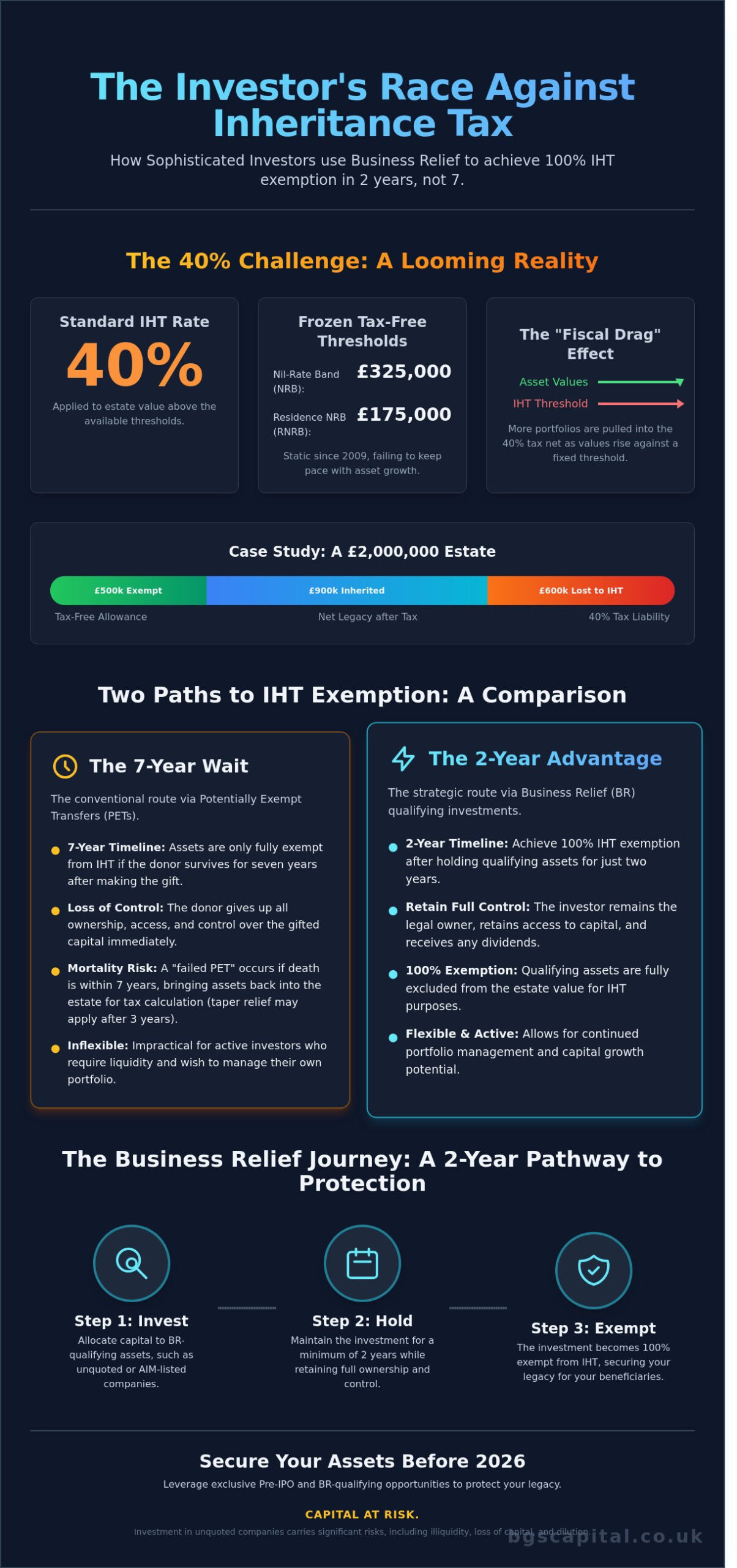
UK investors face a stark reality in 2026. The standard 40% tax rate applies to any estate value exceeding the Nil-Rate Band (NRB). This threshold has remained frozen at £325,000 since April 2009, while the Residence Nil-Rate Band (RNRB) adds a further £175,000 for those passing a main residence to direct descendants. Combined, these allowances provide a £500,000 buffer, yet this figure hasn’t adjusted for the significant inflation seen over the last decade. Understanding the mechanics of Inheritance Tax (IHT) is now a baseline requirement for wealth preservation rather than an optional exercise. CAPITAL AT RISK.
The 2026 environment is defined by “fiscal drag”. As equity markets and property values appreciate, more assets cross the static £325,000 line. This isn’t an accident; it’s a deliberate policy to increase Treasury receipts without raising the headline tax rate. For high net worth individuals (HNWIs), this creates a tactical imperative for robust inheritance tax planning for investors. Relying on outdated thresholds is no longer a viable strategy for those holding diversified portfolios. You must determine your current exposure before the liability compounds further. Am I Eligible for relief?
The Problem with the Seven-Year Rule
Traditional gifting through Potentially Exempt Transfers (PETs) is the most common advice, but it’s often the least practical for active investors. A PET requires the donor to survive seven years for the gift to leave the estate entirely. If death occurs within this window, the gift is “failed” and remains taxable, though taper relief may apply after year three. The primary issue isn’t just the mortality risk; it’s the total loss of control. Once you gift capital to a child or a trust, you lose the ability to manage those funds, draw income, or pivot the investment strategy.
Sophisticated investors typically prefer to keep assets in their own name to maintain liquidity and flexibility. Gifting large sums can leave a donor “capital poor” while their beneficiaries lack the expertise to manage the windfall. Many investors find the lack of autonomy over their own hard-earned capital unacceptable. This is why inheritance tax planning for investors has shifted toward solutions that offer relief without requiring the immediate surrender of ownership. Business Relief (BR) has emerged as a primary alternative, offering a two-year qualification period instead of seven.
The 2026 IHT Thresholds: A Tactical Review
The current Nil-Rate Band sits at £325,000, and the Residence Nil-Rate Band is £175,000, with both scheduled to remain at these levels until at least 2028. These figures represent a shrinking percentage of total wealth for successful investors. The RNRB also starts to taper away for estates valued over £2 million, reducing by £1 for every £2 over the limit. For a £2m diversified portfolio, the 40% death tax liability can effectively liquidate £600,000 of family wealth upon the second death.
- Nil-Rate Band: £325,000 (Frozen since 2009).
- Residence Nil-Rate Band: £175,000 (Subject to tapering).
- Main Tax Rate: 40% on the excess.
- Qualification Period for BR: 2 years.
Investors must recognise that staying within the current system without active intervention is a choice to accept a 40% haircut on their legacy. We operate as an introducer to specialist managers who focus on Business Relief qualifying companies, which can sit within a SIPP or ISA. This allows for IHT exemption while maintaining legal ownership of the shares. Check your eligibility to see if your portfolio qualifies for these exclusions.
The Strategic Advantage of Business Relief (BR) in Estate Planning
Inheritance tax (IHT) at 40% can significantly erode a family’s wealth. For those focusing on inheritance tax planning for investors, Business Relief (BR) provides a robust mechanism to protect assets without the long wait times associated with other strategies. While most gifts take seven years to leave an estate for tax purposes, BR-qualifying assets achieve 100% IHT exemption after a holding period of just two years. This makes it an essential tool for older investors or those with immediate estate concerns.
The primary benefit of BR is the retention of control. Traditional IHT mitigation often involves gifting assets to heirs or into trusts; this usually means giving up legal ownership and access to the capital. With BR-qualifying investments, the investor remains the legal owner. You keep the right to receive any dividends and can liquidate the investment if your personal circumstances change. It’s a government-sanctioned incentive designed to direct private capital into the UK’s productive trading economy, supporting growth and employment in exchange for tax relief.
HMRC applies a strict distinction between “trading” and “investment” activities. To qualify, a company must not consist “wholly or mainly” of dealing in securities, stocks, land, or buildings. This means the business must be an active trading entity. If a company spends more than 50% of its time or resources on investment activities, it’ll likely lose its BR status. Understanding these boundaries is vital when you check your eligibility for specific private equity or AIM-listed opportunities.
How Business Relief Bypasses the 7-Year Rule
The two-year qualifying period is the fastest way to achieve IHT exemption under current UK law. Unlike Potentially Exempt Transfers (PETs), which require the donor to survive seven years, BR assets are exempt from the moment the two-year anniversary is reached. Additionally, settling BR-qualifying assets into a discretionary trust doesn’t trigger the 20% lifetime transfer charge normally applied to amounts over the £325,000 nil-rate band. If an investor sells a BR asset, “Replacement Relief” rules allow them to reinvest the proceeds into another qualifying asset within three years without restarting the two-year clock, provided the combined holding period meets the requirement.
Identifying Qualifying Trades and Excluded Activities
Qualifying sectors typically include renewable energy, physical infrastructure, forestry, and certain unquoted trading companies. These businesses provide tangible services or products to the UK economy. Conversely, property investment businesses and companies that “deal in shares” are specifically excluded. For a company to qualify, it must be “unquoted,” though HMRC recognises shares listed on the Alternative Investment Market (AIM) as unquoted for BR purposes. This opens a significant avenue for inheritance tax planning for investors who prefer the liquidity of a junior stock market over private equity. Always verify that a company’s primary revenue comes from trading rather than holding passive assets, as HMRC will review the business’s balance sheet and activities at the time of the owner’s death.
Comparing IHT-Efficient Investment Vehicles: AIM, Unquoted, and Pre-IPO
Effective inheritance tax planning for investors requires a granular understanding of how Business Relief (BR) applies to different asset classes. While the standard IHT rate remains at 40%, assets qualifying for BR can be passed on tax-free after a two-year holding period. Investors typically choose between three main routes: the Alternative Investment Market (AIM), unquoted private companies, and pre-IPO opportunities. Each vehicle carries a distinct risk-reward profile and liquidity structure.
AIM Shares: Liquidity vs. Volatility
The AIM market provides a bridge between private equity and the main London Stock Exchange. It offers the benefit of relatively high liquidity, as shares can typically be sold within days. However, liquidity doesn’t guarantee stability. The FTSE AIM All-Share Index fell by 8.2% during the 2023 calendar year, illustrating the significant market risk that can erode the 40% tax saving if timing is poor.
Eligibility is another critical factor. Not every company on AIM qualifies for Business Relief for Inheritance Tax. For example, businesses that primarily deal in land, buildings, or investment instruments are excluded. Most sophisticated investors avoid DIY stock picking due to the complexity of maintaining a BR-compliant portfolio. Instead, they utilise managed AIM IHT services. These professional managers charge fees, often between 1% and 2% annually, to monitor the underlying trades and ensure they remain eligible for relief under current HMRC rules.
Pre-IPO and Private Equity: The New Frontier
Unquoted growth companies and pre-IPO deals represent a shift towards “smoother” capital growth curves. Unlike AIM shares, these assets aren’t marked-to-market daily. Their valuations are based on funding rounds and performance milestones rather than public sentiment. This lack of daily volatility is attractive to those seeking inheritance tax planning for investors without the stress of market swings.
- Capital Appreciation: Investing in a company 12 to 24 months before a planned listing can capture the “IPO pop” and significant private-sector growth.
- Structural Suitability: Most trading private limited companies naturally qualify for 100% Business Relief, provided they aren’t investment-focused.
- Exclusivity: These opportunities aren’t available to the general public. Access is restricted to High Net Worth (HNW) individuals or Sophisticated Investors as defined by FCA regulations.
BGS Capital operates as an introducer to these exclusive environments. We connect eligible investors with accredited firms and wealth managers who facilitate access to these private placements. This gateway is essential because pre-IPO deals often require a minimum ticket size, frequently starting at £25,000 or £50,000.
CAPITAL AT RISK: All BR-qualifying investments are high-risk. These assets are often in smaller, younger companies that may fail entirely. Unlike cash or blue-chip stocks, your capital is not guaranteed. Liquidity in unquoted shares is severely restricted; you may not be able to sell your holding until a liquidity event, such as a trade sale or an IPO, occurs. Always verify your status by asking, “Am I Eligible?” before proceeding with any high-level investment strategy.
Executing an IHT Strategy: Timelines, Compliance, and Risk
Efficient inheritance tax planning for investors requires more than selecting assets; it demands a rigorous approach to timing and regulatory adherence. The primary mechanism for most investors is Business Relief (BR). This provides 100% relief from IHT after a two-year holding period. However, this window creates a specific “mortality risk” that must be managed through insurance or strategic asset allocation. Success depends on timing and the ability to maintain the “trading status” of the investment throughout the holding period.
The Two-Year Qualifying Period: A Tactical Window
The 24-month qualification window is a hard deadline. If the investor dies 23 months after the initial allocation, the 40% IHT liability remains fully active. Many sophisticated investors mitigate this by taking out a two-year “interim” life insurance policy. This covers the potential tax bill until the assets reach their exempt status. It’s a transactional approach to risk that ensures the estate isn’t left vulnerable during the qualification gap.
The “Spousal Transfer” benefit is a critical component of UK law under IHTA 1984. If an investor dies and leaves BR-qualifying assets to a surviving spouse, the time already accrued counts toward the survivor’s two-year clock. This prevents the clock from resetting and ensures the family doesn’t lose progress toward tax-free status. The replacement property rule allows an investor to sell one qualifying asset and reinvest in another within three years without restarting the two-year qualification clock.
Risk Management and Capital Preservation
Tax relief is a benefit, not a justification for poor investment choices. Capital preservation is the priority. Diversification is essential to avoid “single-asset risk.” Concentrating a £500,000 IHT portfolio into one unquoted company or a single AIM stock is a strategic error. A robust portfolio should be spread across multiple sectors, such as renewable energy, infrastructure, or a basket of 15 to 20 AIM-listed companies. This protects the estate from the 20% to 30% volatility often seen in smaller-cap markets.
Investors must also account for liquidity risk. While AIM shares are traded on an exchange, they’re often thinly traded. Selling a large block of shares can take weeks or result in a significant price discount. Unquoted shares are even less liquid. A minimum five-year investment horizon is standard for this asset class. You shouldn’t invest capital that you might need to access on short notice.
Regulatory Compliance and Qualification
Accessing high-quality inheritance tax planning for investors involves navigating complex FCA regulations. Most BR-qualifying opportunities are restricted to certain categories of individuals under the Financial Services and Markets Act 2000. These restrictions protect investors from entering into high-risk contracts without the necessary financial cushioning.
- High Net Worth Individuals (HNW): You must have an annual income of at least £250,000 or net assets exceeding £1,000,000, excluding your primary residence and pension rights.
- Sophisticated Investors: This requires a certificate from an authorised firm or a history of investing in unquoted companies within the last two years.
Professional introducers play a vital role in this ecosystem. They act as a filter, sourcing pre-vetted opportunities that have undergone rigorous due diligence. This reduces the burden on the investor to verify the “trading status” of a company, which is the cornerstone of BR eligibility. Using an established network ensures that the underlying businesses are genuinely engaged in qualifying trades rather than excluded activities like investment or land dealing. This compliance-first approach is the only way to ensure HMRC doesn’t disqualify the relief upon probate.
Am I Eligible?
Connecting with Exclusive IHT Opportunities via BGS Capital
BGS Capital operates as a professional introducer and a dedicated network for the sophisticated investment community. We act as a conduit, bridging the gap between private capital and high-growth ventures. Our primary function is to facilitate direct connections between investors and pre-IPO or IPO investor relations teams. We don’t provide financial advice. We don’t facilitate capital raises ourselves. This distinction is vital for maintaining our role as a transparent gateway to the market. CAPITAL AT RISK.
Our commitment to transparency ensures that every participant understands the boundaries of our service. We provide the infrastructure for discovery, allowing investors to engage directly with the firms they’re interested in. This direct-access model is particularly relevant for those executing inheritance tax planning for investors, where understanding the underlying asset’s eligibility for Business Relief (BR) is a priority. By removing the traditional layers of intermediation, we allow for a clearer line of communication between the investor and the issuing entity.
Accessing the Pre-IPO and IPO Markets
The BGS Capital platform organises opportunities into a structured format. This layout allows investors to compare different ventures and find new investments that align with their specific portfolio requirements. We provide direct introductions to wealth managers and accredited investment firms, ensuring that the connection point is always professional and compliant. Our network is built upon two core pillars: Low Cost and Expertise. We believe that accessing high-level opportunities shouldn’t be burdened by excessive administrative layers. Our expertise lies in identifying and vetting the firms that join our network, ensuring they’re prepared for engagement with sophisticated capital.
Investors can use our database to track secondary placings and upcoming listings. This visibility is essential for those looking to diversify away from standard equity markets. Because we focus on the pre-IPO and IPO stages, the opportunities often involve companies at a pivotal growth phase. Accessing these firms through a structured network provides a level of efficiency that’s difficult to replicate through independent research alone. We ensure that the firms featured are qualified and ready for professional scrutiny.
The Qualification Process: Am I Eligible?
Defining the criteria for participation is a legal and operational necessity. Exclusive access to these markets requires rigorous self-certification to maintain network integrity. In the United Kingdom, the Financial Conduct Authority (FCA) sets clear benchmarks for who can access these types of investments. To qualify as a High Net Worth Individual, you must confirm an annual income of at least £170,000 or hold net assets exceeding £430,000, excluding your primary residence and pension rights. These thresholds, updated in February 2024, ensure that participants have the financial resilience to manage the risks associated with unlisted securities.
Sophisticated Investors must meet different but equally stringent standards. This typically involves being a director of a company with a turnover of at least £1.6 million or being a member of an organised network of “business angels” for at least six months. These hurdles exist to protect both the investor and the integrity of the deals being discussed. Accessing these exclusive opportunities is not a matter of simple registration; it requires a formal declaration of status and professional oversight. This process is a fundamental part of inheritance tax planning for investors who require high-conviction assets that meet specific regulatory definitions. CAPITAL AT RISK.
Accessing these exclusive markets starts with a simple verification of your investment status. Am I Eligible? Check your status and access our database
Secure Your Legacy Before the 2026 Fiscal Deadline
The 2026 tax landscape demands immediate action for high net worth individuals. Following the Autumn Budget 2024, the first £1 million of combined business and agricultural assets will maintain 100% relief. Any value exceeding this threshold will attract an effective 20% tax rate. Successful inheritance tax planning for investors relies on meeting the mandatory two-year holding period for Business Relief qualifying assets. Delaying your strategy until 2025 creates a significant risk of missing this critical window before the new rules apply.
BGS Capital serves as a specialist introducer network. We facilitate direct access to investor relations teams within firms targeting AIM, unquoted, and pre-IPO opportunities. Our operations maintain strict compliance with FCA investor definitions to ensure only qualified individuals access these exclusive placements. CAPITAL AT RISK. We don’t provide tax advice; we connect sophisticated investors with the vehicles they need to execute their wealth preservation goals. Early preparation is the only way to mitigate the impact of the upcoming 2026 reforms.
RAISING CAPITAL? FEATURE YOUR BUSINESS or AM I ELIGIBLE? to find new IPO investments. Your proactive approach today defines your family’s financial security for decades to come.
Frequently Asked Questions
What is the 2-year rule for Inheritance Tax and Business Relief?
To qualify for Business Relief, you must hold the relevant assets for at least two years before your death. This rule applies to unlisted shares and certain AIM-listed companies. If you transfer assets between spouses, the holding period usually carries over to the recipient. This allows for faster inheritance tax planning for investors compared to the standard seven-year gift rule.
Can I use my SIPP or ISA for Inheritance Tax planning?
Your SIPP is typically held outside your estate and remains exempt from the 40% inheritance tax charge. However, standard ISAs are fully taxable upon your death. You can mitigate this by investing in AIM-listed shares within an ISA. These qualify for 100% Business Relief after a two-year holding period. It’s a common strategy for those with ISA balances exceeding £100,000.
Do all AIM-listed shares qualify for Business Relief?
Not all AIM-listed shares qualify for Business Relief. HMRC excludes companies that deal in land, buildings, or investments. Approximately 30% of AIM companies fail to meet the criteria for 100% relief. You must ensure the specific company carries out a qualifying trade. We recommend checking the status of each holding regularly; company activities often shift over time and can impact your tax status.
What happens to my IHT-exempt investments if I sell them?
If you sell your IHT-exempt investments, you lose the relief unless you reinvest the proceeds into replacement property within three years. This replacement property must also qualify for Business Relief. The two-year holding period doesn’t reset if the total ownership time across both assets exceeds two years. This provides flexibility for managing your portfolio without losing your 40% tax advantage.
How much can I save on Inheritance Tax using Business Relief?
You can save the full 40% inheritance tax charge on the entire value of qualifying assets. For a £500,000 investment in qualifying shares, this represents a £200,000 saving for your beneficiaries. There’s no upper limit on the amount of Business Relief you can claim. It’s an effective tool for reducing the tax burden on estates exceeding the £325,000 nil-rate band.
Is capital at risk when investing for IHT purposes?
Yes, your capital is at risk when investing in Business Relief qualifying assets. These investments involve smaller or AIM-listed companies which are typically more volatile than FTSE 100 stocks. You might lose some or all of your initial investment. Tax rules can also change; the 40% saving isn’t guaranteed if HMRC alters its criteria in future budgets.
How do I qualify as a Sophisticated Investor in the UK?
You qualify as a self-certified sophisticated investor if you meet specific FCA criteria. This includes being a director of a company with a turnover of at least £1.6 million within the last two years. Alternatively, you qualify if you’ve been a member of a business angel syndicate for at least six months. You’ll need to sign a legal statement confirming you understand the high-risk nature of these investments.
Can I invest in pre-IPO companies for IHT relief?
You can invest in pre-IPO companies to obtain 100% inheritance tax relief. Most unlisted trading companies qualify for Business Relief provided you’ve held the shares for two years. These opportunities are usually restricted to high net worth or sophisticated investors. It’s a strategic way to combine growth potential with inheritance tax planning for investors while supporting early-stage British businesses.