
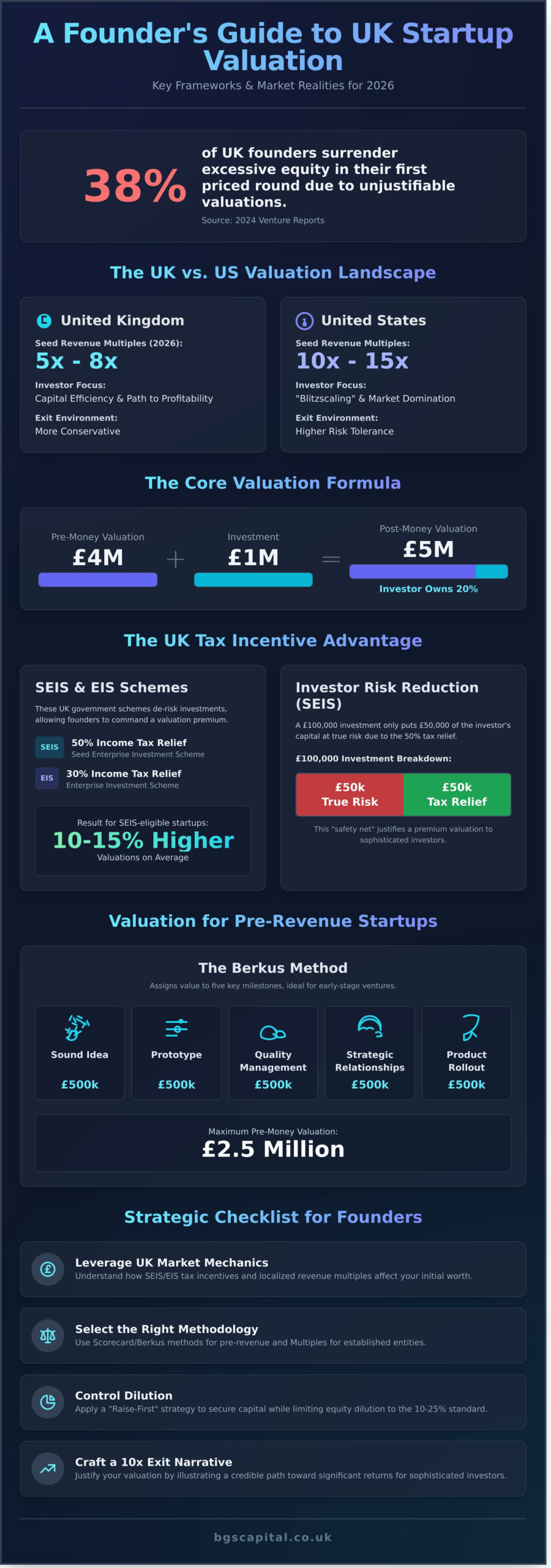
What if the most dangerous figure in your pitch deck isn’t your burn rate, but your pre-money valuation? Data from 2024 venture reports indicates that 38% of UK founders surrender excessive equity in their first priced round because they cannot justify their asking price. Mastering how to value a startup uk is a technical necessity for any founder engaging with sophisticated High Net Worth investors or institutional syndicates. You likely feel the tension between seeking the capital you need and the fear of being dismissed by wealth managers for presenting an unrealistic figure.
This guide provides the frameworks required to reach a defensible valuation that protects your cap table. You’ll learn to apply the Berkus and Scorecard methods while leveraging SEIS and EIS tax incentives to justify a premium to investors. We’ll examine the specific metrics UK investors demand in 2026 to ensure you secure funding on your own terms. It’s time to replace uncertainty with a data-driven strategy that stands up to professional scrutiny.
Key Takeaways
- Understand the distinct mechanics of the British market, including how SEIS/EIS tax incentives and localized revenue multiples affect your initial worth.
- Master how to value a startup uk by selecting the appropriate methodology, from Scorecard systems for pre-revenue firms to Multiples for established entities.
- Apply the “Raise-First” strategy to secure necessary capital for your next milestone while limiting equity dilution to the standard 10-25% range per round.
- Develop a robust exit narrative that justifies your valuation to sophisticated investors by illustrating a credible path toward 10x returns.
- Prepare for institutional-grade engagement by understanding the transition from angel funding to professional pre-IPO strategic introductions.
The Fundamentals of Startup Valuation in the UK Market
Valuation isn’t a speculative guess; it’s a strategic calculation of a company’s worth at a specific point in time. Determining how to value a startup uk in 2026 requires a firm grasp of both pre-money and post-money figures. These metrics define the ownership stakes and the price per share for incoming investors. British markets operate with a distinct set of rules compared to Silicon Valley. While US ventures often chase 10x or 15x revenue multiples, UK seed rounds in early 2026 typically hover between 5x and 8x. This discrepancy stems from a more conservative exit environment and a historical preference for capital efficiency over “blitzscaling” models.
The 2026 macroeconomic climate has significantly altered the cost of capital. With the Bank of England base rate reaching 4.5% in February 2026, the era of “cheap money” is over. Investors now apply a higher discount rate to future cash flows. This means a company’s What is a Startup? definition must now include a clear path to profitability to justify higher valuations. Sophisticated high net worth (HNW) individuals aren’t swayed by vanity metrics. They demand valuation defensibility, requiring founders to back their numbers with rigorous data from comparable company analysis (CCA) or recent transactions in the London tech sector.
Pre-Money vs. Post-Money: Why the Distinction Matters
The calculation is straightforward: Post-Money Valuation = Pre-Money Valuation + Investment Amount. Miscalculating this simple sum leads to unexpected founder dilution that can’t be easily reversed. Pre-money valuation is the equity value before new capital is injected. If you agree to a £4 million pre-money valuation and raise £1 million, the post-money is £5 million. The investor then owns 20% of the business. Founders who confuse these terms often find they’ve accidentally signed away 5% to 10% more of their company than intended. Precision in these definitions is the first step in learning how to value a startup uk effectively.
The Impact of UK Tax Schemes (SEIS/EIS) on Valuation
Tax efficiency is a primary driver of the UK investment landscape. The Seed Enterprise Investment Scheme (SEIS) and the Enterprise Investment Scheme (EIS) significantly reduce the downside risk for British investors. SEIS offers 50% income tax relief, while EIS offers 30%. Because of this “safety net,” companies with HMRC advance assurance often command a “valuation premium.” Data from Q1 2026 indicates that SEIS-eligible startups can often secure valuations 10% to 15% higher than their non-eligible peers. Sophisticated investors prioritize these schemes because they essentially subsidize the investment. A £100,000 investment only puts £50,000 of the investor’s capital at true risk under SEIS. This leverage allows founders to maintain higher valuations even when market conditions are tight. Without advance assurance, raising capital at a competitive valuation becomes exponentially more difficult in the current UK market.
5 Proven Methodologies to Value a Startup UK
Valuation isn’t a fixed science. It’s a strategic negotiation backed by specific data points. Founders must select their approach based on their current revenue stage and industry sector. While revenue multiples are the gold standard for late-stage companies with stable EBITDA, they’re functionally useless for pre-revenue ventures. To determine how to value a startup uk accurately, you need to triangulate a “fair” range using at least three distinct business valuation methods. This process balances quantitative financial projections with the qualitative narrative that sophisticated investors demand.
Multiples work best when there’s a clear peer group. If a SaaS competitor recently exited at 8x ARR, that provides a benchmark. However, early-stage founders shouldn’t rely on this. Market volatility in 2024 and 2025 showed that multiples can contract by 50% in a single quarter. Relying on a single metric is a risk. Instead, use a combination of the following frameworks to build a robust case for your equity price. It’s about showing the logic behind the number, not just the number itself.
1. The Berkus Method & Scorecard Valuation
The Berkus Method is ideal for pre-revenue startups. It assigns financial value to five specific milestones: Sound Idea, Prototype, Quality Management, Strategic Relationships, and Product Rollout. In the 2026 UK market, each category typically carries a maximum value of £500,000, capping the pre-money valuation at £2.5 million. To quantify “Quality of Management” for a sophisticated investor, you must demonstrate a track record. This includes previous successful exits, 10+ years of sector expertise, or specialized IP ownership. It moves the conversation from potential to proven capability.
2. Risk Factor Summation Method
This method evaluates 12 specific risk categories, including Manufacturing, Litigation, Legislation, and Exit potential. It aligns with the CAPITAL AT RISK warnings required by the FCA for high-net-worth investment promotions. You start with an average industry valuation and adjust it in increments, typically £150,000 to £250,000, based on each risk factor. Using risk mitigation as a tool is effective. For example, securing a multi-year patent or a long-term supplier contract can directly justify a higher valuation by neutralizing the “Technology” or “Supply Chain” risk scores.
3. Discounted Cash Flow (DCF) for High-Growth Startups
DCF is the preferred choice for startups with high growth and predictable cash flows. You project future earnings over a five-year period and discount them back to today’s value. Choosing a realistic “Terminal Value” is critical in a fluctuating UK economy; most analysts now use a 2.5% perpetual growth rate. The discount rate reflects the high risk of startup failure. Typically, this rate ranges from 35% to 55% for early-stage ventures. This methodology provides the rigorous financial modeling required when you check your eligibility for institutional-grade funding rounds.
By combining these methods, you create a valuation floor and ceiling. If the Berkus method suggests £2 million but a DCF suggests £4 million, the fair value likely sits in the middle. This triangulation prevents you from being undervalued during a seed round or overvalued to the point of a future down round. Professional investors don’t want a guess; they want a methodology they can defend to their own stakeholders.
The “Raise-First” Strategy: Calculating Valuation via Dilution
Many UK founders approach the question of how to value a startup uk backwards. They fixate on a prestigious headline figure instead of their actual capital requirements. The pragmatic method starts with your 18-month roadmap. Calculate exactly how much cash you need to reach your next value inflection point. This might be a specific revenue target or a technical milestone. Once you have this figure, reverse-engineer the valuation based on standard market dilution benchmarks.
In the current UK market, early-stage founders typically concede between 10% and 25% of equity per funding round. If you require £750,000 to scale and the market dictates a 20% dilution, your post-money valuation is £3.75 million. This approach prioritizes operational survival over vanity metrics. It also streamlines the process of justifying your valuation to investors because the figure is rooted in tangible budgetary needs. Investors respect a valuation that’s built on a spreadsheet of costs rather than a finger in the wind.
The “Option Pool” shuffle is a critical factor that often blindsides first-time founders. Lead investors usually mandate that you create an unallocated share option pool of 10% to 15% to attract future talent. Crucially, they expect this pool to be carved out of the pre-money valuation. This effectively lowers your valuation. If you agree to a £4 million pre-money valuation but must include a 10% option pool, your effective valuation is actually £3.6 million. You’re bearing the entire cost of that dilution, not the incoming investors.
- Milestone-based budgeting: Link your raise directly to a 12-24 month runway.
- Target Dilution: Aim for the 15-20% sweet spot to maintain founder control.
- Post-Money Reality: Always calculate your ownership post-option pool to see your true stake.
Avoiding the “Down Round” Trap
Setting an aggressive valuation today creates a dangerous benchmark for the future. If your seed valuation is £10 million, you must demonstrate exponential growth to justify a £20 million Series A. If market conditions shift or growth stalls, you face a “flat round” or a “down round.” Sophisticated UK investors view these as major red flags. They signal that the company failed to build enough “valuation headroom” to absorb operational setbacks. In the 2023 venture climate, roughly 20% of global rounds were down rounds or featured heavy structure to protect valuations. Keeping your initial valuation grounded ensures you have room to grow in subsequent raises.
The Agile Funding Alternative
Founders seeking flexibility often bypass fixed valuations using Advanced Subscription Agreements (ASAs). These are the UK equivalent of the US SAFE. ASAs allow you to secure capital now while deferring the valuation until a future priced round. You set a “Valuation Cap” to protect early investors, ensuring they receive equity at a maximum price per share. This is particularly useful when you’re unsure how to value a startup uk in a volatile market.
ASAs are highly efficient for SEIS and EIS tax relief purposes, provided they’re structured to convert within six months. Unlike traditional equity rounds, ASAs don’t require immediate share issuance or complex shareholder agreements. This speed is vital for early-stage momentum. Data from 2023 indicates that seed-stage raises using ASAs close 30% faster than traditional equity raises. They offer a functional bridge to a larger, more stable valuation event later.
How to Justify Your Valuation to Sophisticated UK Investors
Sophisticated UK investors view your valuation as an entry price for a future liquidity event. You aren’t arguing what the company is worth today; you’re proving why the current price represents a bargain relative to a 10x exit. According to SeedLegals data, the average equity surrendered in a UK seed round typically falls between 15% and 20%. If your proposal deviates from these established benchmarks, you must use data to bridge the gap. Understanding how to value a startup uk requires a shift from subjective optimism to objective benchmarking against current market conditions.
The exit narrative is your most powerful tool. Investors in the City or established angel networks look for a clear path to a 10x return within five to seven years. Use Beauhurst reports to identify recent exit multiples in your specific sector. If the median exit for a UK fintech is £150 million, a £15 million post-money valuation today is logically sound. Frame the conversation around the investor’s potential gain rather than your need for capital. This transactional approach aligns your interests with theirs and demonstrates a professional grasp of venture economics.
Building the Financial Model
Your 5-year forecast is a directional tool, but your 12-month plan functions as a performance contract. Investors scrutinize the next four quarters with intensity because they represent the immediate risk. For companies approaching a pre-IPO stage, the EBITDA multiple is the standard justification. However, for earlier stages, sophisticated investors demand specific KPIs. You must articulate your Customer Acquisition Cost (CAC) and Lifetime Value (LTV) with precision. A Burn Multiple under 1.5 indicates high capital efficiency, while anything exceeding 2.0 will likely trigger a valuation haircut during due diligence.
The Role of Traction in Valuation
Traction provides the floor for your valuation. A signed Letter of Intent (LOI) from a FTSE 250 company or a successful pilot program provides tangible proof of market fit. These milestones reduce the risk premium investors apply to your how to value a startup uk calculations. Beyond revenue, you must quantify your “Moat.” This includes UK Patent Office filings, proprietary algorithms, or network effects that increase the cost of entry for competitors. If you’re currently identifying the right partners for your round, you should learn how to find investors for your business in 2026 to ensure your outreach matches your company’s maturity.
When an investor claims your valuation is too high, don’t react emotionally. It’s a negotiation, not a personal critique. Handle objections by referencing sector-specific data. If the median SaaS multiple in London is 6x ARR and you’re asking for 8x, justify it through a lower-than-average churn rate or a faster growth velocity. Sophisticated individuals respect a founder who knows their numbers better than anyone else in the room. Use data to move the conversation from “what it’s worth” to “why this is a calculated opportunity.”
Are you looking to present your business to a network of high-net-worth individuals and professional investors? Check your eligibility to feature your business on the BGS Capital platform.
Preparing for Pre-IPO: Strategic Introductions with BGS Capital
Transitioning from seed funding to institutional-grade pre-IPO rounds marks a fundamental change in a founder’s journey. At this stage, the focus shifts from vision to execution and exit potential. Institutional investors and wealth managers look for more than just growth; they require a valuation that withstands professional scrutiny. Understanding how to value a startup uk at this level involves moving beyond simple multiples to sophisticated discounted cash flow (DCF) models and peer group analysis of LSE-listed entities.
BGS Capital operates as an introducer to sophisticated investment networks. We do not facilitate raises ourselves. Instead, we provide a platform where qualified companies connect with high-net-worth individuals and accredited investment firms. Transparency is the primary requirement for these introductions. A valuation that lacks a clear, data-backed foundation will fail to attract interest from the wealth managers and SIPP providers within our network. CAPITAL AT RISK is a core principle for every participant in this ecosystem.
Featuring Your Business for Maximum Exposure
Presenting your business on the BGS Capital platform requires a precise summary of your financial standing. Your valuation must be defensible and based on concrete metrics. Successful listings often involve professional Investor Relations (IR) teams who bridge the gap between technical data and investor expectations. In 2023, UK companies that engaged IR professionals saw a 42% higher engagement rate from sophisticated networks. These teams ensure your valuation reflects current market conditions and sector-specific benchmarks.
Before featuring your business, your data room must be ready for intense scrutiny. High-net-worth investors will examine your cap table, intellectual property filings, and three-year financial projections. Any discrepancy in your data will terminate discussions immediately. Investors seek to mitigate risk through your transparency. You should ask yourself: “Am I Eligible?” before approaching these networks. Qualification is not just about your balance sheet; it’s about the maturity of your reporting processes.
The Path to a Successful IPO
The pre-IPO round is more than just a capital injection. It sets the “Anchor Price” for your eventual public debut on markets like the AIM or the LSE Main Market. If your pre-IPO valuation is inflated, you risk a “down round” or a failed IPO. Accredited investment firms play a vital role here. Their validation acts as a seal of quality, proving to the wider market that your business worth is grounded in reality. Valuation is the start of the partnership, not just the end of the deal.
Finalizing your approach to how to value a startup uk requires a long-term perspective. You aren’t just selling shares; you’re inviting sophisticated partners into your capital structure. These partners bring more than money; they bring the expertise needed to navigate the complexities of public markets. Ensure your data is accurate, your team is prepared, and your valuation is realistic. A successful introduction through BGS Capital places your business in front of the right people at the right time.
- Prepare audited accounts for the last three years if available.
- Ensure all IP assignments are legally documented and filed.
- Standardise your reporting to meet institutional expectations.
- Engage with IR professionals to refine your investment narrative.
Exclusivity is a hallmark of the pre-IPO space. The networks BGS Capital introduces you to are comprised of individuals who understand the nuances of the UK market. They expect professional conduct and transactional clarity. By focusing on valuation transparency, you position your startup as a credible candidate for high-level investment.
Secure Your 2026 Funding Milestone
Mastering how to value a startup uk requires a technical approach that balances the five core methodologies with 2026 market benchmarks. Founders typically face a 15% to 20% dilution in early rounds. You must justify every pound of your valuation to sophisticated investors who prioritize EBITDA multiples and proven traction. Precise modeling isn’t optional; it’s the baseline for entry into high-level investment circles. Data from 2025 shows that founders who use structured valuation models secure 30% faster term sheet signatures.
BGS Capital acts as a specialist introducer for qualified companies. We provide direct introductions to accredited investment firms and a curated network of HNW and sophisticated investors. Our expertise lies in identifying pre-IPO and IPO investment opportunities that require serious, data-backed valuations. Don’t leave your capital raise to chance when you can access a professional network of wealth managers and institutional partners.
RAISING CAPITAL? FEATURE YOUR BUSINESS ON BGS CAPITAL
CAPITAL AT RISK. Check your eligibility today to ensure your business aligns with our network’s stringent criteria. Your path to a successful exit begins with a professional valuation and the right strategic introductions.
Frequently Asked Questions
How much is a typical UK startup worth at the seed stage?
A typical UK startup at the seed stage is valued between £1.5 million and £3.5 million according to 2023 market data. These figures fluctuate based on the sector; fintech companies often command the higher end of this range. Seed rounds usually involve raising £500,000 to £2 million. Investors look for a clear minimum viable product and early user traction before committing to these valuations. CAPITAL AT RISK.
What is the most common valuation method used by UK angel investors?
UK angel investors primarily use the Scorecard Valuation Method to determine how to value a startup uk. This approach compares your business against recent deals in the same region and sector using a weighted average. Criteria include the strength of the management team, product readiness, and market size. It’s a pragmatic way to adjust a baseline valuation of perhaps £2 million based on specific company strengths.
Can I value my startup based on future revenue projections?
You can value your startup based on future revenue using the Discounted Cash Flow (DCF) method, though investors apply high discount rates of 40% to 60%. While projections show potential, they’re often treated with skepticism in early rounds. Most UK founders combine this with the Venture Capital Method. This calculates a terminal value at exit and works backward to a current post-money valuation. CAPITAL AT RISK.
How does SEIS or EIS eligibility affect my company valuation?
SEIS or EIS eligibility typically increases a startup’s valuation by 10% to 20% because it reduces investor risk. Under SEIS, UK investors receive a 50% tax break on investments up to £200,000. This tax efficiency makes a higher valuation more palatable to angel groups. It’s a critical factor in the UK market that directly impacts your ability to close a round at your desired price.
Is it better to have a higher or lower valuation when raising capital?
A balanced valuation is superior to an excessively high one to avoid future “down rounds” that damage equity. If you set a £10 million valuation today but fail to hit milestones, your next round might be at £5 million. This triggers anti-dilution clauses and hurts founder equity. Aim for a figure that reflects current progress while leaving room for 3x growth before the Series A raise.
How do I value a pre-revenue startup with no assets?
Pre-revenue startups use the Berkus Method to determine how to value a startup uk by assigning financial value to qualitative milestones. Each factor, such as a functional prototype or a strong management team, can add up to £500,000 to the valuation. Since there’s no cash flow, investors focus on the cost to duplicate your technology. This method ensures the valuation reflects intellectual property potential rather than bank balances.
What is a “fair” amount of equity to give away in a seed round?
Giving away 15% to 25% of equity is standard for a UK seed round. If you’re raising £500,000 on a £2 million post-money valuation, you’re surrendering 25%. Founders who give away more than 30% in a single round risk losing control and becoming “uninvestable” for future institutional VCs. Maintain enough equity to ensure you’re motivated for the 7 to 10 year journey toward an exit.
How often should I re-value my startup?
You should re-value your startup every 12 to 18 months or whenever you hit a significant milestone. These milestones include reaching £1 million in annual recurring revenue or securing a major patent. Outside of funding rounds, internal valuations help with issuing share options to employees. Always ensure your valuation aligns with current UK market multiples for your specific industry to remain competitive. CAPITAL AT RISK.