
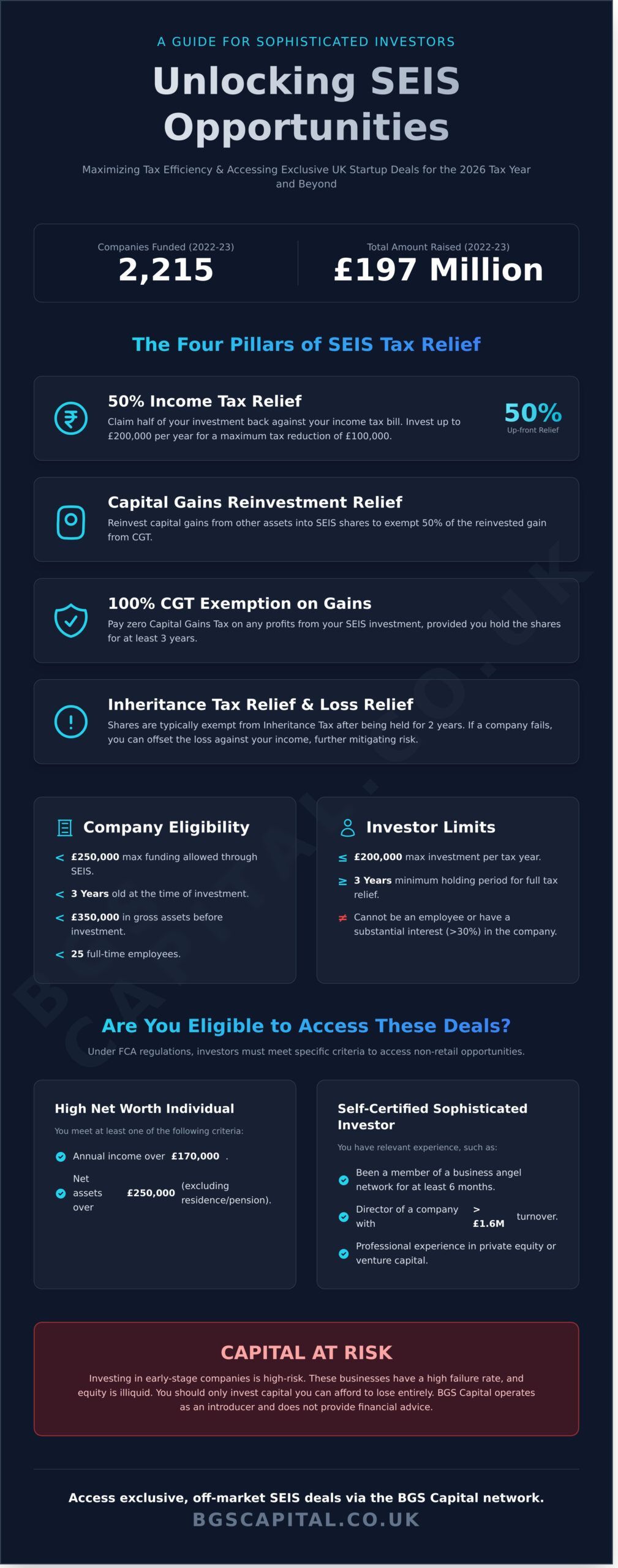
HMRC data for the 2022-23 tax year confirms that 2,215 companies raised £197 million through the Seed Enterprise Investment Scheme, but the highest-tier SEIS investment opportunities are rarely found on retail platforms. For the sophisticated investor, the barrier isn’t the availability of startups; it’s the lack of access to institutional-grade deal flow. CAPITAL AT RISK.
You understand that while 50% up-front income tax relief is a significant incentive, the high failure rate of early-stage ventures requires a rigorous, data-led approach to selection. This guide explains how to access exclusive, non-retail opportunities while maximizing your tax efficiency for the 2026 tax year. We’ll outline the process for securing capital gains tax exemptions and establishing direct connections with the UK’s most innovative founders.
Key Takeaways
- Learn how to claim 50% income tax relief on investments up to £200,000 while utilizing CGT reinvestment relief to mitigate existing tax liabilities.
- Identify high-growth SEIS investment opportunities within the 2026 UK startup ecosystem by applying a sophisticated ‘pre-IPO’ lens to early-stage ventures.
- Compare the diversification benefits of managed SEIS funds against the control and transparency offered by direct equity introductions.
- Master critical due diligence techniques, focusing on management execution history and identifying clear paths to liquidity for seed-stage companies.
- Discover how to access an exclusive database of live SEIS opportunities through the BGS Capital specialist introducer network.
Understanding SEIS Investment Opportunities in 2026
The Seed Enterprise Investment Scheme (SEIS) is a UK government initiative designed to drive capital into early-stage companies. By April 2026, the scheme remains a critical pillar of the UK startup ecosystem. It allows individual investors to support companies that are less than 3 years old and have fewer than £350,000 in gross assets. These businesses represent the highest tier of venture risk. BGS Capital functions as a specialist network, introducing sophisticated individuals to these exclusive, high-growth prospects before they reach mainstream awareness.
Current regulations for the 2026/27 tax year allow companies to raise a maximum of £250,000 through SEIS. Investors can commit up to £200,000 annually to these ventures. This capital fuels innovation in sectors like quantum computing, decentralized finance, and sustainable infrastructure. Sophisticated investors prioritize SEIS investment opportunities because they offer the potential for exponential growth that public markets rarely match. Data from 2025 indicates that over 2,200 companies utilized the scheme to secure their first round of funding, proving the resilience of the UK’s early-stage market.
CAPITAL AT RISK: The fundamental reality of early-stage equity investing is the high probability of loss. Equity in startups is illiquid. Most of these businesses fail within their first 24 months. You should only invest capital you can afford to lose entirely. BGS Capital operates as an introducer to these high-stakes opportunities; we don’t provide financial advice or manage your funds directly.
The Strategic Value of SEIS
SEIS functions as the primary entry point for a structured venture portfolio. It provides the initial “seed” capital that prepares a company for larger Series A rounds or EIS funding. In 2026, the scheme is entirely sector-agnostic. We see heavy activity in Green Energy and Life Sciences. SEIS is a high-risk investment vehicle that provides a 50% tax hedge for eligible UK taxpayers. This hedge, combined with Capital Gains Tax (CGT) reinvestment relief, offsets the inherent volatility of the asset class. If you hold the shares for at least 3 years, any gains are exempt from CGT, which is a significant advantage for high-bracket taxpayers.
Investor Qualification and Eligibility
Access to these deals isn’t universal. Under FCA regulations updated in early 2024, individuals must qualify as either a “High Net Worth Individual” or a “Self-Certified Sophisticated Investor.” A High Net Worth Individual typically earns over £170,000 annually or holds net assets exceeding £250,000, excluding their primary residence and pension. Sophisticated investors must demonstrate a history of private equity involvement or professional experience in the venture capital sector. These rules ensure that only those capable of absorbing total capital loss gain access to private placements.
BGS Capital restricts SEIS investment opportunities from general retail access to ensure regulatory compliance. Our platform serves as a professional conduit for accredited investment firms and wealth managers. Before viewing specific deal flow, you must complete our “Am I Eligible?” framework. This process verifies your status and ensures you understand the risks involved. We don’t facilitate the raises ourselves. We connect qualified individuals with companies currently seeking seed capital. The following criteria typically apply to our network members:
- Annual income exceeding £170,000.
- Net assets over £250,000, excluding property and pensions.
- Previous experience as a director of a company with a turnover of at least £1.6 million.
- Membership in a network of business angels for at least 6 months.
Our focus is on transparency and efficiency. By filtering for eligibility, we maintain a high-standard environment for both the companies raising capital and the individuals looking to deploy it.
Maximizing Tax Efficiency: SEIS Reliefs and 2026 Criteria
Investors utilize the Seed Enterprise Investment Scheme (SEIS) as a structural tool for capital preservation and aggressive tax mitigation. While the primary goal is identifying high-growth startups, the underlying tax framework provides a safety net that is unmatched in the UK financial landscape. For high net worth individuals, understanding the mechanics of these reliefs is mandatory before evaluating specific SEIS investment opportunities.
The scheme offers four primary layers of tax relief that significantly alter the risk-reward profile of early-stage equity:
- Income Tax Relief: Investors can claim 50% of their investment back against their income tax bill. With the annual investment limit now set at £200,000, this allows for a maximum tax reduction of £100,000 per tax year.
- Capital Gains Tax (CGT) Reinvestment Relief: If you’ve realized a gain from the sale of any asset, reinvesting those proceeds into SEIS-qualified shares allows you to exempt 50% of that original gain from CGT.
- Inheritance Tax (IHT) Benefits: SEIS shares generally qualify for Business Property Relief (BPR). Once held for two years, the shares fall outside of your taxable estate for IHT purposes.
- Loss Relief: If the company fails, you can offset the effective loss against your income tax or CGT. For an additional rate payer, this can limit total capital exposure to just 27.5% of the original investment.
The 2026 Tax Year Limits
The 2025/26 tax year maintains the expanded thresholds introduced in April 2023. Individual investors can deploy up to £200,000 annually into qualifying companies. Companies themselves can now raise up to £250,000 in SEIS funding, provided they have less than £350,000 in gross assets and have been trading for less than three years.
Timing is a critical variable for tax planning. The “carry-back” rule allows you to treat all or part of an investment made in the 2025/26 tax year as if it were made in 2024/25. This is particularly useful for managing fluctuating annual income or specific tax liabilities. You must hold the shares for a minimum of three years; selling before this period triggers a full clawback of the initial 50% income tax relief by HMRC.
CGT Exemption on Gains
SEIS remains the most potent vehicle for tax-free capital growth in the UK. Any profit made on the disposal of SEIS shares is entirely exempt from Capital Gains Tax, provided the initial income tax relief was claimed and not withdrawn. In contrast, standard equity gains are typically taxed at 20% for higher-rate taxpayers, while residential property gains can reach 24%.
Successful portfolio construction involves leveraging multiple exits over a five to ten-year horizon. By recycling tax-free gains into new SEIS investment opportunities, sophisticated investors create a compounding effect where the government effectively subsidizes half of the entry cost. Before committing capital, it is essential to check your eligibility for these exclusive high-growth structures. CAPITAL AT RISK.
Structuring these investments requires precision. While the tax benefits are statutory, they depend entirely on the company maintaining its qualifying status throughout the three-year holding period. If a company inadvertently breaches HMRC requirements, such as by engaging in “excluded activities” like banking or property development, the tax reliefs are revoked for all participants. High-level due diligence focuses as much on the company’s long-term SEIS compliance as it does on its commercial viability.
Comparing SEIS Models: Funds vs. Direct Introductions
Investors seeking SEIS investment opportunities generally navigate two primary paths: managed funds or direct equity introductions. Each model presents a distinct risk-reward profile and varying levels of administrative involvement. Managed SEIS funds function similarly to venture capital vehicles. They provide immediate diversification by spreading your capital across a portfolio of 10 to 15 startups. This structure mitigates the impact of a single company failure, which is statistically common in early-stage ventures. However, this convenience carries a heavy fee burden. Most UK fund managers charge annual management fees between 1.5% and 2.5%, alongside performance fees that typically reach 20% of any profits realized. For an investor deploying £100,000, these cumulative costs can significantly diminish the net benefit of the initial 50% tax relief.
Direct equity investment offers a starkly different experience. It grants you maximum control over your portfolio composition. You choose the specific sectors, founders, and business models that fit your personal investment thesis. While this avoids the “blind pool” risk of a fund, it increases your due diligence requirements. You’re responsible for analyzing the 2024 financial projections, the cap table, and the competitive landscape yourself. Sophisticated investors often prefer this route because it allows for larger individual stakes in high-conviction companies rather than diluted interests across a broader basket of assets.
Direct Introduction vs. Brokerage
BGS Capital operates as a specialist introducer rather than a traditional broker. We don’t facilitate the capital raise directly, nor do we handle client funds. This distinction is critical for your cost structure. Traditional brokers often charge success fees or commissions ranging from 3% to 7% of the total investment, which are ultimately paid out of the company’s cash reserves. By utilizing an introducer network, you bypass these middleman costs. You deal directly with company Investor Relations teams. This direct line of communication ensures you receive unfiltered updates and can perform more rigorous questioning during the pre-investment phase. It’s a leaner, more transparent way to access the market.
Which Model Fits Your Strategy?
Your choice between these models should reflect your available time and professional expertise. A passive approach suits those who prefer to outsource the heavy lifting to a fund manager. An active approach is better for High Net Worth individuals who want to leverage their own industry networks to support the growth of their portfolio companies. Regardless of the path you choose, you must prioritize regulatory compliance. Every company you consider must provide evidence of its tax status. Advance Assurance is HMRC’s provisional confirmation of a company’s SEIS eligibility. In the 2022-2023 tax year, HMRC granted this assurance to over 3,000 companies, providing a vital safety net for UK investors.
Evaluating fee structures and alignment of interest is paramount as we move through 2026. Fund managers often have interests that diverge from yours due to their fixed fee income. Direct introductions through BGS Capital ensure that your capital goes further. You aren’t subsidizing a fund’s operational overhead or expensive London office space. You’re investing in the enterprise itself. Every pound you commit is working to scale the business. CAPITAL AT RISK. Before proceeding, you must confirm your status as a sophisticated investor or HNW individual. Am I Eligible?
- Managed Funds: High diversification, 2% average annual fees, 20% performance carry.
- Direct Introductions: Maximum control, zero middleman brokerage fees, direct founder access.
- Due Diligence: Essential for all SEIS investment opportunities to ensure HMRC compliance.
Due Diligence: Evaluating Early-Stage SEIS Opportunities
Rigorous due diligence separates high-conviction portfolios from speculative gambling. When assessing SEIS investment opportunities, we apply a “Pre-IPO” lens. This means looking beyond the immediate tax relief to evaluate the company’s eventual exit potential. A viable startup needs a documented path to liquidity within five to seven years. We prioritize firms targeting acquisition by mid-cap entities or those with a clear roadmap toward an AIM listing by 2029.
The management team is the most critical variable. We look for “skin in the game.” Founders should have significant personal capital or at least two years of unpaid sweat equity committed. Statistics from 2024 indicate that 65% of venture failures stem from team friction. We verify execution history, looking for leaders who’ve previously managed budgets exceeding £1m or led teams of 10 or more. Experience in handling UK regulatory hurdles is non-negotiable for any firm seeking our endorsement.
Scalability requires a Total Addressable Market (TAM) of at least £1bn. To achieve the 10x returns necessary to offset early-stage risk, the business must capture a meaningful percentage of a large, growing sector. Technical viability is also paramount. We vet the underlying code or engineering to ensure the business isn’t a “zombie” startup. These are companies that survive on small grants but lack the infrastructure to scale. We look for proprietary IP or patents filed with the UK Intellectual Property Office before we consider a firm for our network.
The BGS Capital Selection Framework
We vet every business through a multi-stage process before it’s featured on the platform. For the 2026 cycle, our focus shifts to unit economics. We require a minimum LTV to CAC ratio of 3:1 and a monthly burn rate that provides at least 18 months of runway. Protecting your capital starts with IP verification and debt-structure audits. For deeper due diligence tips, read our guide on what angel investors look for before investing.
Risk Management for HNW Portfolios
High Net Worth (HNW) investors should cap SEIS exposure at 10% of their total liquid portfolio. This protects against the high failure rate typical of seed-stage ventures. You must also account for dilution. A 20% stake in an SEIS round might shrink to 5% by Series B. Using a SIPP or SSAS for SEIS investing in 2026 can offer additional tax efficiencies, though these structures require strict adherence to HMRC’s “connected person” rules.
CAPITAL AT RISK. Access to exclusive early-stage deals is restricted to qualified investors.
Accessing Exclusive SEIS Introductions via BGS Capital
CAPITAL AT RISK. BGS Capital operates as a specialist facilitator, bridging the gap between sophisticated investors and high-growth UK startups. The platform provides a streamlined database of SEIS investment opportunities that are often unavailable through standard retail channels. By functioning as an introducer rather than a broker, BGS Capital ensures that the investment process remains efficient and transparent. The database is free for qualified investors, providing a clear window into the early-stage ecosystem without the burden of upfront membership fees.
Navigating the platform is designed for speed. Investors can filter live opportunities based on sector, stage, and capital requirements. This modular approach allows for quick scanning of pitch decks and executive summaries. The primary advantage of this system is the removal of the middleman. Traditional investment houses often obscure the direct line to founders, but BGS Capital prioritizes direct introductions. You connect straight with Investor Relations (IR) teams. This direct access is vital for conducting thorough due diligence and understanding the technical nuances of a company’s growth strategy.
Friction is a hidden cost in early-stage investing. Intermediaries frequently take 5% to 7% in success fees, which can dilute the impact of your capital. BGS Capital’s model eliminates this intermediary friction. When you identify SEIS investment opportunities that align with your portfolio goals, the platform facilitates a warm introduction. This allows you to negotiate terms and ask critical questions directly to the people running the business. It’s a professional, no-nonsense gateway for those who value time and direct communication.
Feature Your Business
Founders seeking to raise capital can list their SEIS-eligible companies to gain exposure to a network of high net worth (HNW) and sophisticated investors. To qualify, your company must adhere to strict HMRC guidelines, including having fewer than 25 full-time employees and less than £350,000 in gross assets. BGS Capital vets each listing to ensure it meets the professional standards expected by our network. If your business is ready for its next growth phase, you can Feature Your Business & Connect With Investors to start the screening process. This is a targeted way to bypass the noise of general crowdfunding and reach serious, qualified capital providers.
Start Your 2026 SEIS Journey
The 2025/26 tax year presents new opportunities for investors to utilize the 50% income tax relief offered by the Seed Enterprise Investment Scheme. Planning should begin now to ensure capital is deployed into the most promising ventures before the tax year end. Access to the BGS database requires a mandatory compliance check to confirm your status as a sophisticated or high net worth investor. This is not a barrier; it’s a regulatory necessity under FCA COBS rules to protect all parties involved. The “Am I Eligible?” process is a 2-minute digital check that validates your investment profile instantly. Once confirmed, you gain immediate access to the current pipeline of UK startups. Am I Eligible? Access the SEIS Database Now to begin your qualification and view live opportunities for the upcoming cycle.
BGS Capital does not provide financial advice or facilitate the actual transfer of funds. We are an introducer. All investment decisions carry risk, and the value of your investment can go down as well as up. Ensure you consult with a qualified tax advisor to confirm how SEIS relief applies to your specific financial circumstances.
Secure Your 2026 SEIS Portfolio Allocation
Navigating SEIS investment opportunities in 2026 requires a disciplined approach to both tax efficiency and risk management. Sophisticated investors can leverage the 50% income tax relief on annual investments up to £200,000, provided target companies adhere to the 2023 updated HMRC limits of under £350,000 in gross assets and are less than 3 years old. Success in this asset class depends on rigorous due diligence and direct access to investor relations teams. BGS Capital functions as a specialist introducer, connecting qualified investors with pre-IPO and high-growth companies before they reach secondary markets. Our platform simplifies the identification of 2026 SEIS opportunities by focusing on transactional efficiency and direct IR introductions. It’s free for accredited individuals and wealth managers looking to diversify within the UK venture capital ecosystem. CAPITAL AT RISK. The 2026 tax year presents unique openings for those ready to commit capital to the next generation of British enterprise.
Am I Eligible? Access the 2026 SEIS Investment Database
Take the next step in building a tax-efficient, high-growth portfolio today.
Frequently Asked Questions
What is the maximum I can invest in SEIS opportunities in 2026?
You can invest up to £200,000 in SEIS investment opportunities during the 2025/26 tax year. This annual limit was increased from £100,000 on 6 April 2023 to provide more capital for early stage UK startups. If you don’t use your full allowance, you’ve the option to use the carry back facility to apply the relief to the previous tax year.
How do I claim my 50% SEIS tax relief?
Claim your 50% income tax relief through your annual Self Assessment tax return using the details from your SEIS3 certificate. The investee company issues this certificate after it’s been trading for 4 months or has spent 70% of the total investment. You’ll enter the specific investment dates and amounts in the Additional Information section of your HMRC filing to reduce your tax liability.
Can I invest in SEIS through my SIPP or SSAS?
You can’t typically invest in SEIS through a SIPP or SSAS because the 50% tax relief is designed for personal income tax. Since pension schemes are already tax-sheltered environments, they’re ineligible for the primary SEIS tax benefits. Most investors hold these shares directly to ensure they qualify for the significant income tax and capital gains tax exemptions offered by the scheme.
What happens to my SEIS tax relief if the company fails?
If an SEIS company fails, you’re entitled to claim loss relief on the remaining 50% of your net investment. This relief is applied at your highest marginal rate of income tax, which is 40% or 45% for many investors. For a £10,000 investment, your total loss after initial relief and loss relief could be limited to just £2,750 for a top-rate taxpayer. CAPITAL AT RISK.
What is the difference between SEIS and EIS investment opportunities?
SEIS targets companies less than 3 years old with under £350,000 in gross assets, whereas EIS is for larger firms up to 7 years old. SEIS investment opportunities offer 50% income tax relief on a £200,000 annual limit. In contrast, EIS provides 30% relief on investments up to £1 million, or £2 million if the companies are officially designated as knowledge-intensive by HMRC.
How long must I hold SEIS shares to qualify for CGT exemption?
You must hold SEIS shares for a minimum of 3 years to qualify for the 100% Capital Gains Tax exemption on any profits. Selling your shares before this 3 year anniversary triggers a full clawback of your initial 50% income tax relief. HMRC enforces this holding period to ensure that capital remains committed to the growth of the UK small business sector over the long term.
Does BGS Capital charge investors a fee for introductions?
BGS Capital doesn’t charge investors a fee for introductions to SEIS investment opportunities. We operate as a specialist network and introducer, connecting high net worth individuals with accredited investment firms. It’s important to check the specific terms of the underlying investment, as fund managers or brokers may apply their own management fees or performance carry within the investment vehicle.
Is Advance Assurance a guarantee that I will receive tax relief?
Advance Assurance isn’t a guarantee that you’ll receive tax relief from HMRC. It’s a provisional opinion based on the company’s current structure and its planned use of funds at a specific date. The company must continue to follow all SEIS compliance rules for the entire 3 year period. If the company’s trade changes or it breaches the gross asset limits, your tax relief may be withdrawn. CAPITAL AT RISK.