
For a UK founder, navigating the world of startup investors is a critical, high-stakes process. The decision to pursue funding from an Angel investor versus a Venture Capital (VC) firm is one of the most pivotal choices you will make. Approaching the wrong source not only wastes valuable time but can lead to misaligned expectations, unfavourable terms, and a fundamental disconnect on long-term vision. This confusion often results in founders either hesitating to seek capital or accepting a deal that compromises control and future growth.
This definitive guide demystifies the distinction between these two core types of capital partners. We provide a clear framework for evaluating the critical differences in their investment criteria, operational involvement, and strategic value. By understanding these nuances, you will be equipped to identify which investor profile aligns with your current business stage, confidently structure your pitch, and strategically secure the ‘smart money’ essential for your company’s long-term success.
Key Takeaways
- Differentiate between an Angel’s personal capital and a VC’s managed fund to anticipate cheque size, risk tolerance, and return expectations.
- Evaluate the trade-off between the faster, less formal process of Angel funding and the rigorous, structured due diligence required by VCs.
- Assess the non-financial value each investor provides, from an Angel’s direct mentorship to a VC’s extensive network and formal governance.
- Strategically select the right startup investors by aligning your company’s stage and capital requirements with their specific investment thesis and operational involvement.
Defining the Players: Who Are Angel Investors and VCs?
For UK startups, securing early-stage capital is a defining milestone. The landscape is primarily dominated by two distinct types of startup investors: Angel Investors and Venture Capital (VC) firms. While both provide essential funding, their motivations, structures, and levels of involvement differ significantly. Understanding these distinctions is critical, as choosing a funding partner is a strategic decision that shapes your company’s governance, growth trajectory, and operational demands.
This decision extends beyond the capital itself; it is about aligning with a partner whose objectives, timeline, and expertise match your long-term vision.
Angel Investors: The Individual Backers
Often referred to as ‘business angels,’ these are typically high-net-worth individuals who invest their own personal funds into early-stage ventures. Many Angel Investors are successful entrepreneurs themselves, motivated not only by the potential for high financial returns but also by the opportunity to mentor and apply their industry expertise. They may invest individually or as part of an informal syndicate, offering greater flexibility and faster decision-making for investment rounds typically ranging from £10,000 to £100,000.
Venture Capital (VC) Firms: The Institutional Funds
Venture Capital firms are formal, institutional entities that invest other people’s money. They raise large pools of capital from Limited Partners (LPs)-such as pension funds or university endowments-to form a managed fund. A VC’s primary mandate is to generate outsized returns for these LPs within a defined fund lifecycle. Operating with a specific investment thesis, their structure includes partners and analysts, enabling them to deploy larger sums of capital, often starting from £250,000 and scaling into the millions. This institutional framework necessitates a more rigorous due diligence process and formal governance requirements post-investment.
At a Glance: Angel vs. VC
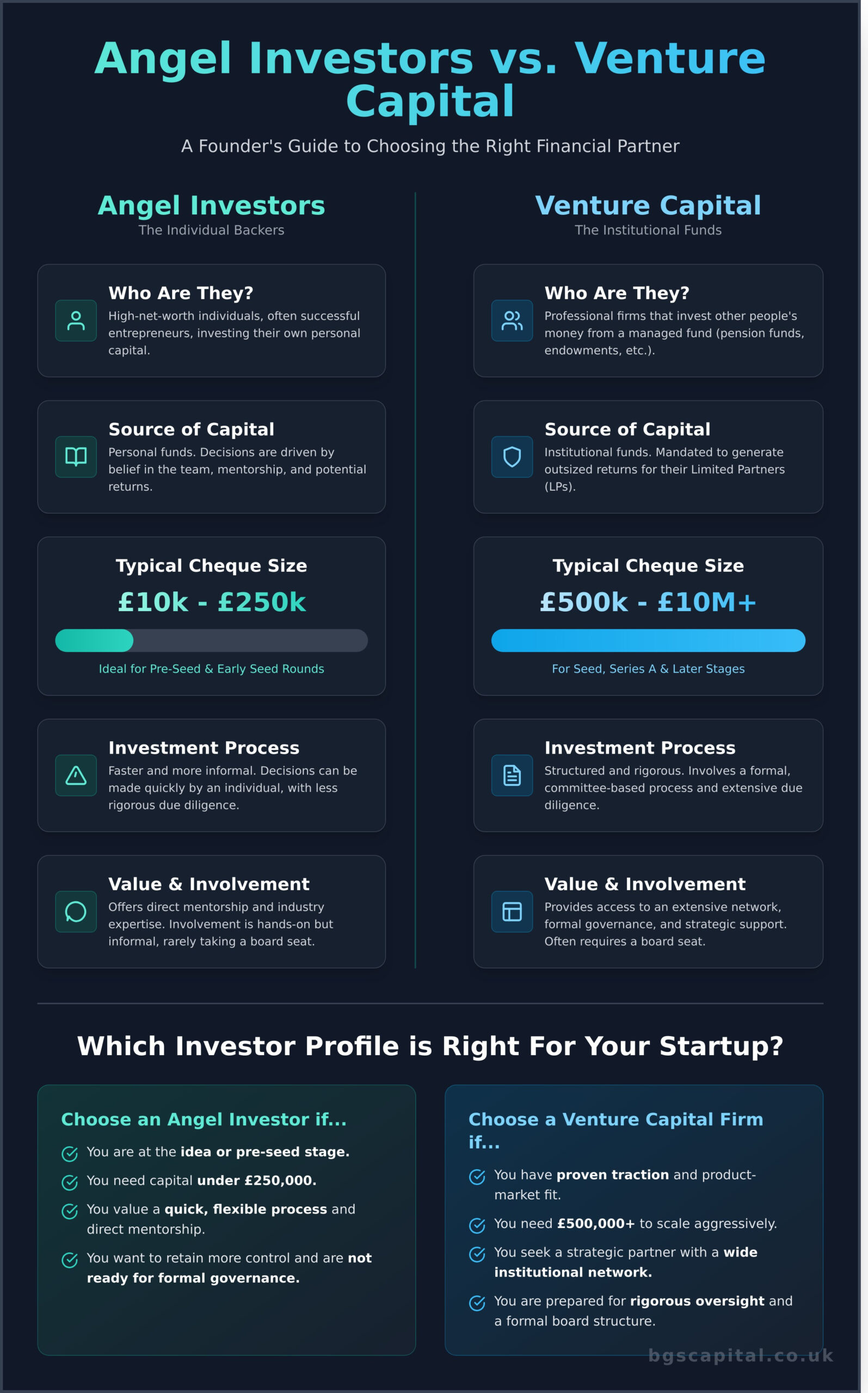
- Capital Source: Angels use personal funds; VCs manage institutional funds from LPs.
- Investment Size: Angels typically invest smaller amounts (£10k – £100k); VCs invest larger sums (£250k+).
- Decision-Making: Angels are often quick and individual; VCs have a formal, committee-based process.
- Involvement: Angels may offer informal mentorship; VCs often take a board seat and have formal reporting requirements.
- Structure: Angels are individuals or informal groups; VCs are professional firms with a defined structure and thesis.
Source and Scale of Capital: A Tale of Two Chequebooks
The fundamental distinction between Angel investors and Venture Capitalists (VCs) lies not in their intentions, but in the source of their capital. This single factor dictates cheque size, risk appetite, and the very nature of the investor-founder relationship. Understanding this difference is critical for founders seeking to align their funding strategy with the right partners for their stage of growth.
These two types of startup investors operate with different mandates, which directly impacts their investment thesis and expectations for your business.
Angel Investment: Personal Funds, Personal Stakes
Angel investors are typically high-net-worth individuals investing their own capital. This personal stake affords them greater flexibility in their decision-making process, allowing them to invest based on their belief in a founding team or an unproven concept, often before significant market traction exists.
- Source of Capital: An individual’s personal wealth.
- Typical Cheque Size: £10,000 – £250,000, ideal for pre-seed and early seed rounds.
- Risk Profile: High. They are often the first professional capital into a venture and can take earlier, more speculative risks.
- Follow-on Funding: Capacity to participate in subsequent, larger funding rounds may be limited.
VC Investment: Pooled Capital, Institutional Pressure
Venture Capital firms manage large pools of capital on behalf of Limited Partners (LPs), such as pension funds, endowments, and family offices. This institutional structure imposes a fiduciary duty to generate significant, fund-returning outcomes across a portfolio of companies.
- Source of Capital: A managed fund from institutional LPs.
- Typical Cheque Size: £500,000 – £10M+, targeting established Seed, Series A, and later stages.
- Risk Profile: Calculated. VCs require evidence of product-market fit, traction, and a large, addressable market to justify their investment.
- Follow-on Funding: VCs strategically reserve capital to support their portfolio companies through subsequent funding rounds.
The implications for your funding roadmap are clear. An Angel may provide the crucial capital to validate an idea, while a VC provides the scale-up funding to capture a market. Aligning your startup’s current stage with the correct type of capital is a foundational step. The process of Choosing the Right Investor requires a strategic assessment of where your business is today and its long-term capital requirements. This decision will define your company’s trajectory for years to come.
Process & Control: Navigating Due Diligence and the Term Sheet
The path to securing capital from startup investors diverges significantly depending on whether you engage with an Angel investor or a Venture Capital firm. These differences in process directly influence the speed of the transaction, the level of scrutiny your business will face, and the degree of control you will ultimately concede.
The Angel Approach: Speed and Simplicity
Engaging with an Angel investor is typically a more direct and personal process. The focus is often on the founder’s vision and the team’s capability rather than exhaustive financial modelling. This leads to a streamlined engagement characterised by:
- Due Diligence: A lighter, faster review. Angels concentrate on the core concept, the market opportunity, and their confidence in the founding team. The process is less formal and can conclude rapidly.
- Decision Making: Decisions are often made by one or two individuals. This avoids the delays of committee approvals, resulting in a swift ‘yes’ or ‘no’ and allowing founders to secure capital more quickly.
- Control & Terms: Angels typically take an advisory or mentorship role. For early-stage investments, particularly those under £250,000, they rarely require a board seat. Term sheets are often simpler, frequently using standard UK documents like SEIS/EIS-compliant agreements or a Simple Agreement for Future Equity (SAFE).
The VC Gauntlet: Rigour and Governance
In contrast, the VC process is a formal, multi-stage institutional evaluation. VCs are fiduciaries managing significant capital from Limited Partners (LPs), which mandates a highly structured and rigorous approach.
- Due Diligence: This is an extensive, formal audit covering every facet of the business. It includes deep dives into financial projections, unit economics, market size, competitive landscape, technology stack, and legal structure. This level of scrutiny aligns with the expectations for different Startup Funding Stages, becoming more intense as the company matures.
- Decision Making: The process is methodical and can take months. It involves multiple stages, from initial partner meetings to a final presentation before an investment committee.
- Control & Terms: A board seat is a standard requirement for a VC investment. Term sheets are complex legal documents that include protective provisions, giving the VC firm veto rights on major corporate decisions. Expect detailed clauses on liquidation preferences, anti-dilution rights, and governance structures.
Ultimately, a founder’s choice between these startup investors dictates the balance between speed-to-capital and long-term autonomy. The Angel path offers agility, while the VC route provides substantial capital in exchange for formalised governance and control.
Value Beyond Capital: What ‘Smart Money’ Really Means
Capital is a commodity; strategic value is not. The most effective startup investors provide what is known as ‘smart money’-a combination of capital and strategic support that accelerates growth. The choice between an Angel and a VC often hinges on the type of non-financial value your business requires to succeed. This partnership is as critical to your long-term success as your product-market fit.
Founders must look beyond the cheque size and evaluate what else an investor brings to the table. This non-financial contribution can be the definitive factor between stagnation and rapid scaling.
Angel Value-Add: Hands-On Mentorship and Expertise
Angel investors, typically successful entrepreneurs or executives, offer a highly personal and direct form of support. Their value is concentrated and hands-on, making them ideal for pre-seed or seed-stage companies navigating initial uncertainty. Key benefits include:
- Direct Mentorship: Unfettered access to an experienced operator for strategic advice, operational guidance, and critical decision-making.
- Personal Network Access: Leveraging the Angel’s trusted contacts to secure foundational hires, land initial key customers, or find specialist advisors.
- Sector-Specific Expertise: An Angel from your industry provides invaluable, nuanced insights that a generalist investor cannot.
- Early-Stage Sounding Board: They often act as a crucial, objective advisor during the volatile early days of building a company.
VC Value-Add: A Platform for Scaling
Venture Capital firms provide value at an institutional scale. Their support is structured, systematic, and designed to prepare a company for hyper-growth and significant future funding rounds. This is a platform approach to value creation.
- Extensive Firm Network: Access to a vast, curated network of talent pools, industry experts, potential enterprise customers, and other portfolio companies for collaboration.
- Platform Team Support: Many UK VCs have in-house teams dedicated to supporting portfolio companies with functions like marketing, PR, recruitment, and financial planning.
- Credibility and Validation: An investment from a reputable VC acts as a powerful signal to the market, attracting top talent and simplifying future fundraising efforts.
- Strategic Milestone Guidance: VCs provide a formalised process for key events, including subsequent funding rounds, international expansion, and exit strategies like M&A or an IPO.
The decision rests on your immediate needs. An Angel investor acts as a mentor, ideal for refining a concept and finding initial traction. A VC provides an entire scaling infrastructure. Founders must critically assess whether they need a co-pilot for the early journey or a launch platform for rapid ascent. Identifying the right startup investors is a core part of any successful capital strategy, and our network at BGS Capital connects founders with qualified capital partners aligned with their vision.
Making the Choice: A Framework for Your Startup
Selecting the right type of capital is as critical as developing your product. The distinction between Angel investors and Venture Capitalists is not merely about the amount of funding; it defines your company’s trajectory, governance, and long-term partnerships. This framework provides a series of direct questions to help you assess your position and formulate a targeted fundraising strategy to attract the most suitable startup investors.
Assess Your Stage and Needs
A realistic evaluation of your current business standing is the first step. The capital you require must align with the milestones you aim to achieve. Consider the following points:
- What is your operational stage? If you are at the pre-product or idea stage, an Angel investor is the most logical first approach. If you have achieved early traction and are demonstrating product-market fit, you may be prepared for institutional VC funding.
- What kind of support do you require? Do you need hands-on mentorship from an individual with deep industry experience (an Angel), or access to a VC’s extensive network for scaling operations and hiring executive talent?
- How much capital do you need? Define the exact amount required to reach your next critical milestone. Angel rounds are typically smaller, often under £500,000, whereas VC seed rounds in the UK generally start significantly higher.
Align With Your Long-Term Vision
Your choice of investor should be a direct reflection of your ultimate business objective. This is a long-term relationship, not a simple transaction. The expectations of different startup investors will shape your company’s future.
- What is your target exit? If you are building a business with the potential for a billion-pound ‘unicorn’ valuation and a major exit (IPO or acquisition), the VC path is structured for this outcome. For strong, profitable businesses with more modest exit plans, Angels provide greater flexibility.
- How much control will you concede? VCs typically require a board seat and more significant governance rights in exchange for their capital and support. Be prepared for this dilution of control in pursuit of accelerated growth.
Next Steps: Preparing Your Pitch
Once you have identified the appropriate investor profile, your pitch must be tailored to their specific priorities. An Angel investor often invests in the founder and their vision, making the team’s story and credibility paramount. In contrast, a VC pitch must be rigorously data-driven, focusing on market size (TAM), defensible moats, unit economics, and a clear, scalable business model.
Ready to get in front of qualified investors? Feature your business on BGS Capital.
Choosing Your Strategic Partner: The Final Analysis
The decision between an angel investor and a venture capitalist is not merely about the size of the cheque. It is a strategic choice that hinges on your startup’s stage, growth ambitions, and tolerance for ceding control. While angels often provide crucial early-stage validation and mentorship with more founder-friendly terms, VCs offer the substantial capital required for aggressive scaling, albeit with rigorous due diligence and formal governance structures. Ultimately, the right startup investors are partners who align with your long-term vision and provide value far beyond the initial capital injection.
When you are ready to move from analysis to action, gaining access to a qualified network is paramount. BGS Capital is a professional introducer service designed for businesses raising capital. We provide direct access to a network of high-net-worth and sophisticated investors, including specialists in pre-IPO and IPO opportunities. Connect with sophisticated investors looking for their next opportunity. Feature your business.
Your ideal funding partner is out there. Take the decisive step forward to secure the capital your vision deserves.
Frequently Asked Questions About Startup Investors
Can a startup raise money from both Angel Investors and VCs?
Yes, this is a common and often sequential funding path for UK startups. A company typically secures initial capital from angel investors in a pre-seed or seed round, frequently leveraging tax-efficient schemes like SEIS or EIS. This early funding is used to achieve product-market fit and establish key metrics. Once these milestones are met, the startup becomes a more viable candidate for a larger, subsequent Series A round led by a Venture Capital firm to facilitate significant scaling.
What is a ‘super angel’ and how do they differ from traditional angels?
A ‘super angel’ is a high-net-worth individual who invests larger sums more frequently than a traditional angel, operating in the capital gap between typical angel rounds and institutional VC funding. While a UK angel may invest £10,000 to £100,000, a super angel often writes cheques for £250,000 or more. They may lead a seed round, operate with a formal investment thesis, and manage their capital through a small, personal fund or syndicate structure.
Do VCs invest in the same early stages as Angel Investors?
Generally, Venture Capital firms do not operate at the same early stage as angels. Most VCs in the UK target Series A and later funding rounds, requiring evidence of significant traction and revenue before investing. Angel investors specialise in the higher-risk pre-seed and seed stages, providing the initial capital to get a concept off the ground. While some micro-VCs do participate in seed rounds, their evaluation criteria remain far more rigorous than that of a typical angel.
How does equity dilution differ between Angel and VC investment rounds?
Equity dilution is a function of capital raised against valuation. An angel round might see founders sell 10-20% equity for a sum like £150,000 to £500,000. A subsequent VC-led Series A round, while potentially diluting a similar 15-25%, involves a much larger capital injection, often in the millions of pounds. The percentage of dilution can be comparable, but the post-money valuation and capital raised are substantially greater in a VC round, reflecting the company’s advanced stage.
What are the key red flags to watch out for in an investor term sheet?
Founders must meticulously review term sheets for non-standard or predatory clauses. Critical red flags include full participating preferred shares, aggressive liquidation preferences (e.g., greater than 1x), broad investor veto rights over operational decisions, and an overly long no-shop or exclusivity period. It is imperative to engage a UK solicitor with direct experience in venture capital transactions to identify and negotiate these terms before any commitment is made, ensuring they align with market standards.
Is it better to have one large VC or a syndicate of Angel Investors?
The optimal structure depends on the startup’s stage. At the seed stage, a syndicate of angel investors provides access to a diverse pool of expertise, industry contacts, and mentorship, which can be more valuable than capital alone. For a Series A round and beyond, a single lead VC is preferable. They provide the significant capital required for scaling, bring institutional discipline to the board, and possess the network and credibility to facilitate future funding rounds.
Besides Angels and VCs, what other types of startup investors exist?
The ecosystem of startup investors extends beyond these two primary groups. Other sources of capital include Corporate Venture Capital (CVC) arms, which offer strategic alignment with a large corporation. Equity crowdfunding platforms, such as Crowdcube and Seedrs, enable investment from a broad base of retail investors. Family offices are also increasingly active in direct early-stage deals. For specific R&D-focused businesses, non-dilutive funding from government bodies like Innovate UK is a viable alternative or supplement.