
UK National Minimum Wage 2025: A Guide for Business Owners
Navigating the upcoming changes to the national minimum wage 2025 is a critical task for UK business owners. Uncertainty over new rates, concerns about the impact on cash flow, and the significant risk of HMRC non-compliance penalties can create considerable pressure on strategic planning and operational budgets.
This definitive guide is engineered to provide clarity and control. We present the confirmed 2025 wage rates in a clear format, broken down by age and apprentice status, to facilitate accurate financial forecasting. Our objective is to equip you not just with the numbers, but with an actionable framework for ensuring full compliance and effective payroll management.
Proceed to gain a comprehensive understanding of your statutory obligations. We will help you calculate the full financial impact beyond the new hourly rates, empowering you to make strategic decisions that protect your business and support your workforce.
Key Takeaways
- Access a clear summary of the confirmed 2025 National Minimum Wage and National Living Wage rates to immediately understand your new baseline payroll costs.
- Calculate the full financial impact of the national minimum wage 2025 increase on your business, including associated National Insurance and pension contributions.
- Utilise an actionable employer checklist to ensure full compliance, update payroll systems, and mitigate the risk of significant financial penalties from HMRC.
- Evaluate the strategic benefits of adopting the voluntary Real Living Wage to enhance staff retention and strengthen your competitive position in the market.
UK National Minimum Wage & National Living Wage Rates for 2025
For UK employers, anticipating annual adjustments to statutory pay rates is a critical component of financial planning and compliance. The government, advised by the independent Low Pay Commission (LPC), sets the National Minimum Wage (NMW) and National Living Wage (NLW) rates that will become legally effective from 1 April 2025. The LPC’s recommendations are based on extensive analysis of economic conditions, affordability for businesses, and the impact on workers’ living standards.
Understanding the upcoming national minimum wage 2025 rates allows businesses to budget for increased payroll costs and ensure continued compliance with UK employment law. Below are the projected rates for April 2025, presented alongside the previous year’s figures for direct comparison.
Projected 2025 Rates by Age Bracket (Effective April 2025)
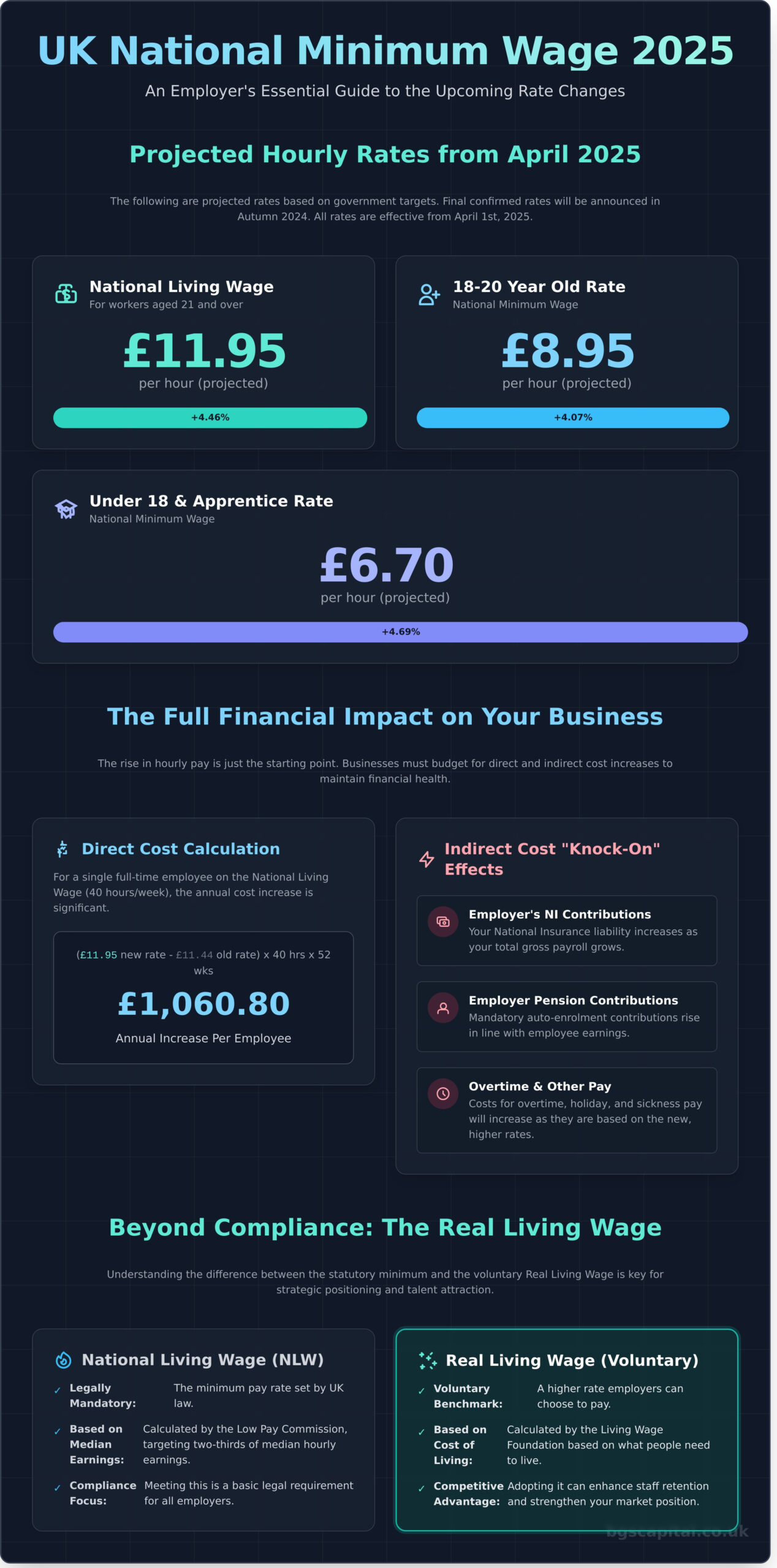
The following table outlines the projected hourly rates. Please note: these figures are projections based on government targets and economic forecasts. The final, confirmed rates will be officially announced by the government in Autumn 2024.
| Age Bracket / Category | Projected Rate from April 2025 | Rate from April 2024 |
|---|---|---|
| National Living Wage (21 and over) | £11.95 (Projected) | £11.44 |
| 18 – 20 Year Old Rate | £8.95 (Projected) | £8.60 |
| Under 18 Rate | £6.70 (Projected) | £6.40 |
| Apprentice Rate | £6.70 (Projected) | £6.40 |
National Living Wage (NLW) vs. National Minimum Wage (NMW): What’s the Difference?
The distinction between the NLW and NMW is based on age. The National Living Wage is the highest statutory minimum rate, mandatory for all workers aged 21 and over. The National Minimum Wage applies to workers from school leaving age up to the age of 20, with separate bands for those under 18 and apprentices. This tiered structure was established under the National Minimum Wage Act 1998 and is designed to reflect different levels of experience and career stages.
It is essential not to confuse these statutory rates with the ‘Real Living Wage’. The Real Living Wage is a voluntary benchmark calculated by the Living Wage Foundation based on the cost of living; it is not legally enforceable. The government’s stated long-term ambition for the statutory NLW is for it to reach two-thirds of median hourly earnings, a target that continues to influence the LPC’s annual recommendations.
How the 2025 Wage Increase Impacts Your Business Finances
The upcoming rise in the national minimum wage 2025 represents more than a simple adjustment to hourly pay. For founders and directors, it is a critical variable that directly influences payroll, operational costs, and ultimately, business valuation. A comprehensive understanding of its total financial impact is essential for robust strategic planning and maintaining a competitive edge.
Calculating the Direct Impact on Your Payroll
The primary financial impact is the direct increase in your wage bill. To quantify this, you must analyse your entire workforce, not just those currently at the minimum wage. The calculation for a single employee is straightforward:
(New Hourly Rate – Current Hourly Rate) x Weekly Hours x 52 Weeks = Total Annual Cost Increase
For example, if an employee working 40 hours per week sees their rate increase by £0.60, the annual cost to your business for that individual alone rises by £1,248 (£0.60 x 40 x 52). This analysis must be applied to all affected staff, paying close attention to employees moving into a new age-related wage bracket. Furthermore, remember that overtime pay, often calculated as a multiple of the base rate, will also increase proportionally.
Budgeting for Indirect Costs: NI, Pensions, and Benefits
The wage increase creates a significant knock-on effect on associated employment costs. These indirect costs must be factored into your budget to avoid unforeseen financial pressure. Key areas include:
- Employer’s National Insurance (NI) Contributions: As your gross payroll increases, so will your NI liability, which is calculated as a percentage of employee earnings above a certain threshold.
- Employer Pension Contributions: Under auto-enrolment rules, your mandatory contributions are a percentage of an employee’s qualifying earnings. A higher wage directly translates to higher pension payments.
- Salary-Linked Benefits: Other benefits, such as life insurance or private health cover, may be tied to salary levels, leading to increased premium costs.
Implications for Financial Forecasting and Business Valuation
For forward-looking businesses, particularly those preparing for a funding round or acquisition, modelling these cost increases is non-negotiable. The scheduled rise in the national minimum wage 2025 must be built into your financial forecasts for the 2025/26 fiscal year. As detailed in the government’s official National Minimum Wage in 2025 report, these adjustments are mandatory and will directly impact your operational expenditure.
This rise in OpEx can compress profit margins and reduce your EBITDA (Earnings Before Interest, Taxes, Depreciation, and Amortization)-a key metric used in business valuation. Investors scrutinise EBITDA to assess a company’s core profitability and financial health. Proactively managing these costs and demonstrating a clear strategy to maintain profitability is crucial. Connect with our investor network to position your business for growth and secure the capital needed to navigate these economic shifts effectively.
Ensuring Compliance: A Checklist for Employers
Failure to comply with National Minimum Wage (NMW) legislation is a significant operational and financial risk. HM Revenue & Customs (HMRC) actively enforces these regulations, with the power to issue substantial financial penalties, demand back-pay for up to six years, and publicly “name and shame” non-compliant businesses. This checklist provides a direct, actionable framework for business owners and HR managers to ensure full compliance ahead of the upcoming changes.
Who is Entitled to Minimum Wage?
Understanding eligibility is the first step in compliance. The NMW applies to most individuals classified as ‘workers’ in the UK. This includes full-time employees, part-time staff, agency workers, and casual labourers. Apprentices are entitled to a specific apprentice rate, while interns must be paid the minimum wage unless their work is a required part of a UK-based further or higher education course. Genuinely self-employed individuals and company directors are typically exempt, as are volunteers.
Common Pitfalls: What to Avoid
Many compliance failures are unintentional, arising from common misunderstandings of the rules. Key areas to monitor include:
- Unlawful Deductions: Making deductions for items like uniforms, tools, or training costs is a frequent error. These deductions are unlawful if they reduce an employee’s total pay below the applicable NMW rate in that pay period.
- Unpaid Working Time: All time considered ‘working time’ must be paid. This includes mandatory training, work-related travel (excluding the normal commute), and time spent on security checks at the beginning or end of a shift.
- Salary Sacrifice Schemes: While beneficial, these schemes cannot reduce an employee’s gross pay to a level below the NMW. Careful calculation is required.
- Inaccurate Records: Employers are legally required to keep accurate and sufficient pay and time records for at least three years to prove compliance.
Action Plan for April 2025
To prepare for the national minimum wage 2025 update, follow these critical steps:
- Identify Affected Staff: Conduct a full audit of your workforce to identify every employee whose pay will require adjustment. Pay close attention to employees who will move into a new age band.
- Update Payroll Systems: Ensure your payroll software is updated with the new rates before processing the first pay run in or after April 2025. You can verify the official figures by checking the current minimum wage rates on the GOV.UK website.
- Communicate with Staff: Inform all affected employees of the changes to their pay rate in writing. This proactive communication demonstrates transparency and can prevent future disputes.
- Review Contracts: Examine employment contracts and offer letters to ensure all terms align with the new national minimum wage 2025 requirements. Amend any clauses that are now outdated or non-compliant.
Beyond Compliance: The Real Living Wage and Competitiveness
Meeting statutory pay rates is a legal necessity. However, with the national minimum wage 2025 set to continue its upward trajectory, astute business leaders are looking beyond mere compliance towards strategic advantage. Adopting a fair pay strategy is not simply an operational cost but a measurable investment in corporate resilience, brand equity, and long-term competitiveness in a discerning market.
What is the Real Living Wage?
The Real Living Wage is a voluntary hourly rate, calculated independently each year based on the actual cost of living. It is a benchmark for responsible employers, set by the Living Wage Foundation. Unlike the statutory minimum, it accounts for real-world expenses. There are two distinct rates, updated annually in the autumn: a UK-wide rate and a higher London Living Wage to reflect the capital’s significantly increased costs.
The Business Case for Becoming a Living Wage Employer
Committing to the Real Living Wage yields tangible returns that directly impact the bottom line. Beyond positive public relations, accredited employers report significant and quantifiable operational improvements:
- Improved Staff Retention: A fairly compensated workforce is more loyal, reducing staff turnover and the associated high costs of recruitment and training.
- Enhanced Productivity and Morale: Research consistently shows that financial security reduces employee stress, leading to better focus, higher engagement, and improved output.
- Stronger Brand Reputation: Accreditation signals ethical practice, attracting ethically-minded customers, partners, and top-tier talent who value corporate responsibility.
Attracting Investment: How Fair Pay Impacts ESG Credentials
In today’s investment landscape, financial performance alone is insufficient. Sophisticated investors and funds increasingly use Environmental, Social, and Governance (ESG) criteria to identify sustainable and well-managed companies. Paying a wage that exceeds the mandatory national minimum wage 2025 directly strengthens a company’s ‘Social’ score, signalling a stable workforce and ethical governance.
This commitment is a powerful indicator of a low-risk, forward-thinking operation that values its human capital. A strong ESG profile is no longer a peripheral concern; it is central to attracting modern investors. Showcase your business today.
Navigating the 2025 Wage Increase to Secure Future Growth
Successfully managing the upcoming national minimum wage 2025 increase requires more than just payroll adjustments. It demands strategic financial forecasting to absorb higher operational costs and a meticulous approach to ensure full legal compliance. For forward-thinking businesses, this regulatory change also presents an opportunity to evaluate overall compensation strategy, positioning the company as a competitive employer and safeguarding long-term stability.
While adapting to these new wage structures is essential for operational integrity, scaling your enterprise requires a robust capital strategy. BGS Capital provides qualified companies with direct introductions to our exclusive network of pre-vetted, sophisticated investors and accredited investment firms, creating clear pathways for pre-IPO and IPO capital raising.
Is your business ready for its next stage of growth? Feature your company to our network of sophisticated investors.
Frequently Asked Questions
Do I have to pay the National Minimum Wage to interns or work experience placements?
Entitlement to the National Minimum Wage (NMW) is determined by an individual’s status as a ‘worker’. If an intern or work experience placement has a contract, is required to perform specific tasks, and must attend work, they are likely classified as a worker and must be paid the appropriate NMW rate. Genuine volunteers or students on placements of less than one year as a required part of a UK-based higher education course are typically exempt from these rules.
How are the apprentice rates calculated and who is eligible for them?
The apprentice rate is a single hourly rate set by the government. It applies to apprentices who are under 19, or those aged 19 or over who are in the first year of their apprenticeship. Once an apprentice completes their first year and is aged 19 or over, they must be paid at least the NMW rate corresponding to their age bracket. The rate is not calculated on a pro-rata basis; it is a fixed minimum that must be met for all hours worked.
What records do I need to keep to prove I am compliant with NMW laws?
Employers are legally required to maintain sufficient records to prove NMW compliance. These records must be retained for a minimum of three years. Key documents include payslips, contracts of employment, time sheets, records of absences, and evidence of any deductions or payments made from wages. These records must clearly demonstrate the total hours worked by each employee and the gross pay they received in each pay reference period.
Does the minimum wage apply to salaried employees, and how do I check compliance?
Yes, the NMW applies to salaried workers. To ensure compliance with the national minimum wage 2025, you must calculate the employee’s equivalent hourly rate. Divide their gross annual salary (for basic hours only) by the total number of basic annual contracted hours. This figure must be equal to or greater than the applicable NMW rate. It is critical to perform this check for all salaried staff, particularly those in lower pay bands, to avoid non-compliance.
How does the NMW increase affect statutory payments like maternity or sick pay?
The NMW increase does not directly alter the rates for Statutory Maternity Pay (SMP) or Statutory Sick Pay (SSP), as these are set independently by the government. However, an employee’s eligibility for these statutory payments is contingent on their average weekly earnings exceeding the Lower Earnings Limit. A higher NMW may therefore enable more employees on lower incomes or variable hours to meet this earnings threshold and qualify for statutory payments.
What are the penalties if HMRC finds my business is not paying the correct minimum wage?
Non-compliance with NMW legislation results in significant financial and reputational penalties. HMRC can issue a notice of underpayment requiring the business to pay all arrears to affected workers. A penalty of 200% of the total underpayment (up to a maximum of £20,000 per worker) is also levied. Furthermore, HMRC has the authority to pursue criminal prosecution and publicly name non-compliant employers, causing substantial brand damage.