
For a founder, a funding round is more than a transaction; it is a defining moment for the future of the business. Yet, the path is frequently obscured by critical concerns: the risk of excessive equity dilution, the uncertainty of an accurate company valuation, and the complexity of dense legal agreements. Successfully navigating the world of investor finance requires more than a compelling business plan; it demands a strategic, informed approach to structuring the deal itself.
This guide provides a structured framework for UK founders preparing to raise capital. We will deconstruct the essential components of your next funding round, from establishing a credible valuation and mastering the term sheet to identifying qualified investors who offer strategic value beyond capital. Equip yourself with the knowledge to negotiate with confidence, protect your long-term interests, and secure the investment required to accelerate your company’s growth.
Key Takeaways
- Meticulous preparation is non-negotiable for a successful capital raise. Learn to construct a compelling and defensible investment case to command investor attention.
- Master the core mechanics of valuation and dilution. Understand the critical difference between pre-money and post-money valuation to protect your equity.
- The Term Sheet defines your deal structure. Decode key clauses on control, economics, and liquidation preferences before committing to binding legal agreements.
- Effective investor finance extends beyond capital. Discover the process for sourcing and selecting strategic partners who provide ‘smart money’ and industry expertise.
Understanding the Landscape of Investor Finance: Key Options for Founders
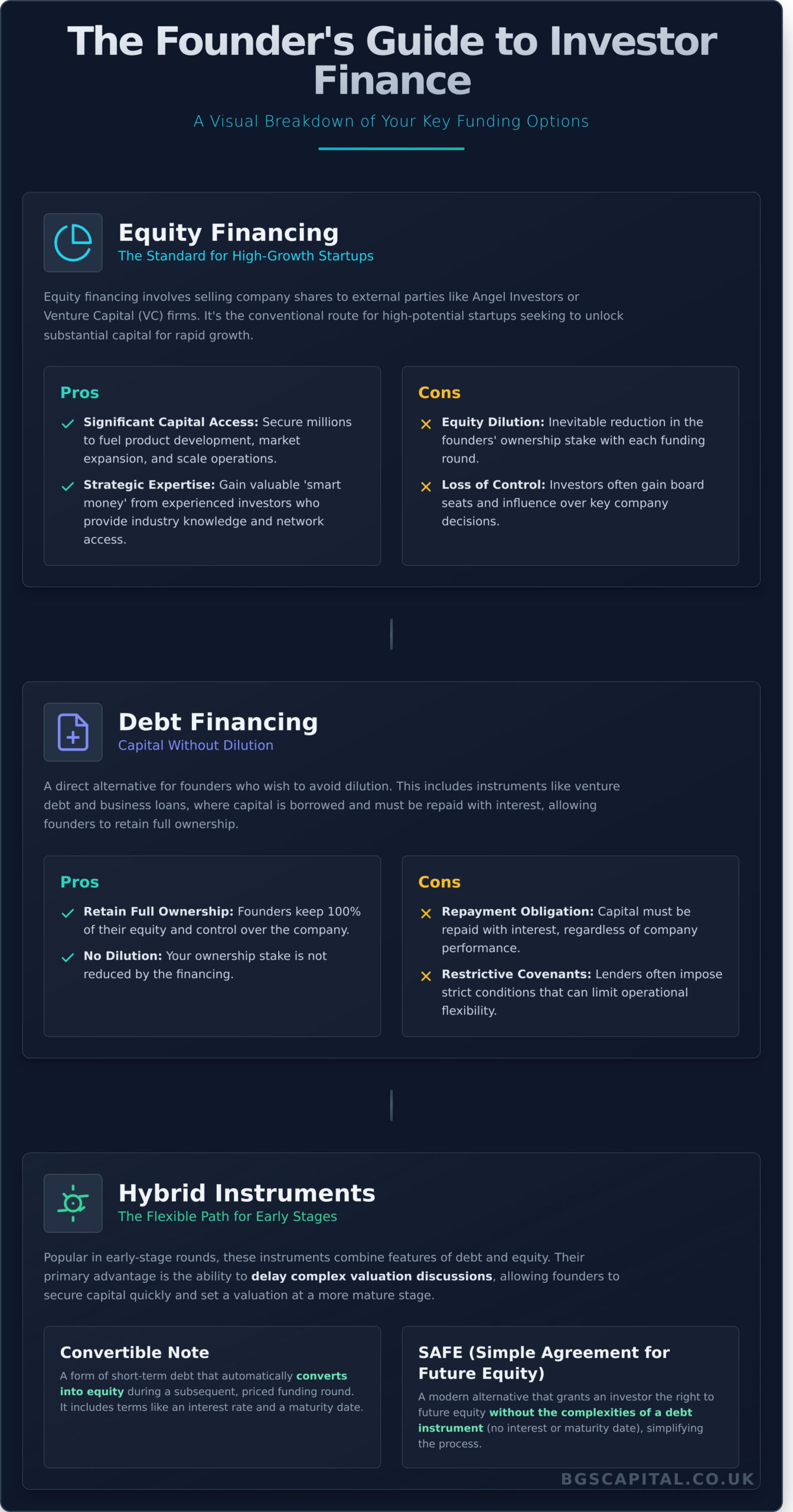
From a business perspective, investor finance is the strategic exchange of company equity or future equity for external capital. The primary objective is to secure the necessary funding to fuel critical growth stages, whether for product development, market expansion, or scaling operations. Selecting the appropriate financing structure is a critical decision, contingent on your company’s stage, growth trajectory, and long-term objectives. The landscape is primarily divided into three distinct categories: equity financing, debt financing, and hybrid instruments.
Equity Financing: The Standard for High-Growth Startups
Equity financing is the conventional route for high-potential startups. The mechanism involves selling company shares to external parties, typically Angel Investors or specialised Venture Capital (VC) firms. For a comprehensive overview of this institutional model, see this guide on Venture Capital Explained. While this approach can unlock substantial capital, it comes with clear trade-offs.
- Pros: Access to significant capital, often in the millions of pounds, and the addition of strategic expertise from experienced investors.
- Cons: Inevitable dilution of the founders’ ownership stake and a degree of lost control over key company decisions.
Debt Financing: Capital Without Dilution
For founders who wish to avoid dilution, debt financing offers a direct alternative. This category includes instruments like venture debt and other forms of secured or unsecured business loans. The core benefit is straightforward: founders retain full ownership and control of their company. However, this path is not without its obligations and risks, as the capital must be repaid with interest, irrespective of company performance. Lenders also frequently impose strict covenants that can restrict operational flexibility.
Hybrid Instruments: Convertible Notes and SAFEs
Popular in early-stage rounds, hybrid instruments combine features of both debt and equity. A Convertible Note is a form of short-term debt that converts into equity during a subsequent, priced funding round. A more modern alternative is the SAFE (Simple Agreement for Future Equity), which grants an investor the right to future equity without the complexities of a debt instrument. The primary advantage of these vehicles is their ability to delay complex valuation discussions, allowing founders to secure capital quickly and set a valuation at a more mature stage.
Preparing for Your Funding Round: An Essential Pre–Launch Checklist
Success in securing investor finance is not a matter of chance; it is a direct result of meticulous preparation. Before engaging with potential investors, a company must assemble a compelling, coherent, and defensible investment case. The objective is to anticipate every question and remove all friction from the due diligence process. This requires a suite of core documents and a well-organised data room, demonstrating operational excellence and strategic foresight from the outset.
Crafting Your Investor Pitch Deck
The pitch deck is your narrative instrument, designed to communicate the investment opportunity concisely. It must be a data-backed story, not a list of features. While content should be tailored to the specific investor (e.g., Venture Capital vs. Angel), the core structure remains consistent. An effective deck typically includes 10-12 slides covering:
- Problem: The market pain point you are solving.
- Solution: Your product or service as the definitive answer.
- Market Size: TAM, SAM, and SOM analysis.
- Business Model: How you generate revenue.
- Team: The expertise driving the company forward.
- Financials: Key projections and historical performance.
- The Ask: The amount of capital sought and its intended use.
Building a Defensible Financial Model
Your financial model is the quantitative backbone of your pitch. It must provide clear, logical projections for revenue, costs, and profitability over a three-to-five-year period. Sophisticated investors will scrutinise the underlying assumptions. Focus on bottom-up forecasting, built from tangible drivers, rather than top-down market-share claims. Key metrics to highlight include Customer Acquisition Cost (CAC), Lifetime Value (LTV), monthly burn rate, and projected cash runway.
Finalising Your Business Plan and Cap Table
While a pitch deck provides the overview, a concise business plan offers the strategic detail. While UK-specific regulations apply, foundational principles of business funding are universal, and various reputable business finance guides offer a structured overview of what’s required to secure capital. Equally critical is an accurate capitalization (cap) table. This document is the definitive ledger of company ownership, tracking all shareholders, option holders, and their respective stakes. It is essential for modelling the dilution effects of a new funding round and demonstrating a clean, professional approach to equity management.
Valuation and Dilution: The Core of Your Investor Finance Deal
In any investor finance structure, valuation and dilution represent the central negotiation. Determining a company’s worth is both an art and a science, blending quantitative analysis with qualitative judgments on market potential, team strength, and competitive positioning. The outcome of this negotiation directly dictates the equity stake an investor receives. The relationship is defined by three key terms: pre-money valuation (the company’s value before investment), the new investment amount, and the post-money valuation (pre-money value plus the new investment).
The calculation for investor equity is direct:
(Investment Amount / Post-Money Valuation) = Investor’s Equity Stake
Valuation methodologies differ based on the company’s stage. Pre-revenue startups often use the Berkus Method, assigning monetary value to qualitative milestones like a sound idea, a working prototype, and a quality management team. Early-stage firms may use the Scorecard Valuation Method, benchmarking against comparable deals in the market. For established companies with predictable revenue, a Discounted Cash Flow (DCF) analysis, which projects future earnings and discounts them to a present value, becomes more applicable.
Understanding the distinction between pre-money and post-money valuation is critical for founders. For example, if a company has a pre-money valuation of £4 million and secures a £1 million investment, its post-money valuation becomes £5 million. The new investor’s equity is calculated on this post-money figure: (£1,000,000 / £5,000,000) = 20%. This calculation is a foundational element in understanding How Startup Funding Rounds Work, as it determines the price per share for the new round and prevents founders from miscalculating their own diluted ownership.
Equity dilution is an unavoidable consequence of raising capital. With each successive funding round, the ownership percentage of founders and earlier investors decreases. Furthermore, the creation or expansion of an employee stock option pool (ESOP) is typically required by new investors and is calculated on a pre-money basis, further diluting existing shareholders. Strategies to mitigate excessive dilution include negotiating for the highest defensible valuation, utilising convertible instruments in early rounds, and focusing on capital efficiency to extend runways and reduce the frequency of future fundraising.
Structuring the Deal: Decoding Key Terms in Finance Agreements
Once an investor expresses serious interest, the next step is negotiating the Term Sheet. This document, while typically non-binding, outlines the fundamental terms and conditions of the investment. Its purpose is to ensure all parties are aligned on the major points of the deal before engaging in the costly and time-consuming process of drafting definitive legal agreements. Founders must scrutinise every clause. We strongly advise engaging legal counsel with specific expertise in UK startup and venture capital transactions before signing any document.
Key Economic Terms in a Term Sheet
The economic terms dictate the financial outcome for all parties. Understanding them is critical for any founder navigating the investor finance process. Key components include:
- Valuation, Investment Amount, and Price Per Share: This establishes the company’s pre-money valuation, the total capital being invested (e.g., £1,000,000), and the resulting price per share for the new investors.
- Liquidation Preference: This clause determines who gets paid first in a liquidity event, such as a sale of the company. A 1x non-participating preference is standard and founder-friendly, meaning investors get their initial investment back before other shareholders, but do not receive additional proceeds.
- Employee Option Pool (ESOP): Investors will require a pool of shares be set aside for future key hires. This is typically 10-15% of the company’s equity and is usually created from the pre-money valuation, diluting existing shareholders.
Key Control and Governance Terms
Beyond the economics, a Term Sheet will define the balance of power and control post-investment. These terms govern how the company is managed and what major decisions require investor approval.
- Board Seats: A lead investor will almost always require a seat on the company’s board of directors, granting them direct influence over strategic direction.
- Protective Provisions: These are veto rights that give investors a say in critical company decisions, such as selling the business, issuing more senior shares, or taking on significant debt.
- Pro-Rata Rights: This gives investors the right, but not the obligation, to participate in future funding rounds to maintain their percentage ownership.
Navigating Due Diligence After the Term Sheet
After the Term Sheet is signed, the investor begins a formal due diligence process to verify all claims made by the company. This is an intensive review of all aspects of the business, commonly focusing on financial records, legal structure and contracts, technical intellectual property, and the backgrounds of the founding team. To streamline this critical phase, prepare a well-organized virtual data room containing all relevant documentation. A smooth due diligence process builds investor confidence and accelerates the timeline to closing.
Ready to connect with qualified investors who understand this process? Feature your business.
Finding the Right Partner: How to Source and Select Investors
Securing investor finance is more than a financial transaction; it is the beginning of a long-term strategic partnership. The right investor brings “smart money” to the table-capital combined with invaluable industry expertise, a powerful network, and strategic guidance that can accelerate growth. Conversely, a misalignment in vision or working style can create significant friction. Therefore, sourcing and selecting the right partner is a critical phase of any capital raise.
Angel Investors vs. Venture Capital Firms
Understanding investor profiles is essential. Angel Investors are typically high-net-worth individuals investing their own capital, often at the seed or pre-seed stage. Their involvement can be hands-on, providing mentorship based on their own entrepreneurial experience, with typical investments ranging from £10,000 to £250,000. In contrast, Venture Capital (VC) Firms manage institutional funds and enter at later stages (Series A and beyond) with significantly larger cheques, often £1 million or more. VCs provide structured support and typically require a board seat, demanding rigorous reporting and a clear path to exit.
Building Your Investor Target List
A targeted approach is more effective than a broad outreach campaign. Your research should focus on identifying investors with a clear mandate that aligns with your company’s stage, sector, and geography. Key actions include:
- Analyse Portfolios: Identify investors who have a track record of success in your industry.
- Review Competitor Funding: Understand which firms are active and knowledgeable in your specific market.
- Prioritise Warm Introductions: Leverage your existing network of advisors, mentors, and industry contacts. A trusted referral is significantly more powerful than a cold email.
Why Use an Introducer Network like BGS Capital?
For many growth-stage companies, navigating the private investment landscape is a resource-intensive challenge. An introducer network streamlines the process of finding the right investor finance. By engaging with a platform like BGS Capital, you gain direct access to a pre-vetted network of sophisticated and high-net-worth investors. This saves valuable time by connecting you with principals who are actively seeking opportunities in the pre-IPO and growth equity space, ensuring your proposition reaches a qualified and engaged audience from the outset.
Secure Your Next Round: Finalising Your Investor Finance Strategy
Successfully navigating the complex landscape of investor finance hinges on meticulous preparation and a clear understanding of core mechanics. As this guide has detailed, a robust pre-launch checklist is non-negotiable, a firm grasp of valuation and key deal terms protects your equity, and a strategic approach to sourcing the right partners determines long-term success. Mastering these elements transforms fundraising from a challenge into a strategic advantage for your business.
With your strategy and documentation in place, the critical next step is gaining access to a network of qualified capital. Presenting your opportunity to the right audience is essential for accelerating your growth and achieving your funding objectives efficiently.
BGS Capital facilitates this connection. We provide direct introductions to our exclusive network of sophisticated and high-net-worth individuals, along with access to investor relations teams. As specialists in pre-IPO and IPO opportunities, we ensure your business is seen by those ready to invest. Ready to connect with qualified investors? Feature your business on BGS Capital.
The right capital and the right partners are waiting. Position your company for success today.
Frequently Asked Questions About Investor Finance
How much equity should a founder give away in a seed funding round?
In the UK market, founders typically dilute between 15% and 25% of their equity in a seed funding round. This figure is contingent on the company’s pre-money valuation and the total capital sought. For instance, raising £500,000 on a £2 million pre-money valuation results in a 20% dilution. The primary objective is to secure sufficient capital to reach key milestones without conceding excessive equity, thereby preserving ownership for future, larger funding rounds.
What is the difference between a lead investor and other investors in a syndicate?
A lead investor is the principal capital provider who negotiates the investment terms, conducts extensive due diligence, and often takes a board seat. Their commitment provides a critical signal of confidence to the market. Other investors in the syndicate, known as ‘followers’, typically invest smaller amounts on the same terms established by the lead. They rely on the lead investor’s due diligence and do not actively participate in term sheet negotiation.
How long does the investor finance process typically take from first pitch to cash in the bank?
The investor finance process is comprehensive and typically spans three to six months from the initial pitch to the transfer of funds. This timeline encompasses initial meetings, a thorough due diligence period, term sheet negotiation, and the drafting of final legal documentation. Founders must factor this extended timeline into their financial planning to ensure the business remains adequately capitalised throughout the fundraising process, as delays in any stage are common.
What are the most common mistakes founders make when raising capital?
Common mistakes include inadequate preparation, such as an incomplete data room or weak financial projections, and targeting the wrong investors-those who do not invest in the company’s sector or stage. Founders also frequently underestimate the significant time commitment required, distracting them from core business operations. Finally, failing to secure a strong lead investor can make it difficult to close the remainder of the round, creating negative momentum that can jeopardise the entire raise.
Is my business too early-stage to seek investor finance?
Investor finance becomes viable once a business demonstrates clear validation. This does not strictly require revenue; it can be a minimum viable product (MVP) with early user engagement, letters of intent from potential customers, or defensible intellectual property. Pre-seed or seed investors expect to see evidence of a substantial market opportunity and a credible founding team capable of executing the business plan. Without these foundational elements, a company is likely to be considered too early-stage for institutional capital.
What legal documents are required to close a funding round?
Closing a funding round in the UK requires several key legal documents. The most critical are the Term Sheet, which outlines the principal terms, and the Subscription and Shareholders’ Agreement (SSA), which is the definitive binding contract. Additionally, the company’s Articles of Association must be amended and filed at Companies House to reflect the new share structure. A Disclosure Letter, in which founders provide warranties about the state of the business, is also standard practice.