
For sophisticated UK investors, the Enterprise Investment Scheme (EIS) presents one of the most powerful tools for tax-efficient portfolio growth. Yet, its potential is often obscured by a complex regulatory framework. The intricate rules governing investor and company eligibility, coupled with the inherent risks of early-stage ventures, can deter even seasoned individuals. This leads to missed opportunities and uncertainty when navigating the distinctions between EIS, SEIS, and VCTs.
This definitive guide eliminates that ambiguity. Here, we provide a complete breakdown of the EIS, detailing the substantial tax reliefs you can claim-from 30% income tax relief on investments up to £1 million per year to full capital gains tax exemption on disposal. We will equip you with the precise criteria needed to assess qualifying companies and confirm your own eligibility. By the end, you will understand how to leverage the scheme to support high-growth UK businesses and discover how to access a pipeline of pre-vetted EIS opportunities.
Key Takeaways
- Understand the substantial tax reliefs available through the Enterprise Investment Scheme, designed to mitigate the risks of investing in high-growth UK companies.
- Identify the strict HMRC eligibility criteria for both investors and companies to ensure you can secure tax relief and conduct effective due diligence.
- Discover the primary channels for sourcing and evaluating qualifying eis investment opportunities, from direct company approaches to specialised platforms.
- Evaluate the key distinctions between EIS, SEIS, and VCTs to determine the most suitable structure for your personal investment objectives and risk tolerance.
What is the Enterprise Investment Scheme (EIS)?
The Enterprise Investment Scheme (EIS) is a UK government initiative designed to stimulate investment into smaller, unlisted companies that carry a higher degree of risk. It serves a dual purpose: providing a critical source of finance for early-stage businesses to scale, while simultaneously offering substantial tax reliefs to investors to compensate for the inherent risks involved. This structure makes the scheme a key strategic tool for experienced investors seeking to diversify their portfolios with high-growth-potential assets.
Unlike standard equity investments, where returns are solely dependent on capital appreciation and dividends, an EIS investment provides a suite of tax incentives from the outset. These benefits, which include income tax relief and capital gains tax exemption, fundamentally alter the risk-reward profile, making it a distinct asset class within a sophisticated investment strategy.
The Core Purpose of the Scheme
The primary objective of the EIS is to foster economic growth by bridging a critical funding gap. Many innovative, early-stage companies are considered too high-risk for traditional lenders or later-stage venture capital. The scheme incentivises private investors to fill this void by providing generous tax reliefs, effectively encouraging capital flow into the sectors of the economy with the highest potential for job creation and innovation. It directly rewards investors for deploying capital into riskier, yet vital, enterprise.
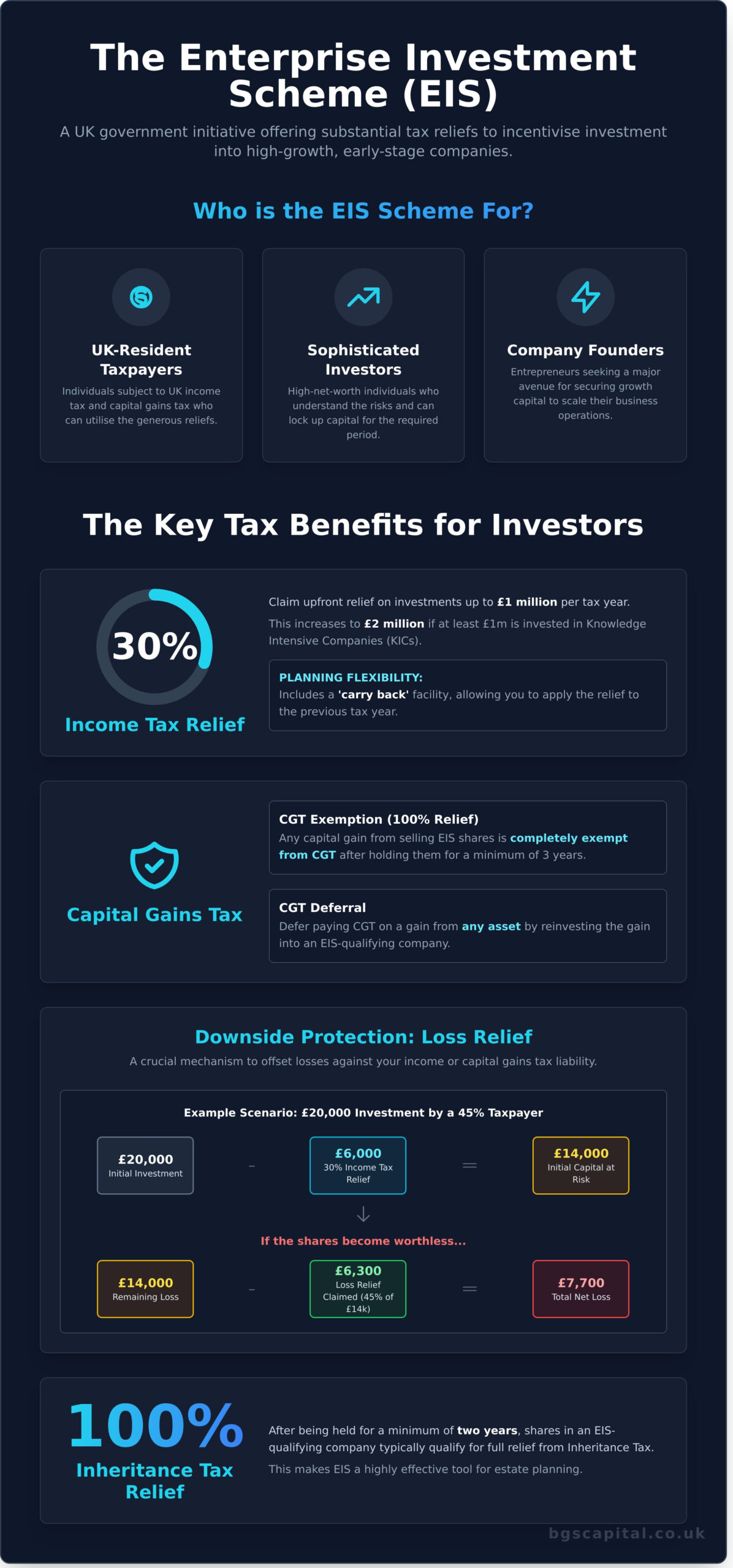
Who is the EIS Scheme For?
The scheme is specifically structured for certain participants in the investment ecosystem:
- UK-Resident Taxpayers: The tax reliefs are designed to be offset against UK tax liabilities, making it most suitable for individuals who are subject to UK income tax and capital gains tax.
- Sophisticated & High-Net-Worth Investors: Given the high-risk nature of the underlying companies, EIS is appropriate for experienced investors who understand the potential for capital loss and can afford to lock up capital for the required holding period.
- Company Founders: For entrepreneurs, understanding the mechanics of the scheme is essential. It represents a major avenue for securing the growth capital needed to scale their business operations.
The Key Tax Benefits of EIS for Investors
The Enterprise Investment Scheme (EIS) is structured by the UK government to incentivise investment into high-growth, early-stage companies. The primary driver for investor participation is the comprehensive suite of tax reliefs designed to significantly mitigate the inherent risks of venture capital. Understanding these powerful incentives is fundamental for any sophisticated investor considering this asset class. The significant tax benefits of EIS make it one of the most generous tax-efficient investment schemes available.
Income Tax Relief
Investors can claim upfront income tax relief of 30% on the value of their investment. This is available on investments up to £1 million per tax year, which can be increased to £2 million provided at least £1 million is invested in Knowledge Intensive Companies (KICs). Furthermore, the scheme includes a ‘carry back’ facility, allowing investors to apply the relief to the tax year prior to the one in which the investment was made, offering valuable planning flexibility.
Capital Gains Tax (CGT) Exemption and Deferral
The EIS offers two distinct Capital Gains Tax benefits:
- CGT Exemption: Any capital gain realised from the sale of EIS shares is completely exempt from CGT, provided the shares have been held for a minimum of three years and the company maintains its qualifying status.
- CGT Deferral: An investor can defer payment of CGT on a gain from the disposal of any asset by reinvesting that gain into an EIS-qualifying company. The deferred tax becomes payable only when the EIS shares are sold.
Loss Relief
This is a crucial downside protection mechanism. Should an EIS investment result in a loss, the investor can offset this loss against their income tax or capital gains tax liability. For a higher-rate (45%) taxpayer who invests £20,000, their initial at-risk capital is reduced to £14,000 after claiming £6,000 in income tax relief. If the shares become worthless, they can claim loss relief on the remaining £14,000, potentially recovering a further £6,300 (£14,000 x 45%). This reduces the total net loss to just £7,700 on the original £20,000 investment.
Inheritance Tax (IHT) Relief
For estate planning purposes, shares in an EIS-qualifying company can be highly effective. After being held for a minimum of two years, the shares typically qualify for 100% relief from Inheritance Tax, as they are eligible for Business Property Relief (BPR). This allows the full value of the investment to be passed on to beneficiaries free from IHT.
EIS Rules and Eligibility Criteria for Investors
Securing and retaining tax relief through the Enterprise Investment Scheme requires strict adherence to a comprehensive set of HMRC regulations. For investors, these rules function as an essential checklist that must be satisfied from the point of investment through to the eventual exit. Failure to comply with any single criterion can result in the full withdrawal of tax relief, making a thorough understanding of your obligations paramount.
Investment Limits and Holding Period
An individual can invest up to £1 million per tax year into EIS-qualifying companies (£2 million if at least £1 million is invested in knowledge-intensive companies). To retain the associated income tax relief, the shares must be held for a minimum of three years from the date of issue. Should the shares be sold or disposed of within this mandatory holding period, any upfront income tax relief claimed will be clawed back by HMRC. This three-year rule is a cornerstone of the eis scheme, designed to encourage long-term investment in early-stage businesses.
The ‘No Connection’ to the Company Rule
To qualify for tax relief, an investor must not be ‘connected’ to the company. This rule is in place to ensure the scheme benefits genuine external investors, not existing owners or employees. HMRC defines a connection in two primary ways:
- Employment Connection: You cannot be an employee, partner, or paid director of the company. There are some exceptions for business angels who become directors after the investment is made.
- Financial Connection (Substantial Interest): You cannot control more than 30% of the company’s ordinary share capital, voting rights, or rights to its assets. This restriction applies for a period beginning two years before the share issue and ending three years after.
How to Claim EIS Tax Relief
Tax relief is not granted automatically. The process is initiated by the investee company, which must first demonstrate to HMRC that it is compliant with all scheme rules. Once approved, the company will issue each investor a unique compliance certificate, known as form EIS3 (or EIS5 for investments made via an approved fund).
This certificate contains the necessary details to make your claim. You must use the information on your EIS3 form to claim tax relief through your annual Self-Assessment tax return. The certificate is typically issued after the company has been trading for at least four months and has spent the majority of the funds raised.
Understanding EIS-Qualifying Companies
For both investors conducting due diligence and founders seeking to raise capital, understanding the strict eligibility criteria for an EIS-qualifying company is fundamental. These rules are set by HMRC to ensure the scheme supports genuine, growth-oriented UK businesses. Before fundraising, companies should apply to HMRC for Advance Assurance, which provides a provisional indication that the company and the share issue will meet the scheme’s requirements.
Qualifying Trades and Company Status
A company must be engaged in a ‘qualifying trade’. HMRC explicitly excludes certain activities deemed lower-risk or not aligned with the scheme’s growth objectives. These excluded trades include banking, insurance, legal services, property development, and energy generation. Furthermore, the company must have a permanent establishment in the UK and must not be listed on a recognised stock exchange at the time of the share issue, nor have any plans to do so.
Company Age, Size, and Funding Limits
Specific thresholds for company size and funding history must also be met. These are designed to direct investment towards smaller, early-stage enterprises. The key criteria include:
- Gross Assets Test: The company must have gross assets of no more than £15 million before the investment and no more than £16 million immediately after.
- Employee Limit: It must have fewer than 250 full-time equivalent employees at the time the shares are issued.
- Age Limit: The company must receive its first investment through the eis or another venture capital scheme within 7 years of its first commercial sale.
- Funding Limit: A company can raise a maximum of £12 million in its lifetime from all state aid venture capital schemes, including SEIS, EIS, and VCTs.
The ‘Risk to Capital’ Condition
A critical component of eligibility is the ‘Risk to Capital’ condition. This principle, enforced by HMRC, ensures that the scheme is not used for capital preservation or low-risk investment strategies. The company must use the funds for genuine growth and development, and the investment structure must not provide a preferential return or substantially mitigate risk for the investor. The investment must represent a real risk to the investor’s capital, aligning the scheme with its core purpose of fostering high-growth potential businesses.
How to Find and Make an EIS Investment
Understanding the mechanics of the Enterprise Investment Scheme is the first step. The next is identifying and accessing qualified investment opportunities. For sophisticated investors, several established channels exist to find promising, high-growth UK companies seeking capital. This section moves from theory to the practical steps required to build a portfolio of EIS-qualifying assets.
Sources for EIS Investment Opportunities
Investors can source eis opportunities through various channels, each with distinct characteristics:
- Angel Investor Networks & Syndicates: These groups connect high-net-worth individuals directly with founders. They often provide a collaborative environment for deal sourcing and due diligence.
- Equity Crowdfunding Platforms: Certain platforms specialise in listing early-stage businesses, many of which have secured Advance Assurance from HMRC, confirming their eligibility.
- Specialist EIS Funds: For investors seeking diversification and professional management, these funds build a portfolio of multiple EIS-qualifying companies, managed by a dedicated fund manager.
Using an Introducer Platform
An alternative model is the introducer platform, which connects qualified investors directly with pre-vetted companies. Unlike a fund, this model gives you direct control over your investment decisions. Platforms like BGS Capital provide access to a curated pipeline of opportunities without offering advice or managing the investment on your behalf. This direct approach can offer greater transparency and control for experienced investors.
Find exclusive pre-IPO and growth opportunities.
Conducting Your Own Due Diligence
It is critical to remember that EIS qualification is a tax status, not an endorsement of a company’s commercial viability. The generous tax reliefs are designed to offset the high risk associated with early-stage investing. Before committing capital, investors must conduct their own thorough due diligence. This involves a rigorous review of the business plan, financial projections, competitive landscape, and the experience of the management team. Always remember that with any EIS investment, your capital is at risk.
EIS vs. SEIS vs. VCTs: A Comparative Overview
For sophisticated investors navigating the UK’s venture capital landscape, understanding the distinctions between the Enterprise Investment Scheme (EIS), the Seed Enterprise Investment Scheme (SEIS), and Venture Capital Trusts (VCTs) is critical. While all three offer significant tax incentives, they cater to different stages of business growth, investment amounts, and investor risk profiles. This overview provides a direct comparison to inform strategic allocation.
EIS vs. Seed Enterprise Investment Scheme (SEIS)
SEIS is designed for investment in very early-stage, ‘seed’ level companies. It offers a higher rate of income tax relief-50% on investments up to £200,000 per tax year-to compensate for the elevated risk associated with nascent businesses. In contrast, EIS targets more established, yet still high-growth, small companies. The income tax relief for EIS is 30% on a larger maximum annual investment of £1 million. It is standard for a qualifying startup to first raise capital under SEIS before progressing to subsequent, larger funding rounds using its eis allowance.
EIS vs. Venture Capital Trusts (VCTs)
The primary distinction lies in the investment structure. An EIS investment is a direct holding in the shares of a single qualifying company, offering investors a concentrated position. A VCT, however, is an investment company listed on the London Stock Exchange that holds a diversified portfolio of qualifying assets. This structure inherently provides risk diversification. While both offer 30% upfront income tax relief, VCTs also provide the significant benefit of tax-free dividends, a feature not available through EIS. The choice depends on an investor’s preference for direct involvement versus a managed, diversified fund approach.
The following table summarises the core differences:
| Feature | SEIS | EIS | VCT |
|---|---|---|---|
| Investment Type | Direct investment in a single company | Direct investment in a single company | Investment in a diversified fund |
| Max. Annual Investment | £200,000 | £1,000,000 (£2,000,000 for KICs) | £200,000 |
| Income Tax Relief | 50% | 30% | 30% |
| Capital Gains on Disposal | 100% exempt after 3 years | 100% exempt after 3 years | 100% exempt |
| Key Differentiator | Highest tax relief for earliest stage | Higher investment limits; CGT deferral | Diversified portfolio; tax-free dividends |
Ultimately, the selection between these schemes must align with an investor’s individual financial objectives, capacity for loss, and desired level of portfolio diversification. Each represents a distinct asset class within the UK’s tax-efficient investment framework. To explore qualifying opportunities, review the investment criteria available at bgscapital.co.uk.
Harnessing the Power of the Enterprise Investment Scheme
The Enterprise Investment Scheme is a cornerstone of the UK’s venture capital landscape, offering a compelling structure for sophisticated investors. As we’ve explored, the primary advantages lie in its significant tax reliefs, which are designed to mitigate the inherent risks of investing in early-stage businesses. A successful strategy requires a firm grasp of the eligibility criteria for both the investor and the company, ensuring every investment fully qualifies under the eis framework.
While understanding the mechanics is crucial, the ultimate challenge is sourcing high-quality, vetted investment opportunities. This is where a professional network provides a distinct advantage. BGS Capital offers a direct conduit to curated pre-IPO and growth-stage companies seeking capital. Our platform provides direct access to investor relations teams and connects you with a trusted network of sophisticated investors and wealth managers, streamlining your due diligence process. Connect with vetted, high-growth companies seeking investment.
Take the next step in strategically enhancing your portfolio and fuelling the growth of UK enterprise.
Frequently Asked Questions
What happens if a company I invest in loses its EIS status?
If an EIS-qualifying company loses its status within the three-year holding period, any upfront Income Tax relief you claimed will be withdrawn by HMRC. This process is often referred to as a ‘clawback’. Furthermore, you would lose the Capital Gains Tax (CGT) exemption on any future gains when you dispose of the shares. The timing of the disqualifying event is critical in determining the impact on your tax reliefs, making company compliance a key risk factor for investors.
How do I receive my EIS3 certificate and how long does it take?
The investee company is responsible for applying to HMRC for EIS3 certificates. This can only be done after the company has been trading for at least four months or has spent 70% of the capital raised. Once HMRC approves the application, it issues the certificates to the company, which then distributes them to its investors. This entire process can take several months, and it is not uncommon for investors to wait 6-12 months post-investment to receive their form.
Can I invest in an EIS-qualifying company through my SIPP or SSAS?
No. Investments into EIS-qualifying companies must be made directly by an individual to be eligible for the associated personal tax reliefs. Pension schemes such as a Self-Invested Personal Pension (SIPP) are already tax-advantaged wrappers. Using a SIPP for an EIS investment is not permitted and would negate the scheme’s core benefits, such as Income Tax relief and CGT exemption, which are designed to apply to an individual’s personal tax liability.
Is it possible to claim EIS relief if I am not a UK resident?
To claim EIS Income Tax relief, an individual must have a UK Income Tax liability for the tax year in which the investment is made. Therefore, a non-UK resident may be eligible if they have UK-source income that is subject to UK tax. Eligibility for other reliefs, such as the CGT exemption upon disposal, can be more complex and will depend on your specific tax residency status at the time of the sale. Professional tax advice is strongly recommended.
What are the risks associated with EIS investments beyond potential capital loss?
Beyond the high risk of capital loss inherent in early-stage ventures, investors face several other significant risks. EIS investments are highly illiquid, with no secondary market for a timely exit. There is also legislative risk, where changes to government policy could adversely affect the tax reliefs available. Furthermore, there is a compliance risk that the company may fail to maintain its qualifying EIS status, leading to a withdrawal of tax benefits for its investors.
Can I be a director of a company I invest in under EIS?
Yes, but strict rules apply regarding your connection to the company. You cannot be a paid director at the time the shares are issued. However, under the ‘business angel’ provision, you can become a paid director after the investment has been made. You can also be an unpaid director. The rules are designed to prevent individuals from gaining tax relief for investing in companies they already control or are employed by, so careful adherence to HMRC guidelines is essential.
Are EIS investments illiquid?
Yes, investments made under the EIS are fundamentally illiquid. The shares are in unlisted private companies, and there is no established secondary market for selling them. Investors must be prepared to hold their shares for a minimum of three years to retain the tax reliefs. However, a realistic exit horizon is often significantly longer, typically between 5 and 10 years, and is usually dependent on a liquidity event such as a trade sale, acquisition, or an Initial Public Offering (IPO).