
For a founder, securing capital is a critical stage gate to growth. Yet, the digital landscape for fundraising can be fragmented and opaque, leading to wasted resources and missed opportunities. Understanding how to look for investors effectively requires a definitive map of credible, UK-based platforms. The challenge is not simply finding a source of funding, but identifying the correct one for your business stage-whether you require angel investment, venture capital, or access to pre-IPO capital.
This guide provides that strategic overview. We have curated the UK’s leading online platforms for connecting qualified companies with sophisticated investors. You will gain a clear understanding of each platform’s focus, fee structure, and ideal user profile. Furthermore, we provide an essential checklist to ensure your business is prepared to engage, giving you the confidence to navigate the online fundraising landscape with precision and efficiency.
Key Takeaways
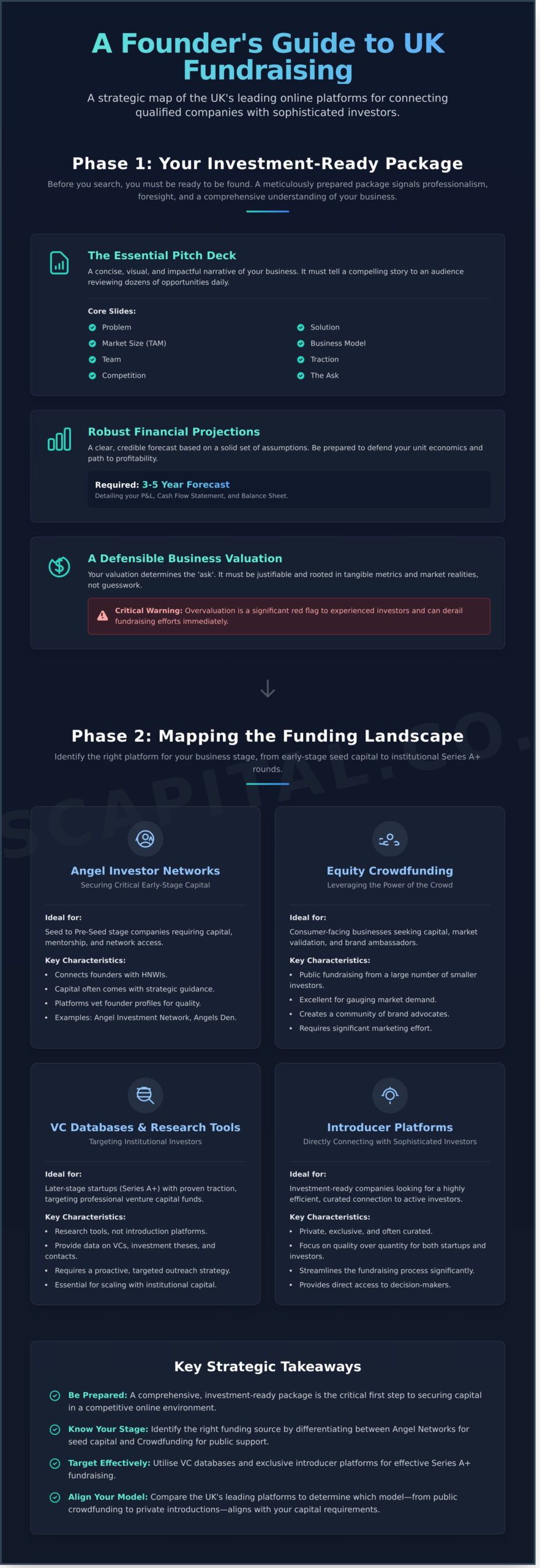
- Understand why a comprehensive, investment-ready package is the critical first step to securing capital in a competitive online environment.
- Identify the right funding source for your stage by differentiating between Angel Investor Networks for seed capital and Equity Crowdfunding for public support.
- Discover effective strategies on how to look for investors for Series A+ rounds by utilising VC databases and exclusive introducer platforms.
- Compare the UK’s leading platforms to determine which model-from public crowdfunding to private introductions-aligns with your company’s capital requirements.
Before You Search: Building Your Investment-Ready Package
Before you begin your search for capital, understand that effective preparation is the most critical phase of the fundraising process. In the competitive digital landscape, your documentation is your first, and often only, impression. A meticulously prepared investment package signals professionalism, foresight, and a comprehensive understanding of your own business. Mastering how to look for investors is less about the search itself and more about ensuring you are ready to be found. These assets will form the foundation of your profile on any online platform and are non-negotiable for securing serious consideration.
The Essential Pitch Deck
Your pitch deck is the narrative of your business, designed to be concise, visual, and impactful for an online audience that reviews dozens of opportunities daily. It must tell a compelling story. Whether you are presenting to a venture capital fund or a high-net-worth Angel Investor, this document must be flawless. Ensure it includes these core slides:
- Problem: The market pain point you are addressing.
- Solution: Your unique product or service.
- Market Size: Demonstrable total addressable market (TAM).
- Business Model: How you generate revenue.
- Team: The expertise and track record of your key personnel.
- Traction: Key metrics, milestones achieved, and user growth.
- Competition: Your competitive landscape and unique advantage.
- The Ask: The amount of capital you are raising.
Robust Financial Projections
Investors require a clear and credible financial forecast. This is not guesswork; it is a strategic projection based on a solid set of assumptions. Your package must include a 3-5 year forecast detailing your profit and loss (P&L) statement, cash flow statement, and balance sheet. Be prepared to defend your key assumptions, demonstrate a firm grasp of your unit economics, and clearly articulate your path to profitability.
A Defensible Business Valuation
Your valuation determines the ‘ask’-how much capital you are raising in exchange for a specific percentage of equity. While methods vary (e.g., Discounted Cash Flow, market comparables), your valuation must be justifiable and rooted in tangible metrics and market realities. A common mistake that derails fundraising efforts is overvaluation. Experienced investors will view an inflated valuation as a significant red flag, indicating a founder’s disconnect from the market.
Angel Investor Networks: Securing Critical Early-Stage Capital
For founders learning how to look for investors, angel networks provide a structured and efficient gateway to early-stage capital. Angel investors are typically high-net-worth individuals (HNWIs) who invest their personal funds into startups in exchange for equity. Beyond capital, they often provide invaluable mentorship, strategic guidance, and access to their professional networks. Dedicated online platforms have streamlined this process, creating a digital marketplace where vetted founders can connect with active investors, significantly accelerating the fundraising timeline.
Angel investment is a critical component of the early-stage funding landscape. High-authority resources like the U.S. Small Business Administration provide a foundational overview of how to fund your business, outlining the distinct roles that different capital sources play in a company’s growth trajectory.
What to Expect from Angel Networks
The process on most angel networks is straightforward. Founders create a detailed company profile, which is then vetted by the platform to ensure it meets specific criteria for quality and readiness. Once approved, the profile becomes visible to a database of registered investors. A strong, concise profile is paramount; it must clearly articulate the problem, solution, market size, and team. Many platforms also facilitate syndicates, where multiple angels pool their capital to invest in a single round, allowing for larger investment sums and diversified risk for the investors.
Leading UK Angel Investment Platforms
The UK has a mature angel investment ecosystem supported by several key platforms. Understanding their focus is a key part of knowing how to look for investors effectively.
- Angel Investment Network (AIN): As one of the world’s largest angel networks, AIN has a substantial presence in the UK. It offers a broad platform connecting entrepreneurs with a diverse pool of investors across nearly every industry sector.
- Angels Den: This platform combines online listings with curated pitch events (both virtual and in-person). They are known for their strong focus on syndication, often co-investing alongside their network of angels.
- Niche and Regional Groups: Founders should also investigate sector-specific or regional groups such as London Business Angels (LBA) or Cambridge Angels, which offer deep industry expertise and local connections.
Best Practices for Your Angel Network Profile
To maximise visibility and attract serious interest, your profile must be professional and compelling. Key elements include:
- A Sharp Executive Summary: This is your first impression. It must be data-driven, concise, and immediately convey the investment opportunity.
- A High-Quality Video Pitch: If the platform allows, a professional 2-3 minute video can significantly increase engagement and better communicate your vision and passion.
- Proactive Engagement: Do not simply post your profile and wait. Actively engage with investors who view your pitch, respond to enquiries promptly, and utilise the platform’s communication tools to build relationships.
Equity Crowdfunding Platforms: Leveraging the Power of the Crowd
Equity crowdfunding presents a modern, public-facing alternative for businesses looking to raise capital. This model involves securing small investments from a large number of individuals online, typically in exchange for equity. Unlike the private introductions characteristic of angel investing, crowdfunding is a transparent campaign directed at the public. This provides a dual benefit: not only does it generate capital, but it also builds a community of brand advocates and early adopters. For UK-based companies, demonstrating eligibility for the Seed Enterprise Investment Scheme (SEIS) or Enterprise Investment Scheme (EIS) is critical, as it provides significant tax incentives for investors.
How the Crowdfunding Model Works
The process is structured around a public fundraising campaign. A company sets a specific funding target, a pre-money valuation, and a fixed timeframe (e.g., 30-60 days) to reach its goal. Most platforms operate on an ‘all-or-nothing’ basis; if the target is not met, no funds are collected. A key element for success is often securing a lead investor before the public launch. This cornerstone investment validates the opportunity for the wider public and provides critical momentum for the campaign.
Top UK Equity Crowdfunding Platforms
The UK market is dominated by two primary platforms, each with distinct features:
- Crowdcube: As one of the largest and most established platforms, Crowdcube has facilitated raises for numerous high-profile companies. It offers a direct investment model where individuals become direct shareholders.
- Seedrs: Known for its nominee structure, Seedrs holds the shares on behalf of all individual investors. This simplifies a company’s capitalization table, which is advantageous for future funding rounds. Seedrs also operates a secondary market, offering a degree of liquidity.
Both platforms have rigorous vetting processes and distinct fee structures for the companies that raise capital through them.
Is Crowdfunding Right for Your Business?
Determining if this public route aligns with your strategy is a critical step in understanding how to look for investors. While it offers a powerful way to raise funds, it is not suitable for every business. A comprehensive guide to finding investors will always weigh the distinct advantages and disadvantages of each funding method.
Key Considerations:
- Pros: Provides immediate market validation, generates significant brand exposure, and grants access to a very wide and diverse investor base.
- Cons: Requires public disclosure of sensitive financial information, involves a high-pressure and resource-intensive campaign, and carries the risk of public failure if the target is missed.
This model is particularly effective for business-to-consumer (B2C) companies with a strong brand story and a product that resonates with a retail audience.
VC Databases & Research Tools: Targeting Institutional Investors
As a business matures beyond seed funding and demonstrates significant market traction, the focus shifts from angel investors to institutional capital. Venture Capital (VC) firms are professional entities that manage pooled capital from limited partners (LPs) to invest in high-growth, scalable companies, typically from Series A onwards. Securing VC funding requires a robust business model, a clear path to a large market, and compelling metrics. A scattergun approach will fail; a targeted, research-driven strategy is mandatory.
Leveraging Data to Find the Right VC
The first step in any effective outreach is rigorous due diligence. Platforms such as Crunchbase and PitchBook are indispensable tools for this process. They allow founders to systematically filter and identify potential VC partners based on critical criteria:
- Investment Stage: Target firms that actively invest in your current round (e.g., Series A, Series B).
- Sector Focus: Identify VCs with a stated investment thesis and portfolio experience in your industry, be it UK FinTech, SaaS, or Deep Tech.
- Geography: Focus on firms with a mandate to invest in your region.
Critically, you must analyse a VC’s existing portfolio. This confirms alignment and, more importantly, helps you avoid approaching a firm that has already invested in a direct competitor.
The Critical Importance of a Warm Introduction
Cold outreach to VC partners has an exceptionally low success rate. Top-tier firms receive hundreds of unsolicited pitches weekly, and most are never reviewed by a decision-maker. The most effective method for how to look for investors at the institutional level is through a warm introduction. Use your network and platforms like LinkedIn to identify a mutual connection-a portfolio company founder, an advisor, or another investor-who can make an introduction. A referral from a trusted source validates your proposition and bypasses the initial screening process, placing your company directly on a partner’s radar.
Building Your Target VC List
Systematic organisation is key to managing the fundraising process. Create a spreadsheet to track target firms, specific partners within those firms, and potential pathways for a warm introduction. Instead of building a list of hundreds, prioritise a highly-vetted list of 20-30 VCs where there is a clear and defensible strategic fit. For each firm on your list, personalise your approach. Reference their portfolio companies, mention a partner’s recent article or public statement, and articulate precisely why your business aligns with their investment thesis. This demonstrates professionalism and preparation.
Introducer Platforms: Connecting Directly with Sophisticated Investors
For established businesses seeking significant capital, the challenge of how to look for investors shifts from broad outreach to targeted engagement. This is where introducer platforms excel. Unlike open crowdfunding sites or sprawling angel networks, an introducer model operates as a curated, private network. The core principle is quality over quantity, connecting growth-stage companies directly with pre-vetted, serious capital partners.
This approach bypasses the noise and inefficiency of public fundraising, creating a professional environment for high-stakes investment conversations. It is specifically designed for later-stage companies, including those preparing for an IPO, that require access to a more sophisticated class of investor.
The Role of a Professional Introducer
A professional introducer is a facilitator, not a broker or financial advisor. Their function is to make a formal introduction between a company seeking capital and a relevant investor within their network. This creates a direct line of communication with decision-makers, streamlining the entire process. The focus is on efficiency and ensuring a precise match between the company’s needs and the investor’s mandate, saving valuable time for all parties.
Why Choose a Curated Network like BGS Capital?
Engaging with a specialist introducer network provides distinct advantages for companies that are serious about securing growth capital. The primary benefit is gaining direct access to a qualified, private network that is otherwise difficult to reach. This includes:
- High-Net-Worth and Sophisticated Investors actively seeking new opportunities.
- Accredited Investment Firms and professional wealth managers.
- Family Offices and Venture Capital firms with specific investment criteria.
By leveraging a curated platform, you position your company in front of engaged capital partners who have been vetted for their credibility and investment capacity. If your business is ready for this level of engagement, you can feature your business to connect with qualified investors.
Who is this Model For?
The introducer model is the definitive answer for founders who have moved beyond early-stage fundraising and need a more strategic method for how to look for investors. This approach is ideal for:
- Businesses seeking substantial growth capital, pre-IPO funding, or secondary placings.
- Companies with a proven track record, clear revenue streams, and a defined growth trajectory.
- Founders and management teams who want to engage in direct, professional dialogue with potential capital partners without the filter of multiple intermediaries.
Transitioning from Search to Secured Investment
Navigating the digital landscape for funding is a critical phase for any founder. Your success depends on two core pillars: meticulous preparation of your investment-ready package and the strategic selection of the right channel, from broad equity crowdfunding sites to targeted VC databases. Understanding how to look for investors is ultimately about matching your company’s stage and ambition to the appropriate capital source.
For high-growth companies targeting significant milestones, a more direct approach is often more effective than broad-based platforms. An introducer service bypasses the noise, facilitating direct connections to qualified capital. BGS Capital specialises in these introductions, connecting vetted businesses with our established network of High-Net-Worth Individuals and wealth managers, with a distinct focus on pre-IPO and IPO opportunities.
RAISING CAPITAL? Feature your business to connect with our network of sophisticated investors.
By leveraging the right network, you can accelerate your fundraising process and secure the strategic capital required for your next phase of growth. The right partnership is within reach.
Frequently Asked Questions
What is the typical timeframe for raising a round of funding online?
The timeframe for raising capital online varies significantly based on the funding stage and market conditions. A pre-seed or seed round typically takes between three to six months from initial outreach to closing. For Series A and later stages, the process is more intensive, often extending to six to nine months or more. While online platforms can expedite initial contact, the due diligence, negotiation, and legal finalisation stages remain comprehensive and time-consuming processes for all parties involved.
How much equity should a startup give away in its first funding round?
In the UK market, startups typically dilute between 10% and 25% of their equity in a first (seed) funding round. The precise figure is a function of the company’s pre-money valuation, the total capital being raised, and the strategic input offered by the investors. Founders must carefully balance securing sufficient funding for growth against the risk of excessive early-stage dilution, which can impact future fundraising capabilities and founder control. This is a critical strategic decision.
What are the most common red flags for online investors?
When you learn how to look for investors, it is critical to avoid common red flags. These include unrealistic valuations without clear justification, a poorly defined target market, and weak financial projections. Investors are also cautious of incomplete management teams lacking relevant industry experience. An unprofessional pitch deck or the absence of a minimum viable product (MVP) with early traction signals a lack of preparation and significantly reduces the probability of securing investment.
What is the difference between a lead investor and a follow-on investor?
A lead investor is the primary financial backer in a funding round. They typically contribute the largest amount of capital, negotiate the investment terms and valuation, and conduct the primary due diligence on behalf of the syndicate. Leads often take a board seat. In contrast, follow-on investors participate in the round under the terms established by the lead. They invest smaller amounts of capital and generally play a more passive role in the governance of the company post-investment.
Are online fundraising platforms regulated in the UK?
Yes, platforms facilitating equity investment in the UK are strictly regulated. Any firm arranging investment deals, including online equity crowdfunding and introduction platforms, must be authorised and regulated by the Financial Conduct Authority (FCA). This regulatory oversight mandates adherence to rules on financial promotions, client money, and investor protection. Verifying a platform’s FCA registration is a critical due diligence step for any company exploring these fundraising channels.
How do I protect my intellectual property when sharing my pitch deck online?
To protect intellectual property (IP), refrain from including proprietary trade secrets or source code in your initial pitch deck. For later stages, use a Non-Disclosure Agreement (NDA) before providing access to a detailed data room. It is also standard practice to include a clear confidentiality and copyright notice on each slide of your presentation. For core innovations, securing patents or trademarks prior to fundraising provides the strongest available legal protection for your business assets.