
The journey from a promising concept to a public listing is defined by a series of critical financial decisions. For many founders, the world of venture capital, term sheets, and valuation is an opaque landscape, making the process of securing startup funding a formidable challenge. The terminology is complex, investor expectations are unclear, and the risk of ceding too much control is a constant concern. This guide is engineered to provide a clear, strategic roadmap through this environment.
Here, we demystify the entire capital-raising lifecycle. We will dissect each funding stage-from the initial Pre-Seed and Seed rounds to Series A, B, C, and the eventual Initial Public Offering (IPO) in the UK market. You will learn the key milestones required to advance, understand what investors demand at every step, and be equipped to identify the precise type of capital and partner for your company’s specific stage of growth. Consider this your definitive manual for navigating the fundraising process with authority and confidence.
Key Takeaways
- Understand that funding rounds are sequential stages, each with distinct capital requirements, investor profiles, and strategic objectives for growth.
- Recognise that the source of capital is critical; different investors provide varying levels of expertise, network access, and operational involvement.
- Master the preparation process required to secure startup funding, from developing a compelling narrative to substantiating it with robust financial data.
- Navigate the complexities of a term sheet by looking beyond the headline valuation to understand key terms that impact control, dilution, and future financing.
- Gain insight into the primary exit pathways for venture-backed companies, including strategic acquisition or an Initial Public Offering (IPO).
The Funding Ladder: Understanding the Key Stages of Startup Investment
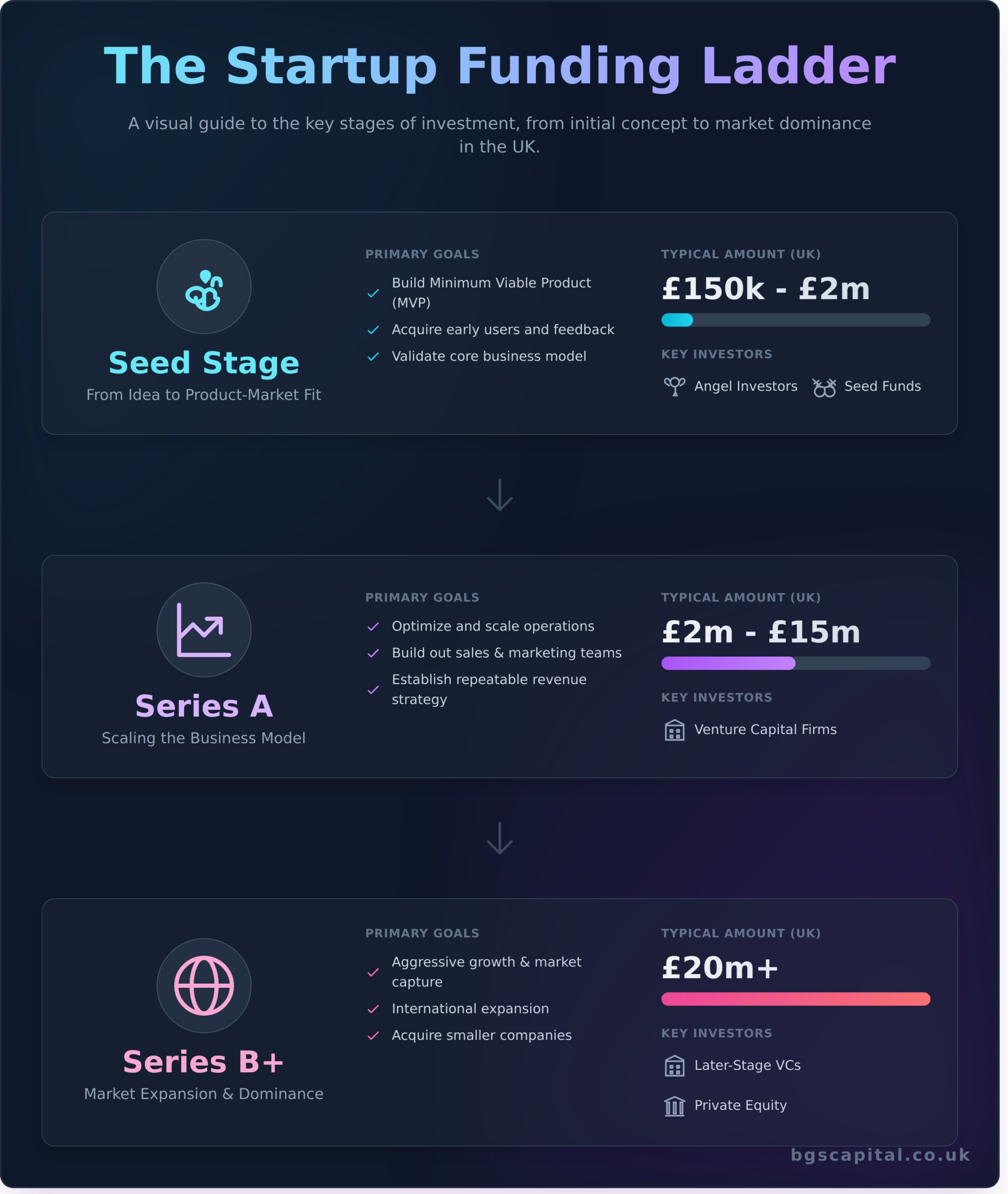
Securing startup funding is not a singular event but a structured progression through distinct stages, akin to climbing a ladder. Each rung represents a new phase of growth, requiring different levels of capital, attracting specific investor types, and focusing on unique strategic objectives. This progression, often detailed in discussions of venture financing rounds, ensures that capital is deployed against specific, measurable milestones, from initial concept to market dominance. Understanding this ladder is critical for founders seeking to navigate the complex investment landscape.
Pre-Seed & Seed Funding – From Idea to Product-Market Fit
This initial stage is about transforming an idea into a viable business concept. Pre-Seed funding often originates from the founders themselves (bootstrapping) or their immediate network-commonly referred to as friends, family, and fools (FFF). Seed funding is the first ‘official’ capital raised, typically from angel investors, accelerators, or early-stage seed funds. The primary objective is to build a minimum viable product (MVP), acquire early users, and validate the core business model to achieve product-market fit.
Series A – Scaling the Business Model
Once a startup has demonstrated product-market fit and established a consistent, albeit small, revenue stream, it is ready for Series A funding. This round is led by formal Venture Capital (VC) firms who scrutinise key performance indicators (KPIs) and growth metrics. The capital is used to optimise the business model, scale operations, and build out essential departments such as sales and marketing. The goal is to create a repeatable and scalable strategy for customer acquisition and revenue generation.
Series B, C, and Beyond – Market Expansion and Dominance
Later-stage funding is focused on aggressive growth and capturing market share. A Series B round enables a company to expand its reach, build out its team, and outperform competitors. Subsequent rounds, such as Series C and beyond, are typically used for international expansion, developing new product lines, or acquiring smaller companies. Investors at this stage include later-stage VCs, private equity firms, and corporate venture arms, all preparing the company for a potential exit, such as an Initial Public Offering (IPO) or a strategic acquisition.
.funding-table { width: 100%; border-collapse: collapse; margin-top: 20px; }
.funding-table th, .funding-table td { border: 1px solid #ddd; padding: 8px; text-align: left; }
.funding-table th { background-color: #f2f2f2; font-weight: bold; }
| Stage | Typical Amount (UK) | Primary Goal | Key Investors |
|---|---|---|---|
| Seed | £150k – £2m | Validate idea / Product-market fit | Angel Investors, Seed Funds, Accelerators |
| Series A | £2m – £15m | Scale operations / Optimise business model | Venture Capital Firms |
| Series B+ | £20m+ | Market expansion / Achieve dominance | Later-Stage VCs, Private Equity |
Sources of Capital: A Comparative Overview of Investor Types
Securing startup funding is not merely a financial transaction; it is the formation of a strategic partnership. The source of your capital is as critical as the amount raised, as different investors introduce distinct levels of expertise, network access, and operational involvement. While various government-backed initiatives and programmes offer a broad overview of capital structures, founders must critically evaluate investor types to find a partner, not just a chequebook. This decision will fundamentally shape your company’s trajectory.
Angel Investors: The Smart Money for Early-Stage Startups
Angel investors are high-net-worth individuals (HNWIs) who invest their personal capital into early-stage ventures. Often former entrepreneurs themselves, they provide invaluable mentorship and industry connections alongside capital injections, which in the UK typically range from £25,000 to £250,000. The primary drawback is that their involvement can be less structured than institutional funds, and their capacity for follow-on investment may be limited. They are the ideal source of capital for Pre-Seed and Seed stage companies.
Venture Capital (VC) Firms: Institutional Fuel for High-Growth Companies
Venture Capital (VC) firms are institutional investors that manage pooled capital to invest in businesses with high-growth potential. VCs provide substantial funding-typically starting from £1 million for a Series A round-and offer structured support, including board-level guidance and access to an extensive portfolio network. The trade-off is significant: founders cede considerable equity and control, and face intense pressure to achieve rapid, scalable growth to deliver the high returns the fund requires.
Crowdfunding: The Power of the Crowd
Equity crowdfunding platforms, such as Seedrs and Crowdcube in the UK, enable startups to raise capital by offering shares to a large number of retail investors online. This method serves as a powerful tool for market validation and builds a community of brand advocates from day one. However, a successful campaign demands a significant marketing and PR effort to generate momentum. A failed campaign can be public and potentially damaging, making this route best suited for consumer-facing businesses at the Seed stage.
The Founder’s Toolkit: How to Prepare for Your Funding Round
Securing startup funding is an intensive process, demanding the focus of a full-time commitment. Meticulous preparation is not optional; it is the foundation of a successful capital raise. Investors seek a compelling narrative that clearly defines the market opportunity, supported by robust data that validates the business case. Mastery of three core documents is essential to present a professional and credible proposition. For a detailed framework, the Startup India Funding Guide provides a comprehensive overview of what investors expect throughout the fundraising lifecycle.
Crafting a Compelling Pitch Deck
Your pitch deck is a concise, visual narrative designed to secure the next meeting. It must articulate the problem, your solution, the market size, team expertise, and financial projections across 10-12 slides. The primary objective is to tell a compelling story, not just list facts. Avoid common errors such as text-heavy slides, ambiguous claims, and unrealistic forecasts. Professionalism and clarity are paramount.
Building a Realistic Financial Model
This is a spreadsheet forecasting financial performance over 3-5 years, providing the quantitative evidence to support your pitch deck. It must include defensible revenue forecasts, detailed cost assumptions, and a cash flow statement. Investors will rigorously test the logic behind your numbers, so every assumption must be grounded in market data and logical reasoning. A robust model signals operational competence and a clear understanding of your business mechanics.
Understanding Startup Valuation
Valuation directly dictates the equity you exchange for capital. It is critical to understand the difference between pre-money valuation (the company’s value before investment) and post-money valuation (pre-money value plus the new capital). In the UK, early-stage valuations often rely on comparable analysis of similar deals. A higher valuation reduces founder dilution for a given investment-for example, a £500,000 investment on a £4.5m pre-money valuation results in a 10% stake.
Navigating the Term Sheet: Key Terms Every Founder Must Understand
A term sheet is a non-binding agreement that outlines the fundamental terms and conditions of an investment. While the headline valuation often attracts the most attention, it is a critical error to overlook the other clauses. These terms can significantly impact founder control, dilution, and financial returns upon exit. Before signing any document, it is imperative to seek qualified legal counsel to fully understand the implications of your startup funding agreement.
Equity vs. Convertible Instruments
Investment can be structured as a priced round (equity) or a non-priced round (convertible instrument). A priced round involves selling shares at a fixed price, common in Series A stages. Early-stage deals in the UK often use convertible instruments like an ASA (Advanced Subscription Agreement) or a SAFE (Simple Agreement for Future Equity). These defer the valuation discussion, allowing capital to be invested quickly with lower legal overhead, making them highly efficient for Seed rounds.
Valuation Cap and Discount
Convertible instruments include key terms to protect early investors against future valuation uncertainty. A Valuation Cap sets the maximum pre-money valuation at which the investment converts into equity. For example, a £100,000 investment with a £5 million cap converts at the £5 million valuation, even if the next round is priced at £10 million. A Discount provides a percentage reduction (e.g., 20%) on the share price of the next round, rewarding the investor for early risk.
Liquidation Preferences and Pro-Rata Rights
These two terms are critical for defining investor returns and future participation in your company’s growth.
- Liquidation Preference: This dictates the payout order in an exit event, such as a sale. A standard “1x non-participating” preference ensures investors receive their initial investment back before other shareholders receive proceeds.
- Pro-Rata Rights: This gives an investor the right, but not the obligation, to invest in subsequent funding rounds to maintain their ownership percentage, allowing them to continue backing a successful venture.
A comprehensive understanding of these terms is non-negotiable for any founder. The structure of the deal today defines the trajectory of your company tomorrow. For prepared founders seeking introductions to accredited investors, networks like BGS Capital provide a vital connection point.
The Path to Exit: Pre-IPO Funding and Going Public
For most venture-backed companies, the journey does not end with Series C or D funding. The ultimate objective for founders and investors alike is an ‘exit’-a liquidity event that generates significant returns. This outcome is typically achieved through one of two primary routes: a strategic acquisition by a larger corporation or an Initial Public Offering (IPO), where the company lists its shares on a public stock exchange like the London Stock Exchange.
The period leading up to a public listing marks the final and most sophisticated stage of the private startup funding lifecycle, designed to prepare the company for the rigours of public market scrutiny.
What is Pre-IPO Funding?
Pre-IPO funding is a late-stage investment round for a mature private company that has a clear intention to go public, typically within 6 to 24 months. The purpose of this capital is strategic: it allows the business to finance a final growth push, strengthen its balance sheet, and consolidate its capital structure before an IPO. Investors at this stage differ from early-stage VCs and include institutional investors, private equity firms, hedge funds, and sovereign wealth funds seeking de-risked, high-growth assets.
Connecting with Late-Stage Investors
As a company approaches IPO readiness, the investor landscape changes dramatically. The conversation shifts from vision and potential to proven metrics, predictable revenue, and a defensible market position. Accessing capital at this level requires a targeted strategy, as these opportunities are rarely publicised. Specialist introducers and private networks become essential, providing a curated and compliant gateway to sophisticated capital sources. These networks vet both the company and the potential investors to ensure an appropriate fit for these high-stakes, complex transactions.
Navigating this critical phase demands precision and the right connections. For mature companies preparing for their next stage of evolution, accessing a qualified network is the first step. Connect with qualified pre-IPO investors through BGS Capital.
Executing Your Funding Strategy: The Path Forward
Navigating the path from a seed-stage concept to a publicly-traded entity requires a strategic, stage-appropriate approach. As we have detailed, the journey of startup funding hinges on a comprehensive understanding of the funding ladder, meticulous preparation for each round, and the acumen to negotiate favourable terms. Securing the right capital is not just about the valuation; it is about forging the right partnerships for sustainable growth.
For founders ready to execute their capital-raising strategy, access to the right investor network is the critical next step. BGS Capital provides qualified companies with direct introductions to our curated network of high-net-worth individuals, accredited investment firms, and wealth managers. Connect with the capital you need to scale.
RAISING CAPITAL? FEATURE YOUR BUSINESS
The path to a successful exit is demanding, but with a robust strategy and the right financial backing, your company’s vision is well within reach.
Frequently Asked Questions
How much equity should a startup give away in a seed round?
In the UK market, a typical seed round involves exchanging 10% to 25% of equity. The precise figure is contingent on the company’s pre-money valuation, the amount of capital being raised, and the strategic value of the investors. For example, raising £500,000 on a £2 million pre-money valuation would result in 20% dilution. Founders must balance the need for capital with long-term control and future funding rounds, making valuation a critical negotiation point.
How long does it typically take to raise a round of funding?
The fundraising process typically requires three to six months from initial outreach to capital in the bank. This timeline encompasses several distinct phases: preparation of materials like a pitch deck and financial model, investor outreach, preliminary meetings, and term sheet negotiations. The final stage, involving comprehensive due diligence and the execution of legal documentation, can often be the most protracted. Efficient preparation and a structured approach are essential to managing this timeline effectively.
What is the difference between an accelerator and an incubator?
Accelerators and incubators serve different stages of a startup’s lifecycle. Accelerators provide intensive, fixed-term, cohort-based programmes designed to rapidly scale an existing business, often in exchange for equity. In contrast, incubators offer longer-term, less structured support focused on developing an early-stage idea or business concept. They typically provide workspace and mentorship without a defined endpoint or direct investment, nurturing companies from inception towards being investment-ready.
Do I need to be making revenue to get seed funding?
Pre-revenue status is not an automatic barrier to securing seed funding. Investors understand that early-stage ventures may not yet be commercialised, but they will require evidence of traction. This can include a functional Minimum Viable Product (MVP), strong initial user engagement metrics, or a founding team with a proven track record. The key is to demonstrate market validation and a clear path to future monetisation for your startup funding proposal.
What is a ‘down round’ and why is it bad for a startup?
A ‘down round’ occurs when a company raises capital at a lower valuation than its preceding funding round. This is detrimental as it significantly increases dilution for founders and existing shareholders, diminishing the value of their holdings. Furthermore, it signals to the market that the company has failed to meet its growth expectations, which can damage morale, complicate future fundraising efforts, and deter top talent. It is a clear indicator of business distress.
Can I raise startup funding outside of major tech hubs like London?
Yes, securing startup funding is entirely feasible outside of London. While the capital has the highest concentration of investors, robust venture capital ecosystems exist in cities such as Manchester, Edinburgh, Bristol, and Cambridge. The increasing acceptance of remote due diligence has further decentralised investment activity. Additionally, regional-focused funds and government initiatives are specifically designed to deploy capital into promising ventures across the entire United Kingdom.