
Navigating the complexities of the Seed Enterprise Investment Scheme (SEIS) presents a significant challenge for many sophisticated UK investors. The opaque eligibility criteria, the inherent risk of early-stage ventures, and the procedural hurdles of claiming tax relief can obscure the substantial opportunities available. A strategic seis investment, however, offers one of the most generous tax incentive packages in the country, specifically designed to reward those funding the next generation of high-growth companies.
This definitive guide is engineered to provide clarity. We will dissect the intricate rules, outlining the full scope of tax advantages-from 50% income tax relief to Capital Gains Tax exemption and loss relief. You will gain a framework for assessing risk against potential reward and understand the precise process for identifying qualifying opportunities and successfully claiming your entitlements. The objective is to equip you with the necessary intelligence to confidently integrate SEIS into your investment portfolio and make fully informed decisions.
Key Takeaways
- Understand the significant tax advantages that position SEIS as one of the UK’s most efficient investment structures for sophisticated investors.
- Learn to evaluate the inherent risks of early-stage ventures against their high-growth potential to make informed portfolio decisions.
- Follow a clear, step-by-step process for making an seis investment, from sourcing qualifying companies to claiming tax relief from HMRC.
- Determine if your personal risk tolerance and investment strategy align with the profile of a suitable SEIS investor.
What is an SEIS Investment? A Definition for UK Investors
An SEIS investment is a direct equity investment into an early-stage UK company that qualifies under the government’s Seed Enterprise Investment Scheme (SEIS). The primary objective of the scheme is to stimulate economic growth by incentivising private investors to provide crucial seed funding to high-risk startups and new ventures. In return for taking on this risk, the UK government offers substantial tax reliefs, which are a primary driver for investors considering this asset class.
The scheme targets the very beginning of a company’s lifecycle. It is specifically designed for ‘seed’ stage businesses, making it a precursor to the more widely known Enterprise Investment Scheme (EIS), which supports slightly larger and more established early-stage companies. From a company’s perspective, SEIS is a vital tool for raising initial capital; a qualifying business can raise a maximum of £250,000 in total through SEIS funding. This capital is intended to help the company establish its proof of concept and begin commercial trading.
Key Criteria for an SEIS-Qualifying Company
To be eligible for SEIS, a company must meet stringent criteria set by HMRC to ensure it is a genuine early-stage venture. The main conditions include:
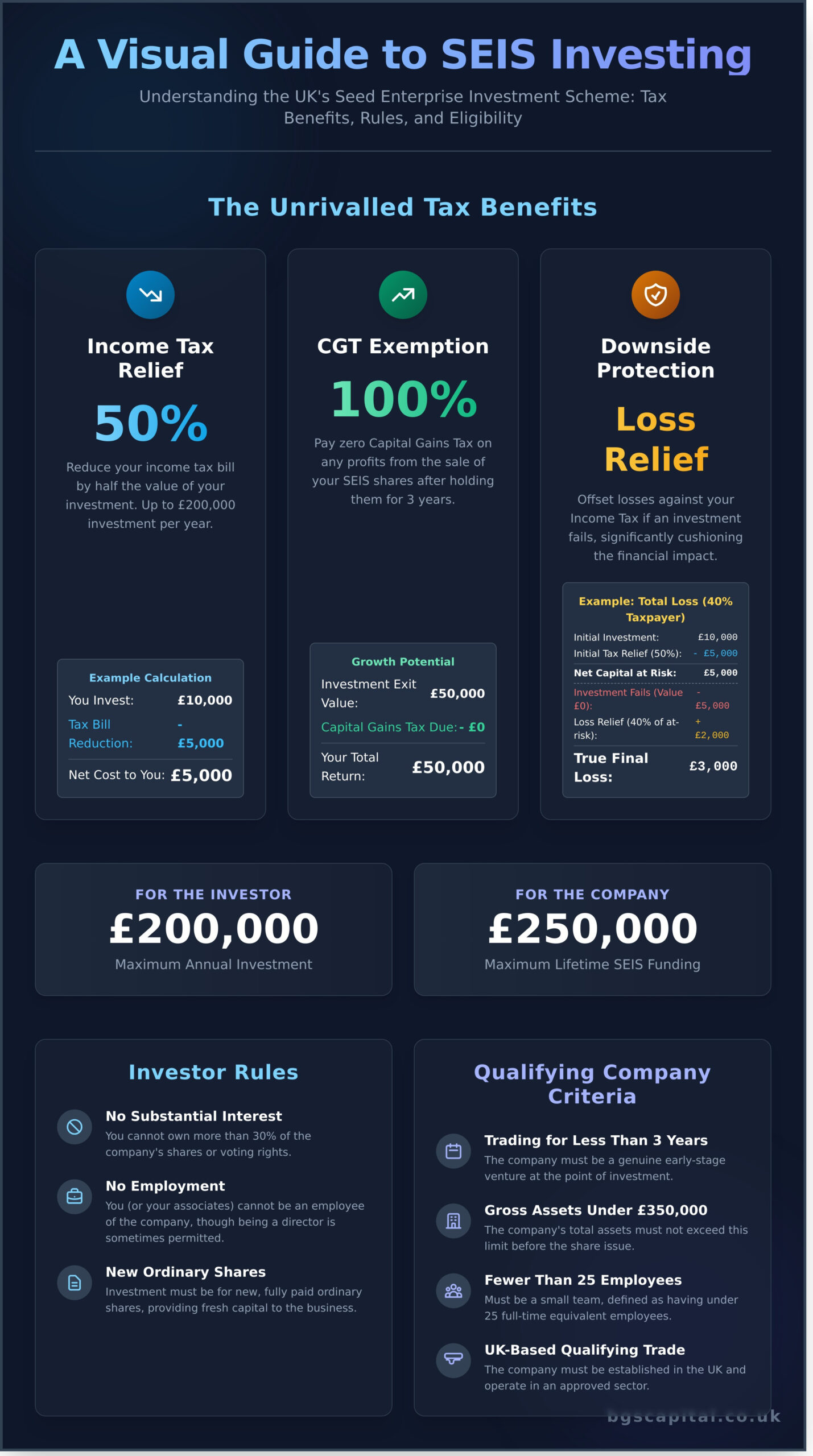
- Trading History: The company must have been trading for less than three years.
- Gross Assets: Its gross assets must not exceed £350,000 immediately before the share issue.
- Employee Count: It must have fewer than 25 full-time equivalent employees.
- Trade Type: The company must be established in the UK and conduct a ‘qualifying trade’ in an approved sector.
The Investor’s Role and Restrictions
Investors must also adhere to specific rules to qualify for the associated tax reliefs. These are designed to ensure the investor is independent and providing new risk capital.
- No Employment: Investors, and their associates, cannot be employees of the company, although holding a directorship is permitted under certain conditions.
- 30% Stake Limit: The investor must not hold more than a 30% stake (a ‘substantial interest’) in the company.
- Share Type: The investment must be for new, ordinary shares which are fully paid for in cash upon issue.
These regulations ensure that a genuine seis investment provides external capital to businesses that need it most, rather than facilitating transfers of ownership or management buyouts.
The Unrivalled Tax Benefits of an SEIS Investment
The Seed Enterprise Investment Scheme (SEIS) is one of the most generous tax-efficient initiatives available to UK investors. The government created these substantial reliefs to compensate for the higher risks associated with investing in very early-stage companies. The structure provides significant advantages at the point of investment, during the holding period, and upon exit, whether successful or not. For any investor considering an seis investment, understanding these benefits is critical.
The primary tax reliefs include upfront Income Tax relief, Capital Gains Tax exemption on profits, and comprehensive loss relief. It is important to note that all reliefs are contingent upon the investee company maintaining its SEIS-qualifying status for at least three years from the date of investment. The rules are specific, and investors should review the official SEIS guidance for full details. To illustrate the impact, we will use a clear example: an investment of £10,000.
50% Income Tax Relief
Investors can claim an immediate 50% Income Tax relief on the amount invested, up to an annual maximum of £200,000. This upfront relief significantly reduces the net cost and the capital at risk. For a £10,000 investment, this translates to a £5,000 reduction in your income tax liability for the year, meaning the net cost of your investment is immediately lowered to just £5,000. Furthermore, the scheme includes a ‘carry-back’ feature, allowing you to apply this relief against the previous tax year’s income tax bill if required.
Capital Gains Tax (CGT) Exemption
A key attraction of an seis investment is the potential for tax-free growth. Provided you hold the shares for the minimum three-year qualifying period, any capital gain realised upon their disposal is 100% exempt from Capital Gains Tax (CGT). This offers a considerable advantage over standard equity investments, where profits are typically subject to CGT at rates of up to 20% for higher-rate taxpayers. This exemption ensures that 100% of the upside from a successful exit is retained by the investor.
Loss Relief on Unsuccessful Investments
While the goal is always a profitable exit, SEIS provides a crucial downside protection mechanism. If your SEIS shares are disposed of at a loss or become worthless, you can elect to offset this loss against either your Income Tax or Capital Gains Tax liability. Continuing our £10,000 example:
- Initial Investment: £10,000
- Upfront Income Tax Relief: £5,000 (reducing net cost to £5,000)
- Scenario: The company fails and the shares become worthless.
- Allowable Loss: £5,000 (the net cost)
An additional-rate (45%) taxpayer can offset this £5,000 loss against their income, creating a further tax saving of £2,250 (£5,000 x 45%). The total tax relief secured would be £7,250 (£5,000 + £2,250), reducing the total capital lost on the original £10,000 investment to just £2,750.
Assessing the Risks and Realities of SEIS Investing
While the tax incentives associated with the Seed Enterprise Investment Scheme are substantial, they are designed to compensate for the significant risks inherent in early-stage ventures. A professional approach to any seis investment strategy must begin with a transparent assessment of these risks. Investors must understand that this asset class is high-risk and speculative. CAPITAL IS AT RISK.
High Failure Rate and Illiquidity
The reality of the startup ecosystem is that a high percentage of new businesses fail. Investors must be prepared for the possibility of a total loss of their invested capital. Furthermore, shares in SEIS-qualifying companies are unquoted and, therefore, highly illiquid. There is no established secondary market for these shares, meaning they cannot be easily sold. Capital should be considered committed for a minimum of three years to retain the associated tax reliefs, and potentially much longer.
The Importance of Diversification
Concentrating a significant portion of a portfolio into a single startup is an exceptionally high-risk strategy. To mitigate company-specific risk, sophisticated investors diversify their holdings across multiple SEIS-qualifying companies. Spreading capital across different sectors, management teams, and business models increases the probability of backing a successful venture that can offset losses from others. Utilising investment platforms or funds can be an effective method for achieving this diversification.
Conducting Due Diligence
Thorough due diligence is a fundamental requirement before committing capital. While the tax advantages are a key feature, the underlying viability of the business is paramount. Key areas for investigation include:
- The Management Team: Assess their experience, industry expertise, and track record.
- The Market: Analyse the size of the target market, the competitive landscape, and the company’s unique value proposition.
- The Business Model: Scrutinise the plan for revenue generation, scalability, and a clear path to profitability.
Understanding the core mechanics of the scheme itself is also crucial; the official British Business Bank guide to SEIS provides a comprehensive government-backed overview. Using a professional network that performs initial screening can provide a valuable layer of vetting. Access pre-vetted opportunities through our network of investors.
How to Make an SEIS Investment: The Process Explained
Navigating your first seis investment involves a structured process with clear responsibilities for the investor, the company, and HMRC. Understanding these steps is fundamental to ensuring compliance and successfully claiming the associated tax reliefs. The procedure is designed to be methodical, moving from initial due diligence and capital deployment through to the final tax return submission, ensuring all regulatory requirements are met.
Step 1: Finding and Evaluating Opportunities
Investors can source SEIS-eligible opportunities through various channels, including specialised angel investor networks and regulated equity crowdfunding platforms. Professional introducers, such as BGS Capital, also play a crucial role by connecting sophisticated investors with a curated selection of pre-vetted, high-growth companies. A critical part of your due diligence is to confirm that the company has received ‘advance assurance’ from HMRC. While this is not a guarantee of the company’s commercial success, it is a vital signal that HMRC agrees the company’s structure and proposed activities appear to meet the scheme’s stringent qualifying conditions at the time of application.
Step 2: The Investment and Share Issue
Once an opportunity is selected, the investment is made by transferring funds directly to the company in exchange for new ordinary shares. A share certificate will be issued to you as legal proof of ownership. The company is then legally obligated to use these funds for qualifying business activities as outlined in its business plan and SEIS application. Critically, the company must spend at least 70% of the money raised before it can apply for compliance. After the shares have been issued and the company has been trading for at least four months, it can submit a compliance statement (form SEIS1) to HMRC.
Step 3: Receiving Your SEIS3 Certificate and Claiming Relief
After reviewing the company’s SEIS1 form and supporting evidence, HMRC will, if satisfied, issue unique SEIS3 compliance certificates to the company for it to distribute to its investors. This SEIS3 certificate is the essential document you need to claim tax relief; without it, no claim can be made. You must use the details on this certificate to complete the ‘Additional Information’ pages of your Self-Assessment tax return for the tax year in which the shares were issued. This final step completes the formal process, allowing you to realise the significant tax advantages of your SEIS investment.
Is an SEIS Investment Right for Your Portfolio?
A Seed Enterprise Investment Scheme (SEIS) opportunity is designed for a specific investor profile: sophisticated or high net worth individuals with a comprehensive understanding of investment risk. Given that these are early-stage, unlisted companies, the potential for failure is significant, and investors must be prepared for the possibility of a total loss of capital. An seis investment is not a mainstream retail product; it is a high-risk venture capital instrument.
For those who meet the criteria, SEIS can play a valuable strategic role within a diversified portfolio. While assets like pensions and ISAs typically form the stable core of a long-term financial plan, SEIS offers a mechanism to allocate a smaller portion of capital towards asymmetric, high-growth potential. It complements more conservative holdings by introducing a different risk-reward dynamic, driven by innovation and entrepreneurial ambition.
Strategic Portfolio Allocation
As a general guideline, financial advisors often suggest that high-risk, illiquid assets should constitute a limited fraction of a portfolio, typically between 5-10%. This allocation allows an investor to gain targeted exposure to innovative sectors-such as fintech, life sciences, and deep tech-that are often inaccessible through public markets. Success in this asset class requires patient capital. An seis investment is a long-term commitment, often requiring a holding period of three years or more to benefit from tax reliefs and realise potential growth.
Connecting with SEIS-Eligible Companies
The primary challenge for qualified investors is not a lack of capital, but sourcing a consistent flow of credible, pre-vetted investment opportunities. Identifying promising SEIS-eligible companies requires significant time, a robust network, and sector expertise.
BGS Capital operates as an introducer network, connecting sophisticated investors with a curated deal flow of SEIS-eligible businesses. This model facilitates direct communication with founders, which is essential for conducting thorough due diligence. If you meet the criteria and wish to explore these exclusive opportunities, you can verify your eligibility and view current raises on our platform.
Discover companies seeking SEIS investment. Am I Eligible?
SEIS Investment: Your Gateway to High-Growth Potential
The Seed Enterprise Investment Scheme presents a compelling proposition for UK investors. It combines unparalleled tax reliefs, including up to 50% income tax relief and capital gains tax exemption, with the potential for significant returns from early-stage companies. However, these advantages are balanced by the inherent risks of investing in startups. A successful seis investment strategy therefore demands rigorous due diligence and a clear alignment with your financial objectives and risk tolerance.
For sophisticated and high-net-worth investors, the primary challenge is identifying and accessing qualified, high-growth opportunities. BGS Capital operates as an introducer, providing a direct connection to a network of pre-IPO and innovative companies. Our platform facilitates access to management and investor relations teams, enabling you to conduct thorough assessments before committing capital.
If you are ready to explore this dynamic investment class, take the definitive step. Find SEIS Investment Opportunities. Am I Eligible?
Frequently Asked Questions
What is the key difference between SEIS and EIS investments?
The Seed Enterprise Investment Scheme (SEIS) is designed for very early-stage companies, typically those trading for less than three years with under £350,000 in gross assets. The Enterprise Investment Scheme (EIS) targets larger, more established small and medium-sized enterprises. The primary incentives differ: SEIS offers up to 50% income tax relief on investments up to £200,000 per year, whereas EIS provides 30% relief on investments up to £1 million.
What is the maximum amount I can invest through SEIS each year?
The maximum amount an individual can invest through the Seed Enterprise Investment Scheme (SEIS) in a single tax year is £200,000. This allowance enables an investor to claim up to £100,000 in income tax relief for that year, representing 50% of the total investment amount. Investors must monitor their total contributions across all SEIS-qualifying companies within the tax year to ensure they remain within this statutory limit and are eligible for the associated reliefs.
How long must I hold my SEIS shares to keep the tax reliefs?
To retain the full income tax and capital gains tax reliefs associated with an SEIS investment, you must hold the shares for a minimum of three years from their date of issue. If the shares are sold, transferred, or otherwise disposed of within this three-year period, HMRC may withdraw the tax relief claimed. This holding period is a critical component of the scheme’s rules, designed to encourage long-term investment in qualifying UK businesses.
Can I be a director in a company I invest in under SEIS?
Yes, an investor can be a director of the company they invest in under SEIS. However, there are strict rules regarding ‘connection’ to the company. You cannot be an employee of the company when the shares are issued, though you may become a paid director after the investment is made. The rules are complex, and a pre-existing employment relationship could impact eligibility. It is essential to verify your status to ensure compliance with HMRC regulations before proceeding.
What happens if a company I invest in loses its SEIS qualifying status?
If a company ceases to meet the SEIS qualifying conditions within three years of your share issue date, any tax relief you have claimed may be withdrawn or reduced. This can occur if the company, for instance, exceeds the gross asset limit or engages in a non-qualifying trade. The responsibility for maintaining qualifying status rests with the company, but the financial risk of non-compliance ultimately impacts the investor’s tax position. This underscores the inherent risks of a seis investment.
Is it better to invest directly or through an SEIS fund?
The choice between direct investment and an SEIS fund depends on an investor’s strategy and risk tolerance. Direct investment provides complete control over company selection but requires significant due diligence. An SEIS fund offers immediate diversification by spreading capital across a portfolio of qualifying companies managed by a fund manager. This can mitigate single-company risk but involves management fees and relinquishes direct control. Each approach presents a different balance of risk, control, and required expertise.
When can I expect to receive my SEIS3 certificate after investing?
The issuance of an SEIS3 certificate, which is required to claim tax relief, follows a specific HMRC process. The investee company must first submit a compliance statement to HMRC. This can only occur after the company has traded for at least four months or has spent 70% of the invested funds. Once HMRC approves the statement, the company can issue SEIS3 certificates to its investors. The entire process can take from several months to over a year post-investment.