
The pitch meeting is set and your business plan is complete. Yet, a critical question remains: what exactly will an investor look for behind the numbers and the narrative? Approaching a potential angel donor without a clear understanding of their evaluation criteria is a significant, and common, strategic error. This lack of preparation often leads to an immediate rejection, undermining a founder’s confidence and wasting a valuable opportunity.
To move from pitch to a term sheet requires more than a compelling idea; it demands a comprehensive understanding of an investor’s mindset. This guide demystifies the process. We provide a functional checklist detailing the exact metrics, team attributes, market validation, and financial projections that experienced investors scrutinise before committing capital. The objective is to equip you with the necessary framework to prepare your business, validate your valuation, and present as a credible, ‘investor-ready’ enterprise.
The Angel Investor Mindset: Moving from ‘Donor’ to Partner
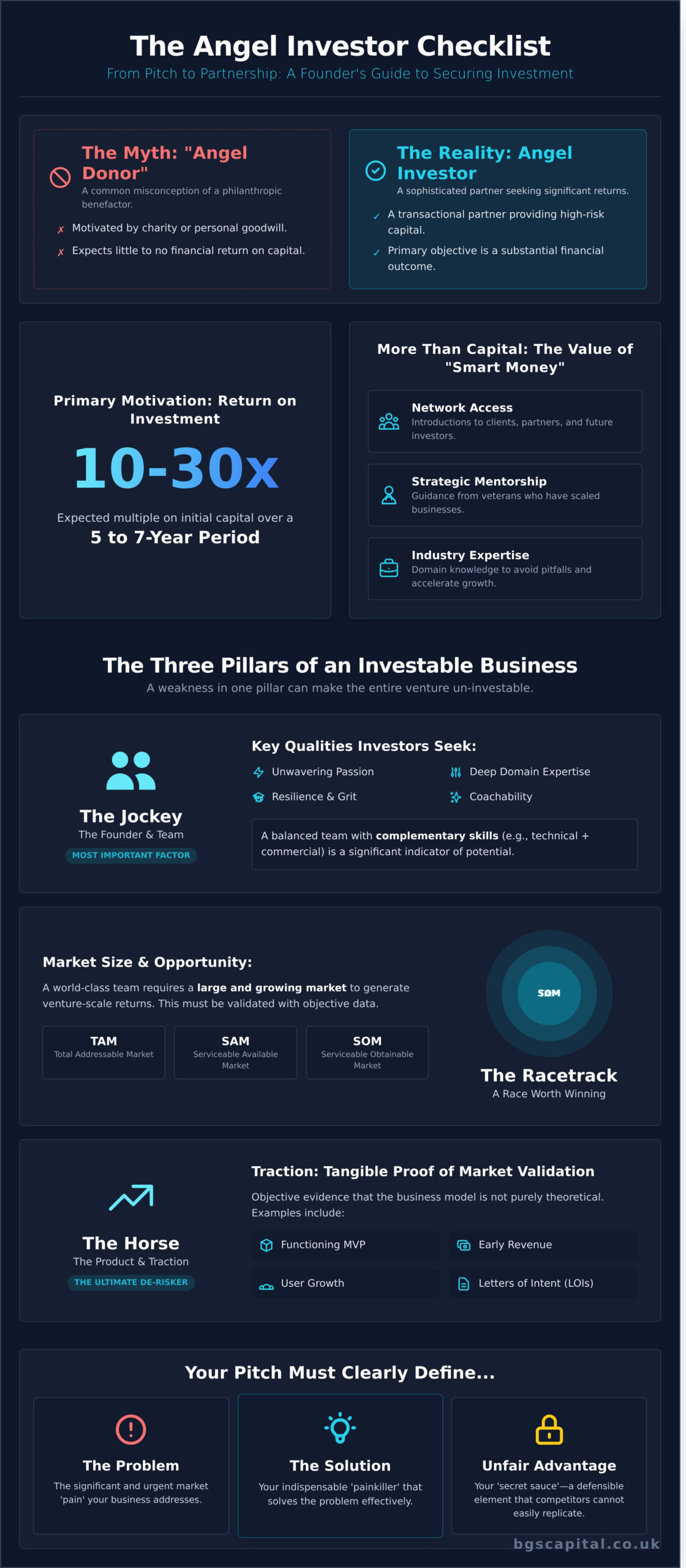
A fundamental misunderstanding for many founders is the term ‘angel’. This often creates the false impression of a benefactor or an angel donor, an individual motivated by philanthropy. The reality is commercial and transactional. An angel investor is a sophisticated, high-net-worth individual who provides capital for a business startup, usually in exchange for convertible debt or ownership equity. Their primary objective is not charity; it is a significant financial return on their high-risk investment.
To achieve this, angels operate with a portfolio strategy. They understand that early-stage investing is inherently risky and that many of their investments will fail to generate a return. Consequently, they require the successful companies in their portfolio to deliver exceptional returns to compensate for these losses. They are not simply providing capital; they are investing in potential partners capable of generating substantial growth.
Understanding the Expectation of ROI
The core motivation for an angel investor is a high return on investment (ROI). Unlike a bank loan with a fixed interest rate, this is an exchange of high-risk capital for an equity stake in your company. The expectation is not a modest profit but a substantial multiple on their initial capital, typically 10-30x over a 5 to 7-year period. This is the critical difference between an investor and an angel donor; one expects a significant financial outcome, while the other expects none.
The Value of ‘Smart Money’
Beyond capital, seasoned founders actively seek out ‘smart money’. This term defines an investment that includes both financial backing and strategic, non-financial support. An investor with relevant experience becomes a critical asset, providing value that far exceeds their cash contribution. Founders should prioritise angels who offer:
- Strategic Mentorship: Guidance from individuals who have navigated the challenges of scaling a business.
- Network Access: Introductions to potential clients, partners, key hires, and downstream investors.
- Industry Expertise: Deep domain knowledge that can help avoid common pitfalls and accelerate growth.
Ultimately, an angel invests in the founding team as much as the business model. They are looking for credible, coachable, and resilient entrepreneurs with whom they can partner to build a high-value enterprise.
Core Evaluation Criteria: The Three Pillars of an Investable Business
An experienced angel investor evaluates a potential opportunity through a structured, analytical lens. While every business is unique, the core assessment criteria remain consistent, often summarised by the framework of ‘The Jockey, The Horse, and The Racetrack’. This model dissects the business into its three most critical components: the management team, the product and its traction, and the market opportunity. A significant weakness in any one of these pillars can render the entire proposition un-investable, regardless of the strength of the other two.
The Founder and Team: Betting on the Jockey
For early-stage ventures, the management team is frequently the single most important investment factor. An exceptional idea is worthless without a team capable of executing it. An angel donor is primarily backing people, seeking specific qualities that correlate with success: deep domain expertise, resilience in the face of adversity, unwavering passion for the problem they are solving, and coachability. This focus on management is a fundamental aspect of How Angel Investors Work, as they are ultimately backing the individuals’ capacity to navigate future challenges. A balanced team with complementary skills-such as a technical founder paired with a commercial lead-is a significant indicator of potential.
The Market Opportunity: A Race Worth Winning
A world-class team requires a substantial market to generate the venture-scale returns investors require. Founders must demonstrate a deep understanding of their market size, typically articulated through:
- TAM (Total Addressable Market): The total global demand for a product or service.
- SAM (Serviceable Available Market): The segment of the TAM targeted by your products and services which is within your geographical reach.
- SOM (Serviceable Obtainable Market): The portion of SAM you can realistically capture.
A large and, crucially, growing market is non-negotiable. Investors need to see objective evidence of market demand that extends beyond the founder’s opinion, validating that the “racetrack” is large enough for a significant financial outcome.
The Product and Traction: Proof the Horse Can Run
Traction is the tangible, objective evidence of market validation. It is the most effective way to de-risk an investment for an angel donor, proving that the business model is not purely theoretical. While pre-revenue companies can secure funding, some form of traction is almost always required. This proof can take many forms, and founders should focus on the metrics most relevant to their model. Examples include a functioning Minimum Viable Product (MVP) with positive user feedback, early revenue streams, consistent month-on-month user growth, or signed letters of intent (LOIs) from prospective enterprise clients.
The Pitch Deck & Business Plan: What Angels Need to See
Your pitch deck and business plan are the primary tools for communicating your venture’s potential. The deck serves as a concise, visual summary designed to capture interest, while the business plan provides the granular detail that substantiates your claims. An experienced angel donor scrutinises these documents to separate viable, high-growth opportunities from speculative concepts. Clarity, data-backed assertions, and a compelling narrative are paramount. Avoid industry jargon and unsubstantiated projections; every slide and section must directly answer a critical question an investor will have.
Problem, Solution, and Unfair Advantage
First, articulate the specific market ‘pain’ your business addresses. A successful pitch frames this problem as significant and urgent. Then, present your solution as the indispensable ‘painkiller’. Finally, define your ‘unfair advantage’ or ‘secret sauce’-the defensible element that prevents competitors from easily replicating your success. This could be proprietary technology, exclusive strategic partnerships, a first-mover advantage, or a novel business model that creates a significant barrier to entry.
Business Model and Go-to-Market Strategy
An investor must see a clear and credible path to revenue. Detail your pricing strategy, key revenue streams (e.g., subscription, transactional, licensing), and projected lifetime value (LTV) of a customer. Your go-to-market plan must outline how you will reach your target audience and the associated Customer Acquisition Cost (CAC). For example, demonstrating a tangible plan to acquire customers for under £100 while projecting an LTV of over £500 provides a concrete metric for potential returns.
Competitive Landscape
Claiming to have ‘no competition’ is a critical error that signals a lack of market research. A sophisticated angel donor expects a thorough and honest analysis of the competitive landscape. Acknowledge direct and indirect competitors, analysing their strengths and weaknesses. Crucially, you must then position your business, highlighting how it is fundamentally different and better. A competitor matrix is an effective tool for visually communicating your unique value proposition against existing market players.
Financials and Deal Structure: The Numbers Behind the Narrative
While a compelling narrative captures interest, the financial model is where a sophisticated angel donor validates the opportunity. Your projections translate your vision into a quantitative roadmap, demonstrating the viability and potential return on investment. Experienced investors understand that forecasts are rarely perfect; their primary purpose is to test the depth of your understanding and the logic behind your assumptions. Be prepared to defend every figure, from customer acquisition costs to churn rates, as this scrutiny is a core part of the due diligence process.
Credible Financial Projections
A robust financial model is non-negotiable. It should include a 3-5 year forecast covering your Profit & Loss, Balance Sheet, and Cash Flow statement. These projections must be built from the bottom-up-based on tangible drivers like planned marketing spend and conversion rates-not a top-down assumption of capturing a percentage of a large market. Clearly articulate your key assumptions and demonstrate a firm grasp of your unit economics (e.g., LTV:CAC ratio). This shows you control the levers of your business.
The ‘Ask’ and Use of Funds
Clarity on capital requirements is critical for building trust. State a specific funding amount and provide a detailed breakdown of how the capital will be allocated. An effective use of funds summary links spending directly to achieving key milestones. For example:
- Total Ask: £250,000
- Product Development (40%): Hire two senior developers to launch version 2.0.
- Sales & Marketing (35%): Execute paid ad campaigns to acquire 1,000 new customers.
- Operational Costs (25%): Covers overheads and provides a buffer.
This capital should provide a clear 12-18 month runway, giving the business sufficient time to hit the next set of value-inflection points before requiring further funding.
SEIS/EIS Eligibility: The UK Investor’s Superpower
For any UK-based startup, eligibility for the Seed Enterprise Investment Scheme (SEIS) or Enterprise Investment Scheme (EIS) is a significant advantage. These government schemes offer substantial income tax relief, capital gains exemption, and loss relief to investors. For a UK-based angel donor, an SEIS/EIS-compliant investment is vastly more attractive as it significantly de-risks their capital. For many, it is a fundamental prerequisite for even considering an investment.
Common Red Flags That Make Angel Investors Pass
Securing investment requires more than a strong business idea; it demands avoiding critical errors that cause an experienced angel donor to immediately pass. Understanding these deal-breakers can save you from an instant rejection. These red flags typically fall into three categories: the founder, the business itself, or the pitch. Awareness of these issues allows you to address them proactively, demonstrating a level of self-awareness and professionalism that investors value highly.
Founder and Team Red Flags
An investor is backing the individuals as much as the company. Signs of a problematic founder or team are a primary concern. Key warning signs include:
- Being uncoachable: An unwillingness to accept feedback or a belief that you have all the answers is a significant deterrent. Investors bring experience and expect a collaborative relationship.
- Lack of transparency: Hiding challenges or being dishonest about the state of the business erodes trust instantly. Investors expect full disclosure of both strengths and weaknesses.
- A solo founder with no plan: While not an automatic ‘no’, a single founder without a clear strategy to build a complementary team presents a major operational risk.
- No ‘skin in the game’: If you have not invested any of your own capital or significant time into the venture, it signals a lack of commitment and belief in your own business.
Business and Deal Red Flags
Beyond the team, the fundamentals of the business and the structure of the deal must be sound. An otherwise promising venture can be undermined by structural issues:
- An unrealistic valuation: A pre-revenue company seeking a £10 million pre-money valuation without extraordinary justification will not be taken seriously.
- A messy capitalization table: Unclear ownership, unresolved founder disputes, or excessive equity given away for minor contributions complicates the deal and future funding rounds.
- No clear defensibility: Without a barrier to entry-such as intellectual property, network effects, or unique technology-investors will question the long-term viability of the business against competitors.
- An insufficient funding request: Asking for £25,000 when £100,000 is clearly needed to achieve the next key milestone shows a lack of strategic financial planning.
Pitching and Communication Mistakes
How you present your opportunity is a reflection of your competence. Simple communication errors can derail your efforts before you even discuss the business model. Every interaction with a potential angel donor is part of the evaluation.
- Not knowing your metrics: Being unable to recall key financials like burn rate, customer acquisition cost, or revenue projections signals a lack of preparation.
- Bad-mouthing competitors: Focusing on the flaws of others instead of the strengths of your own business appears unprofessional and defensive.
- Generic outreach: Sending a non-personalized, templated email to an investor shows a lack of genuine interest and research.
Avoiding these common pitfalls is the first critical step in the fundraising process. The next is to ensure your refined proposition reaches the right audience. Prepare your business to meet qualified investors.
Positioning Your Venture for Angel Investment
Securing capital is not merely a transaction; it is the beginning of a strategic partnership. As this guide has outlined, successful founders must align with the investor mindset, present a compelling case through robust financials and a polished pitch, and diligently avoid common red flags. Moving beyond the perception of a passive angel donor to that of an active, value-adding partner is the fundamental shift required to attract serious investment. This distinction is what separates a fleeting pitch from a funded enterprise.
If your business is prepared to meet these rigorous standards, the next step is to gain exposure to a qualified investor network. BGS Capital provides a direct conduit for pre-IPO and IPO opportunities to be seen by sophisticated and high-net-worth individuals. Our professional team leverages deep industry expertise to ensure your proposition reaches an audience with the capacity and appetite for significant investment.
Feature your investor-ready business on BGS Capital and transform your vision into a venture poised for market leadership.
Frequently Asked Questions
What is the difference between an angel investor and a venture capitalist (VC)?
An angel investor, sometimes referred to as an angel donor, is typically a high-net-worth individual investing their own personal capital into early-stage businesses. In contrast, a Venture Capitalist (VC) invests other people’s money from a managed fund. Angels often invest smaller amounts (£10,000 – £250,000) at the pre-seed or seed stage, while VCs deploy larger sums (£1M+) in later, more established rounds like Series A and beyond, with more formal governance requirements.
How much equity should I expect to give away in an angel funding round?
In the United Kingdom, it is standard to offer between 10% and 25% equity in a seed or angel funding round. The final percentage is contingent on the company’s pre-money valuation and the amount of capital being raised. For example, raising £150,000 on a £1 million pre-money valuation would result in approximately 13% equity dilution. The objective is to secure necessary funding without compromising the company’s ability to raise capital in subsequent rounds.
Do I need to have revenue before approaching an angel investor?
No, revenue is not a mandatory prerequisite for securing angel investment. Many angels specialise in pre-revenue companies, focusing instead on the calibre of the founding team, the scale of the market opportunity, and the defensibility of the technology or intellectual property. However, demonstrating any form of market traction, such as a growing user base, letters of intent, or successful pilot programmes, will substantially strengthen your investment case and increase your probability of success.
What is the typical due diligence process for an angel investor?
The due diligence process is designed to verify the claims presented in your pitch deck and business plan. An angel investor will typically scrutinise your financial projections, cap table, and key contracts. The process also includes background checks on the founding team, a thorough analysis of the competitive landscape, and a review of any intellectual property registrations. This ensures all material facts are confirmed before any capital is committed to the venture.
How important is a warm introduction versus a cold outreach to an angel?
A warm introduction from a trusted, mutual contact is of critical importance. Angel investors are inundated with proposals, and an introduction from a credible source acts as a powerful initial filter, conferring immediate legitimacy upon your business. Cold outreach has an exceptionally low rate of success as it lacks this essential third-party validation. Proactively leveraging professional networks is the most efficient method for securing a qualified introduction to a relevant investor.
What legal documents are required for an angel investment?
In the UK, several key legal documents are required to formalise an angel investment. The process typically begins with a non-binding Term Sheet that outlines the principal terms of the deal. This is followed by a legally binding Shareholders’ Agreement, which details the rights and obligations of all shareholders. The company’s Articles of Association must also be amended to reflect the new share structure and investor rights, ensuring full legal and regulatory compliance.