
Scaling a successful enterprise requires strategic capital. Yet, the path to securing this funding is often obscured by complex terminology and critical distinctions between financial models. Understanding private equity is a crucial first step, but for many business owners, concerns over losing control, the suitability of their company, and the complexity of the process itself can be significant barriers to pursuing this powerful growth mechanism.
This guide is engineered to provide clarity for UK business owners. We will deliver a direct, comprehensive overview of how private equity functions, delineate its key differences from venture capital, and outline the various types of PE funding available in the market. You will learn to identify the definitive characteristics of businesses that attract PE investment and understand the strategic implications of such a partnership.
Ultimately, you will be equipped to assess if a private equity firm is the correct strategic move for your company’s growth and understand the fundamental steps required to prepare for a potential transaction.
Deconstructing Private Equity: The Core Mechanism Explained
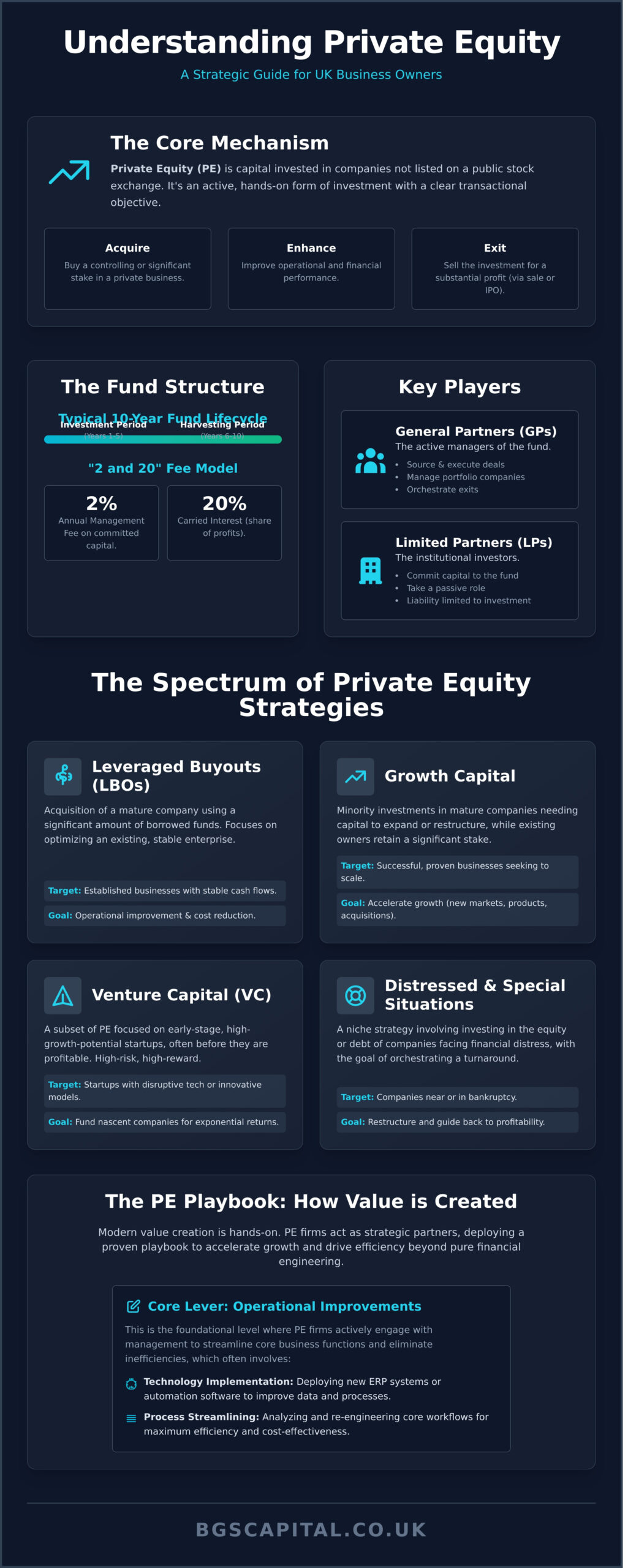
In the financial landscape, private equity refers to capital invested in companies that are not listed on a public stock exchange. The fundamental objective is transactional and clear-cut: to acquire a controlling or significant stake in a private business, enhance its operational and financial performance over a set period, and ultimately exit the investment-typically through a sale or an initial public offering (IPO)-for a substantial profit. For a foundational overview of its structure and history, a useful resource is the Wikipedia article explaining What is Private Equity?. This is an active, hands-on form of investment, where the firm directly influences the strategy and management of its portfolio companies.
The capital for these ventures is sourced from sophisticated institutional investors and high-net-worth individuals, including pension funds, university endowments, and insurance companies. These investors commit capital to a specialised private equity firm, which then acts as the steward of that capital, identifying and executing investment opportunities.
The Fund Structure: How Capital is Raised and Deployed
Capital is typically raised and managed within a closed-end fund structure, which has a finite lifespan, commonly 10 years. This lifecycle is divided into two main phases: an investment period (the first few years) for acquiring companies, and a subsequent harvesting period for improving and selling them. The standard remuneration model is the “2 and 20” fee structure, where the firm charges a 2% annual management fee on committed capital and receives 20% of the profits (carried interest) after returning the initial capital to investors.
General Partners (GPs) vs. Limited Partners (LPs)
The two key players in any private equity fund are the General Partners and Limited Partners.
- General Partners (GPs): These are the executives of the private equity firm. They are the active managers responsible for sourcing deals, conducting due diligence, managing the portfolio companies, and orchestrating the final exit. Their expertise is the primary driver of the fund’s success.
- Limited Partners (LPs): These are the institutional and accredited investors who commit the capital to the fund. Their liability is limited to the amount of their investment, and they take a passive role, entrusting the GP to generate returns.
This structure aligns interests, as the GP’s primary reward-the carried interest-is directly contingent on delivering strong profits for their LPs.
The Spectrum of Private Equity Strategies: Beyond the Buyout
The term ‘private equity’ is not a monolith; it is an umbrella classification for several distinct investment strategies targeting companies at different stages of their lifecycle. For founders and business owners, understanding this spectrum is critical to identifying the right type of capital partner. These strategies range from acquiring established, cash-flow positive enterprises to funding high-growth ventures, with the deployment of debt (leverage) being a common, though not universal, component used to finance transactions and amplify returns.
Leveraged Buyouts (LBOs)
A Leveraged Buyout is the acquisition of a mature company using a significant amount of borrowed funds to meet the cost of acquisition. The assets of the company being acquired are often used as collateral for the loans. Ideal LBO targets are established businesses with stable cash flows, strong management, and clear opportunities for operational improvement or cost reduction. This strategy focuses on optimising an existing enterprise, making effective Private Equity Value Creation a core component of the investment thesis.
Growth Capital
Growth capital, or growth equity, involves minority investments in relatively mature companies that require capital to expand or restructure operations. Unlike an LBO, the existing owners retain a significant stake. This capital injection is typically used to finance specific strategic initiatives, such as entering new markets, launching a new product line, or funding a key acquisition. It is an ideal option for successful, proven businesses looking to accelerate their growth trajectory without a full sale.
Venture Capital (VC)
Often considered a distinct asset class but technically a subset of private equity, Venture Capital focuses on early-stage, high-growth-potential startups. VC firms provide funding to companies that have not yet achieved profitability or stable cash flows, typically in exchange for an equity stake. The focus is almost exclusively on scalable businesses with disruptive technology or innovative models, accepting high risk in pursuit of substantial returns. This is the capital source for nascent companies, not established ones.
Distressed and Special Situations
This highly specialised niche involves investing in the equity or debt of companies facing significant financial distress or bankruptcy. The objective is to gain control or influence over the company’s direction. Investors, often turnaround specialists, work to restructure the business, address operational inefficiencies, and guide it back to profitability. This strategy requires deep expertise in corporate finance, bankruptcy law, and operational management, carrying a unique risk-reward profile.
The PE Playbook: How Private Equity Firms Create Value
A persistent myth frames private equity as an exercise in pure financial engineering, focused exclusively on leveraged buyouts. While optimising the capital structure is a component, the reality of modern value creation is far more hands-on and operational. Successful firms act as strategic partners, deploying a proven playbook to accelerate growth and drive sustainable efficiency. To understand the fundamentals of what is private equity?, one must look past the balance sheet to the three core levers used to transform portfolio companies post-acquisition.
Operational Improvements
This is the foundational level of value creation. PE firms actively engage with management to streamline core business functions and eliminate inefficiencies. This often involves:
- Technology Implementation: Deploying new ERP systems or automation software to improve data visibility and productivity.
- Supply Chain Optimisation: Renegotiating supplier contracts, consolidating procurement, and improving logistics to reduce costs and enhance resilience.
- Management Augmentation: Strengthening the senior leadership team by recruiting executives with specific industry expertise, such as a CFO with public market experience or a COO skilled in operational turnarounds.
Strategic Growth Initiatives
Beyond optimising the existing business, PE firms provide both the capital and strategic oversight required for ambitious expansion. This is not passive investment; it is active growth facilitation. Key strategies include:
- ‘Buy and Build’: Executing a targeted M&A strategy where a core platform company acquires smaller competitors, rapidly consolidating market share and achieving economies of scale.
- Market Expansion: Funding and planning a company’s entry into new geographic markets, such as expanding a UK-based business into mainland Europe, or launching new product lines.
- Network Leverage: Utilising the PE firm’s extensive network of contacts to secure introductions to major new customers, distribution partners, and other key industry players.
Financial Optimisation
While operational and strategic improvements are paramount, sophisticated financial management provides the fuel for growth. This goes far beyond simple leverage. A PE owner will typically:
- Refine Capital Structure: Proactively manage and refinance a portfolio company’s debt to secure more favourable terms, lower interest costs, and improve balance sheet flexibility.
- Provide Growth Capital: Inject the necessary capital for significant strategic investments-such as a new manufacturing facility or a large-scale R&D project-that were previously unaffordable.
- Instil Financial Discipline: Implement rigorous financial reporting standards, dashboards, and Key Performance Indicators (KPIs) to ensure data-driven decision-making across the entire organisation.
Is Private Equity the Right Path for Your Business?
Engaging with a private equity firm is a transformative decision, not merely a funding round. It signifies a fundamental shift in ownership, strategy, and operational intensity. For established UK businesses poised for significant growth, it can be a powerful accelerator. However, founders must conduct a rigorous self-assessment to determine if their company’s structure, culture, and long-term objectives align with the demanding, exit-focused nature of a PE partnership.
The Advantages of a PE Partnership
A partnership with a PE firm provides more than just capital. It offers a strategic toolkit designed to accelerate value creation. Key benefits include:
- Substantial Capital Injection: Access to significant funding for acquisitions, market expansion, or major operational upgrades.
- Operational and Strategic Expertise: Direct input from seasoned professionals who specialise in optimising business performance and driving growth.
- Enhanced Credibility and Network: The backing of a reputable PE firm enhances a company’s standing with lenders, suppliers, and potential clients, while providing access to an invaluable network of contacts.
- A Clear Liquidity Event: Provides a structured path for founders and early shareholders to realise the value of their equity.
Potential Downsides and Considerations
The benefits of a PE partnership come with significant trade-offs that demand careful consideration. Business owners must be prepared for:
- Loss of Control: Founders will cede a controlling equity stake and significant decision-making authority to their new partners.
- Intense Performance Pressure: PE firms operate on strict timelines and expect rapid, measurable results, leading to intense pressure on the management team to meet aggressive targets.
- Finite Investment Horizon: The partnership is temporary, with a clear focus on maximising value for a profitable exit within a 3-7 year timeframe.
- Strategic and Cultural Shifts: The new ownership will likely implement significant changes to strategy, operations, and company culture to drive efficiency and growth.
What PE Firms Look For: The Ideal Company Profile
Firms specialising in private equity typically target mature, stable businesses with clear potential for improvement and growth. The ideal candidate in the UK market generally exhibits the following characteristics:
- A strong, proven management team with a clear track record.
- Consistent and predictable revenue streams, profitability, and positive cash flow.
- A defensible market position, such as a strong brand, intellectual property, or significant barriers to entry.
- Identifiable opportunities for growth, either through operational improvements, market consolidation, or strategic acquisitions.
Ultimately, the decision rests on an alignment of objectives. If your business possesses these core attributes and your leadership team is prepared for a high-stakes, results-driven partnership, then PE investment could be the optimal route to scale and achieve a high-value exit. Businesses seeking to understand their position and explore potential capital-raising opportunities can find relevant connections through networks like BGS Capital.
Preparing Your Company for Private Equity Investment
Securing a partnership with a private equity firm is a significant corporate milestone. The preparation required, however, is more than just a means to an end; it represents sound business practice that strengthens your company’s operational and strategic foundations. Being ‘investor-ready’ not only smooths the intensive due diligence process but can materially increase your company’s valuation. Consider these preparations the essential first step towards engaging with potential financial partners.
Getting Your Financial House in Order
Investors require irrefutable proof of financial health and operational discipline. Before initiating any discussions, ensure your company has a robust financial framework. This is non-negotiable and forms the bedrock of any serious investment proposal. Key requirements include:
- Audited Financial Statements: Professionally audited profit and loss (P&L) statements, balance sheets, and cash flow statements for the last three to five years.
- Detailed Financial Models: Comprehensive and defensible financial forecasts that clearly articulate revenue drivers, cost structures, and potential ROI.
- Clean Corporate Records: Meticulously organised legal documentation, including articles of association, shareholder agreements, major contracts, and IP registrations.
Crafting a Compelling Growth Story
Beyond the numbers, private equity investors buy into a future vision. Your growth story must be clear, credible, and backed by data. It should articulate precisely how an injection of capital will unlock specific opportunities and generate substantial returns. This narrative must demonstrate a deep, nuanced understanding of your market, your competitive positioning, and the precise levers you will pull to achieve scale. A vague or unsupported plan will fail to capture investor interest.
Building Your Advisory Team
Navigating the complexities of a private equity transaction requires specialist expertise. Engaging an experienced advisory team early is a critical investment. Corporate finance advisors or M&A consultants can help prepare your materials, identify suitable investors, and manage the transaction process. Simultaneously, experienced legal counsel is essential to structure the deal and protect your interests. With the right team and preparation, you can confidently approach the market.
Ready to explore your options? Feature your business to connect with qualified investors.
Is Private Equity the Right Strategic Move for Your Business?
Understanding the intricate mechanics of private equity is the first critical step for any ambitious business owner. As this guide has detailed, it is far more than a simple financial transaction; it is a strategic partnership designed to unlock significant value through operational expertise and decisive market guidance. From leveraged buyouts to growth capital, the core principle remains the same: aligning with a partner who can accelerate your trajectory. Preparing your company diligently for this process is the definitive factor in securing an investment that aligns with your long-term vision.
For founders who have positioned their company for this level of growth, accessing the right network is paramount. BGS Capital operates as a direct introduction service, connecting qualified UK companies with our exclusive network of sophisticated and high-net-worth investors. We facilitate introductions for businesses seeking strategic capital for significant milestones, including pre-IPO and IPO opportunities. If your company is ready for its next chapter, we provide the conduit to the capital you require.
Take the definitive step towards securing your company’s future. Feature your business to connect with pre-vetted investors.
Frequently Asked Questions
What is the main difference between private equity and venture capital?
The primary distinction lies in the maturity of the target company. Venture capital funds early-stage, high-growth businesses, often taking a minority stake. In contrast, private equity targets mature, established companies with predictable cash flows. PE firms typically acquire a controlling stake or the entire business, aiming to optimise operations and financial structures to generate returns. The investment strategy shifts from funding potential growth to unlocking existing value.
How much of my company will I have to sell to a private equity firm?
A private equity firm typically seeks a controlling interest to execute its value-creation plan effectively. This usually means selling a majority stake (over 50%) and often involves a 100% sale of the business in a leveraged buyout. Founders and existing owners should anticipate a transaction that transfers control of the company’s governance and strategic direction to the new PE owner, enabling them to implement operational and financial changes.
What is the typical investment timeline for a private equity fund?
Most private equity funds in the UK operate on a closed-end model with a lifespan of approximately 10 years, which may include options for extension. This cycle is generally divided into an investment period of three to five years to acquire portfolio companies, a holding period of three to seven years for growth and operational improvement, and a final period focused on exiting the investments and returning capital to limited partners.
Do private equity firms only invest in very large, established companies?
This is a common misconception. While large-cap buyouts of public companies are highly publicised, a significant portion of the UK market involves lower and mid-market firms. Many specialist private equity funds focus on acquiring and developing small and medium-sized enterprises (SMEs) with revenues from £5 million to £100 million. These firms identify potential for growth and operational enhancement in established, profitable businesses that are not corporate giants.
What happens during the due diligence process with a private equity firm?
Due diligence is an intensive, forensic investigation into every aspect of the target business. It encompasses a detailed review of financial records, commercial contracts, operational processes, legal compliance, and management capabilities. The PE firm will engage third-party advisors, such as accountants and lawyers, to scrutinise data, identify risks, and validate the investment thesis. A satisfactory outcome is a mandatory precondition for committing capital to a transaction.
How do private equity firms exit their investments?
Private equity firms exit investments to realise capital gains for their investors. Common exit strategies in the UK include a secondary buyout, which is a sale to another private equity firm, or a strategic trade sale to a corporate buyer operating in the same industry. A third, less common route is an Initial Public Offering (IPO), where the company’s shares are listed and sold on a public market like the London Stock Exchange.