
Securing capital is a critical inflection point for any ambitious UK business. Yet, the path to funding is often opaque, leaving many founders questioning which investor type is appropriate for their stage, how to navigate a complex fundraising landscape, and where to begin their search without an established network. Mastering how to find investors is less about chance and more about a structured, strategic approach. It requires a clear understanding of the investment ecosystem, from angel investors and venture capital firms to private equity.
This strategic guide provides UK businesses with an actionable framework to do precisely that. We will deconstruct the process, from assessing your own investment readiness and preparing essential documentation like your pitch deck and financial models, to identifying and engaging the right capital partners. You will gain the confidence and clarity needed to navigate your funding round successfully and secure the investment required to scale your operations.
Before You Search: Is Your Business Genuinely Investor-Ready?
The critical first step in learning how to find investors is not to search, but to assess. Before any outreach begins, you must view your business through the uncompromising lens of a potential investor. A compelling idea is insufficient; professional investors, from venture capital firms to a high-net-worth angel investor, fund execution and proven potential. A solid foundation is non-negotiable.
Engaging in this rigorous preparation phase saves invaluable time and dramatically increases your probability of securing capital. It forces you to address weaknesses and build a defensible investment case before you enter high-stakes negotiations.
Solidify Your Business Plan and Financial Model
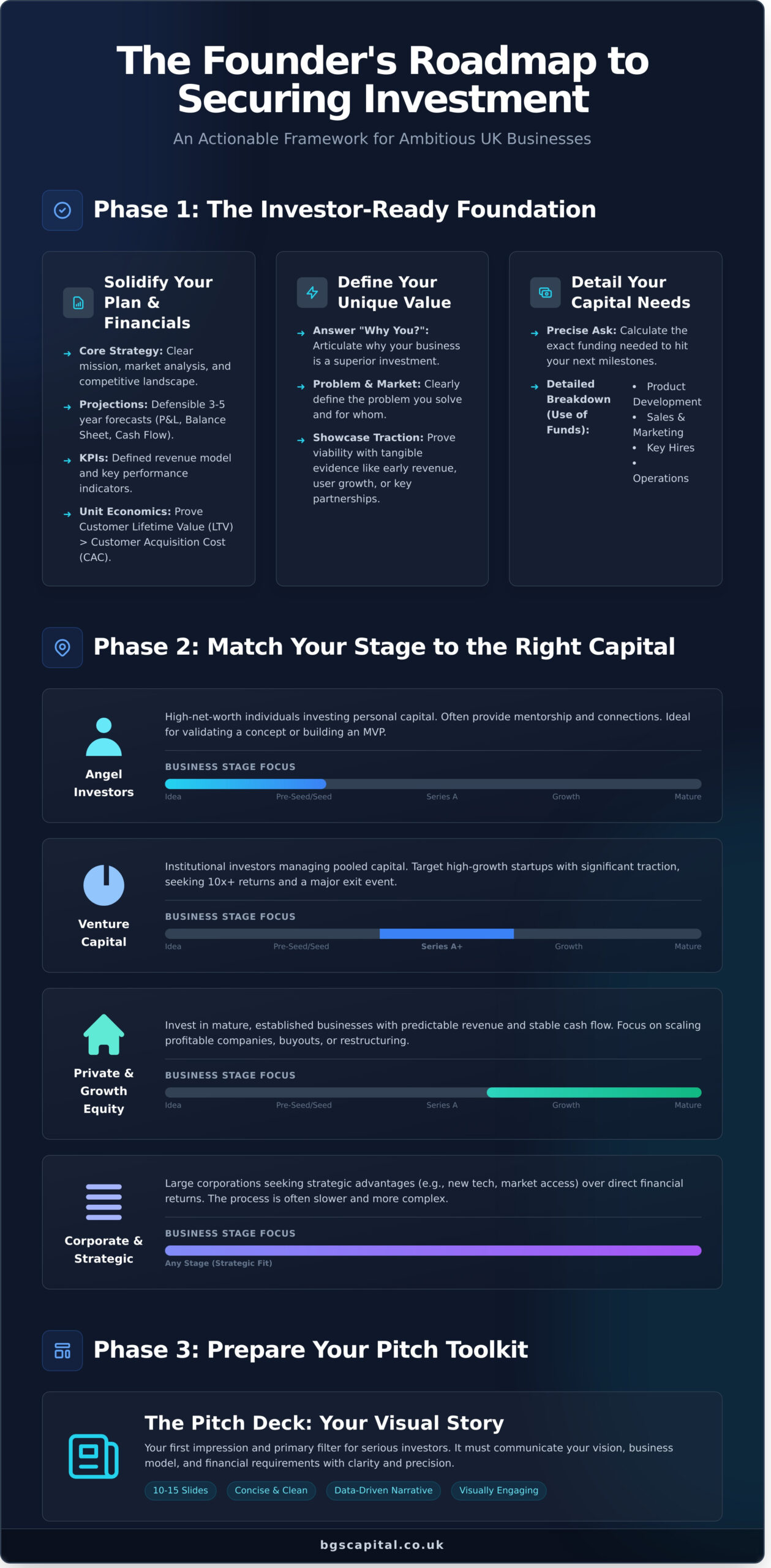
Your business plan and financial model are the foundational documents of your capital raise. They must be data-driven, realistic, and meticulously detailed. Ensure these components are robust:
- Core Strategy: A clear mission, comprehensive market analysis, and an honest assessment of the competitive landscape.
- Financial Projections: Credible and defensible financial forecasts for the next 3-5 years, including profit and loss, balance sheet, and cash flow statements.
- Revenue and KPIs: A precise definition of your revenue model (e.g., SaaS, transactional) and the key performance indicators (KPIs) you use to measure success.
- Unit Economics: A clear demonstration that your customer acquisition cost (CAC) is sustainably lower than your lifetime value (LTV).
Define Your Unique Value Proposition (UVP)
Your UVP must articulate precisely why your business is a superior investment. It answers the question: “Why you?” Clearly define the specific problem you solve and for which target market. More importantly, showcase tangible traction. This evidence can take many forms-early revenue, a growing user base, key strategic partnerships, or proprietary data-but it must prove your model is viable beyond a slide deck.
Understand Your Capital Needs and Use of Funds
Approaching investors without a precise understanding of your capital requirements signals a lack of strategic planning. You must calculate the exact amount of funding needed to reach your next set of critical milestones. Prepare a detailed breakdown of how every pound will be allocated, such as:
- Product Development
- Sales and Marketing Expansion
- Key Personnel Hires
- Operational Overheads
This demonstrates to investors that you are a disciplined operator who will deploy their capital efficiently to generate a return.
The Investor Landscape: Matching Your Stage to the Right Capital
A critical component of understanding how to find investors is recognising that not all capital is suitable for every business. Targeting an investor whose objectives and stage-focus do not align with your own is an inefficient and often fruitless exercise. A company seeking £50,000 for initial product validation has fundamentally different capital requirements than a profitable enterprise planning a £10 million market expansion. Aligning your funding strategy with the correct investor class is paramount to success.
Angel Investors and Seed Funds
Angel investors are typically high-net-worth individuals investing their personal capital into early-stage ventures. They operate individually or in syndicates, focusing on pre-seed and seed rounds. Beyond capital, they often provide invaluable mentorship and industry connections. This makes them ideal for businesses needing to validate a concept, build a minimum viable product (MVP), or secure their first customers. Platforms like the UK Angel Investment Network are primary conduits for connecting founders with this class of investor.
Venture Capital (VC) Firms
Venture Capital firms are institutional investors managing pooled capital from limited partners. They target high-growth potential startups, typically from Series A onwards, that demonstrate significant market traction and scalability. VCs expect a substantial equity stake, often including a board seat, in exchange for multi-million-pound investments. Their mandate is to generate outsized returns (10x or more), meaning they exclusively back businesses with a clear path to a major exit event, such as an IPO or acquisition.
Private Equity (PE) and Growth Equity
This investor class operates at the opposite end of the spectrum from angels and VCs. Private Equity and Growth Equity firms invest in mature, established businesses with predictable revenue and stable cash flow. Growth Equity specifically focuses on scaling already-profitable companies, while traditional PE may engage in leveraged buyouts or significant restructuring. They are not a viable source of capital for early-stage startups but are a primary option for established enterprises seeking to consolidate markets or expand internationally.
Corporate and Strategic Investors
These investors are large corporations seeking strategic advantages, not just a direct financial return. A corporate venture capital (CVC) arm may invest in a startup to gain access to innovative technology, enter a new market, or neutralise a potential competitor. While they can provide unparalleled access to distribution channels and resources, the investment process is often slower and more complex, contingent on internal corporate strategy and lengthy due diligence.
Preparing Your Pitch: The Essential Founder’s Toolkit
Before you contact a single investor, a comprehensive and professional toolkit of materials must be assembled. These documents are your first impression and serve as the primary filter for serious capital allocators. An incomplete or poorly constructed pitch package signals a lack of preparation and undermines your credibility. The objective is to communicate your vision, business model, and financial requirements with clarity and precision. Understanding how to find investors is secondary to being fully prepared for their scrutiny. Each document serves a distinct purpose in the fundraising process, from securing an initial meeting to facilitating final due diligence.
The Pitch Deck: Your Visual Story
The pitch deck is a concise, 10-15 slide presentation that forms the narrative core of your business. It must be data-driven, visually clean, and easy to digest. While its content should be tailored to the specific investor or fund, every version must cover the fundamentals:
- The Problem: The market inefficiency or pain point you address.
- Your Solution: Your product or service and its unique value proposition.
- Market Size: Demonstrable Total Addressable Market (TAM).
- The Team: Key personnel and their relevant expertise.
- Financials: Projections, unit economics, and key performance indicators (KPIs).
The Executive Summary: The One-Page Hook
This is a one-page document that distils your entire business plan into its most compelling elements. It is often the first item an investor will review and its sole purpose is to secure a meeting. It is not designed to close the deal. The summary must be direct, containing your precise funding request (e.g., “seeking £750,000 for 18% equity”), use of funds, and key traction metrics such as Monthly Recurring Revenue (MRR) or user growth figures.
The Data Room: Preparing for Due Diligence
A virtual data room (VDR) is a secure online repository containing all critical company documentation. Having this prepared from day one demonstrates operational maturity and readiness for a transaction. It ensures the due diligence process is efficient and transparent. Essential documents include detailed financial models, incorporation documents from Companies House, the shareholder capitalization (cap) table, material contracts, and intellectual property registrations. A well-organised data room is a hallmark of a professional operation.
Strategic Outreach: Where and How to Connect with Investors
Securing investment is a proactive campaign, not a passive exercise. The most effective fundraising strategies deploy a multi-channel approach, understanding that the core of how to find investors is about building credible, professional relationships. Cold outreach has a notoriously low success rate; warm introductions from trusted sources are significantly more effective. Your objective is to build rapport and demonstrate value long before a formal request for capital is made.
Leveraging Your Personal and Professional Network
Your existing network is your primary asset. Begin by systematically mapping your connections, including professional advisors, former colleagues, and mentors. These individuals can provide invaluable introductions to their own networks of high-net-worth individuals and venture capitalists. When approaching them, request introductions to relevant contacts, not investment directly. Use platforms like LinkedIn to identify mutual connections and validate potential investor profiles. A warm introduction acts as a powerful initial validator for your business proposition.
Using Online Platforms and Introducer Networks
Digital platforms provide an efficient way to identify and research active investors. Resources like AngelList and Crunchbase offer extensive databases of venture capital firms, angel investors, and their investment portfolios. For a more direct approach, introducer networks specialise in connecting qualified businesses with pre-vetted investors. These platforms streamline the search process, increasing your exposure to relevant capital. Feature your business to connect with our network of sophisticated investors and gain access to qualified deal flow.
Industry Events and Pitch Competitions
Targeted industry events, trade shows, and conferences remain a critical channel for connecting with investors active in your sector. Diligent preparation is essential. Research the attendee list to identify target investors, prepare a concise and compelling elevator pitch, and focus on strategic networking. Pitch competitions, in particular, offer a high-visibility platform to present your business directly to a panel of investors, generating immediate feedback, media exposure, and valuable connections.
The Process After First Contact: From Meeting to Term Sheet
Securing an initial meeting is a significant milestone, but it marks the beginning of the investment process, not the end. The subsequent stages demand diligence, patience, and persistence from the founding team. The journey from the first conversation to a signed term sheet is a rigorous evaluation that typically takes between three and nine months to complete. Success in this phase is determined by preparation and professionalism.
Navigating the Due Diligence Process
Once an investor expresses serious interest, the due diligence phase begins. Be prepared for a comprehensive examination of your business, including deep dives into your financial records, technology stack, market position, and the founding team itself. A pre-prepared virtual data room is essential for responding to information requests promptly. Investors will also conduct reference checks and background assessments on key personnel to validate their capabilities and integrity.
Understanding the Term Sheet
A positive due diligence outcome typically leads to a term sheet. This is a non-binding document outlining the proposed terms of the investment, which forms the basis for the final, legally binding agreements. Key terms will include:
- Company Valuation: The pre-money valuation agreed upon for your business.
- Investment Amount: The capital to be injected, specified in pounds sterling (£).
- Board Seats: The investor’s right to representation on your company board.
It is imperative to seek experienced legal counsel within the UK to review the document before signing.
How an Introducer Platform Streamlines This Stage
The challenge of how to find investors who are a genuine fit can consume significant resources. An introducer platform streamlines this critical process. Networks like BGS Capital connect qualified companies directly with pre-vetted, accredited investors whose mandates align with your sector and stage. This eliminates wasted time on unsuitable prospects and shifts your focus from initial discovery to building substantive relationships with interested parties, creating a more efficient path from first contact to due diligence.
Executing Your Capital Raising Strategy
Securing investment for your UK business is a meticulous process, not a matter of chance. As this guide has outlined, success is built upon two pillars: absolute investor-readiness and a highly strategic outreach plan. Understanding which investors to approach and when is as critical as the pitch itself. This methodical approach is the definitive answer to the question of how to find investors, transforming the search from a speculative exercise into a core business function.
Once your preparations are complete, the next challenge is gaining access. BGS Capital serves as the conduit between high-potential companies and strategic capital. We facilitate direct introductions for qualified pre-IPO and growth-stage companies to our curated network of sophisticated investors and accredited investment firms. By leveraging our platform, you gain targeted exposure and bypass the inefficiencies of cold outreach.
Your strategy is defined. Your business is ready. Position your company to secure its next phase of growth. FEATURE YOUR BUSINESS today.
Frequently Asked Questions
How much equity should I give away for funding?
The amount of equity depends entirely on your company’s valuation and funding stage. In the UK, it is standard for pre-seed or seed-stage companies to offer 10-20% equity. For a later Series A round, this figure may rise to 20-25%. The final percentage is a direct result of negotiation between the capital sought and the pre-money valuation agreed upon with the investor. A higher valuation results in less equity dilution for the same investment amount.
How long does the entire fundraising process typically take?
A comprehensive fundraising process in the UK typically requires three to six months from initial outreach to capital being transferred. This timeline encompasses the preparation of materials (pitch deck, financial model), investor outreach and meetings, a thorough due diligence period, and final legal negotiations. Founders must anticipate a significant time commitment, as the process can often extend beyond initial estimates due to market conditions or complex term sheets.
What are the most common mistakes founders make when seeking investment?
The most frequent errors are poor preparation and targeting inappropriate investors. A critical mistake when learning how to find investors is approaching funds whose investment thesis does not align with your sector or stage. Other common pitfalls include an unrealistic company valuation, an incomplete data room for due diligence, and underestimating the legal complexities and costs involved in closing a round. Meticulous research and preparation are essential for success.
What is the difference between an introducer and a broker?
In the UK, the distinction is primarily a regulatory one. An introducer facilitates a connection between a company and a potential investor but is not permitted to give advice or negotiate deal terms. Conversely, a broker is an FCA-regulated entity that can actively manage the deal, provide financial advice, and negotiate on your behalf, typically for a success fee. Understanding this difference is crucial for compliance and managing expectations during the capital-raising process.
Do I need to be making revenue to find an investor?
Revenue is not always a prerequisite, particularly for pre-seed or seed-stage investment. At this early stage, investors often focus on the strength of the founding team, the market opportunity, and the product or concept’s viability. However, for Series A funding and beyond, investors will almost certainly require clear evidence of product-market fit, which is typically demonstrated through significant and growing revenue streams and clear user traction data.
How important is the founding team to potential investors?
The founding team is of paramount importance, especially in early-stage ventures where there are few other metrics to assess. Investors are primarily backing the team’s ability to execute a vision and navigate inevitable challenges. They look for a balanced team with relevant industry expertise, a track record of resilience, technical capability, and a clear understanding of their target market. The team is often considered the single most critical factor in an investment decision.